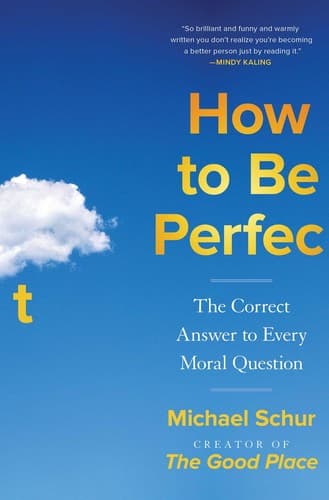
Core Idea
- How to Be Perfect treats ethics as a long-running conversation about how to live, and Schur’s goal is to make that conversation usable for non-philosophers.
- The book’s central message is anti-perfectionist: moral life is hard, failure is inevitable, and the task is to keep trying, correcting, and apologizing rather than seeking flawlessness.
- Schur organizes ethics around recurring questions: what we are doing, why we are doing it, whether something better exists, and why it would be better.
The Main Ethical Lenses
- Schur frames the “Big Three” as virtue ethics, deontology, and utilitarianism, then adds contractualism and ubuntu as especially useful practical complements.
- Aristotle’s virtue ethics asks what makes a person good, not just an act; human flourishing or eudaimonia comes from developing virtues like courage, honesty, generosity, temperance, and mildness.
- Virtue is built by habituation: we become just by doing just acts, brave by doing brave acts, and so on, but the goal is intelligent flexibility rather than mechanical rule-following.
- Aristotle’s golden mean is the idea that virtue lies between excess and deficiency, though Schur emphasizes that the mean is hard to define exactly and must be judged through attention and reflection.
- He uses virtue ethics to explain why people we admire tend to feel balanced, and why his own “dutifulness” became socially annoying when it tipped into excess.
- Judith Shklar’s claim that cruelty is the worst vice matters here: cruelty is willfully inflicting pain on a weaker being, and focusing on “sin” can excuse atrocities.
- Utilitarianism holds that the best action maximizes happiness and minimizes pain; Bentham’s hedonic calculus and Mill’s version are powerful because they treat everyone’s welfare equally.
- Schur likes utilitarianism’s usefulness in emergency allocation problems, but he stresses its strain in hard cases: it can justify sacrificing one innocent person, or push a person into the absurd “happiness pump” of endless self-sacrifice.
- Kantian deontology says actions are moral when done from duty according to a universalizable maxim, not because they produce good outcomes.
- Kant’s categorical imperative and practical imperative explain why lying is wrong and why people must never be treated as mere means, though Schur notes the theory can become rigid and implausible in cases like lying to a murderer.
- T. M. Scanlon’s contractualism is Schur’s favorite “quick-start guide”: rules are those no one could reasonably reject, which makes it good for identifying fair baseline obligations without demanding sainthood.
- Scanlon’s theory is about the minimum conditions for coexistence, not maximal goodness, so Schur often argues that lucky people should do more than the bare contractual minimum.
- The Southern African idea of ubuntu—“I am, because we are”—adds a communal ethic of humanness, compassion, sharing, and interdependence that contrasts with isolated selfhood.
How the Book Tests Ethics in Real Life
- Schur repeatedly uses thought experiments to show how moral judgment shifts with framing, especially the Trolley Problem, the “fat man” bridge case, and the organ-harvesting variant.
- These cases help separate outcome-based thinking, intention, and the feeling that direct personal harm is worse than impersonal harm.
- The book’s recurring theme is that no single theory solves everything: utilitarianism helps with consequences, Kant with duties and respect, Scanlon with mutual justification, and Aristotle with character and limits.
- Schur uses the burning building and Violinist examples to reject moral perfectionism and to argue that people are not required to sacrifice their entire lives, bodies, or projects indefinitely for others.
- He returns to the shopping cart example to show the difference between what is merely permissible and what is better: returning the cart may not be required, but it is a small act of care for workers and strangers.
- During Covid-19, mask-wearing is presented as a strong case for contractualism and ubuntu: a tiny inconvenience that protects many others.
- Schur also applies ethics to praise, charity, and public recognition, arguing that motivation matters, but outcomes and real-world effects matter too.
Motive, Shame, Luck, and Apology
- The Starbucks tipping story introduces moral desert: Schur wanted visible credit for generosity, which exposes the tension between sincere goodness and wanting to be seen as good.
- Thich Nhat Hanh’s mindfulness pushes the opposite direction: do the good act for the act itself, with no ulterior purpose.
- Maimonides’s eight levels of charity support the idea that anonymous giving can be among the highest forms of charity, though Schur notes that public giving can sometimes inspire others.
- Schur’s pragmatist answer, influenced by William James, is that what matters most is whether the act actually moves money or help to where it is needed, unless the motive involves fraud, self-dealing, or reputation laundering.
- His whataboutism and Saab bumper story show that shame is often misplaced when it is attached to unrelated wrongs; guilt is more useful when it can actually lead to correction.
- A major thread in the book is luck and privilege: people differ in resources, safety, social identity, and opportunity, so ethical demands cannot be identical for everyone.
- Schur’s own life story is presented as a “Jenga tower of luck,” and he uses Rawls’s veil of ignorance to argue that fair rules must be chosen without knowing one’s station in life.
- Rawls rejects utilitarian flattening because justice must respect persons and protect a fair floor, while Scanlon asks for reasonable agreement among people already in society.
- The book’s final moral emphasis is on apology: sincere apologies admit fault, name the harm, avoid evasions like “I’m sorry if you were offended,” and open the possibility of forgiveness and repair.
What To Take Away
- Moral life is a practice of balancing multiple frameworks, not discovering one perfect algorithm.
- Know thyself means checking whether your actions fit your values and your sense of integrity.
- Nothing in excess means virtue, duty, generosity, and even shame become harmful when taken too far.
- The best attainable goal is not perfection but flourishing: being good enough to live fairly with others, correct yourself, and keep trying after inevitable failure.
Generated with GPT-5.4 Mini · prompt 2026-05-11-v6