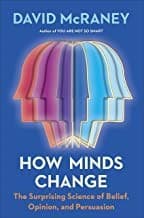
Core Idea
- McRaney argues that minds usually do not change because someone wins a fact battle; they change when people feel safe enough to rethink their own reasons, values, and identity.
- The book rejects the information deficit model and shows that persuasion is often self-persuasion: people revise beliefs when conversation helps them process their own uncertainty.
- Belief change is often punctuated equilibrium: long periods of stability interrupted by rapid shifts when the right social and psychological conditions appear.
Why Facts Usually Fail
- Naive realism makes people feel they see reality exactly as it is, so disagreement looks like ignorance or bad faith.
- In polarized settings, both sides tend to link-dump and fact-check, but they are often fighting over frames, not missing information.
- McRaney connects this to the brain’s habit of assimilation: new evidence is usually fitted into existing models before anyone considers changing the model.
- The book uses The Dress and the socks-and-Crocs experiment to show that people can sincerely interpret the same stimulus differently because priors shape perception.
- Wallisch’s idea of SURFPAD—substantial uncertainty with ramified/forked priors or assumptions—explains why ambiguity yields different “truths” for different people.
- The broader point is that experience is not direct access to reality but a brain-built simulation filtered through expectation, trust, and prior learning.
How Minds Actually Change
- McRaney’s central practical contrast is between debate and conversation: debate creates winners and losers, while conversation can let people think about their own thinking.
- Deep canvassing is his key real-world example: instead of rebutting, canvassers ask about people’s experiences, values, and emotional memories, then connect the issue to those memories.
- The method’s structure is often described as a layer cake: brief rapport, then “our story,” then mostly their story.
- Successful canvassing often begins with questions like where someone first learned a view and whether they know anyone personally affected, because personal memory is more persuasive than abstract argument.
- The Martha abortion example shows the pattern: elicit a rating, listen without arguing, surface an emotionally charged memory, then connect on values rather than try to “win.”
- The book treats street epistemology as a parallel approach: consent-based questioning, a confidence rating, then probing the method behind the belief rather than attacking the conclusion.
- Across these methods, the goal is guided metacognition—getting people to inspect how they know what they think they know.
- McRaney emphasizes that certainty is a feeling state: people do not just hold beliefs, they feel them as right, and this feeling is what change must reach.
- Elaboration matters: if a person actively works through a message, it can stick; if they merely receive facts, the message often bounces off.
- The illusion of explanatory depth helps explain why careful questioning can reduce extremity: people discover they understand less than they thought.
- Persuasion is also tied to cognitive empathy and analogic perspective taking, not just emotional warmth; people change when they can imagine another person’s position without feeling shamed.
Identity, Threat, and Belonging
- The book’s deeper claim is that beliefs are socially embedded, so challenging them can feel like a threat to belonging rather than a request to reconsider evidence.
- Brain and social psychology research in the book shows that counterarguments can trigger threat responses similar to physical danger.
- Experiments like Robbers Cave and the minimal group paradigm show how quickly arbitrary groups become tribal, with loyalty overriding accuracy.
- McRaney uses Dan Kahan’s work to show that people evaluate the same evidence differently depending on whether it is voiced by an in-group or out-group source.
- Conspiracy thinking is especially resistant because it creates a closed conspiratorial loop: disconfirming evidence is reinterpreted as further proof.
- The book distinguishes joining for the story from joining for the community with motivational allures; over time, identity often becomes the stronger glue.
- Charlie Veitch’s change from 9/11 trutherism required not just new facts but a safer alternative tribe where questioning was allowed.
- The same pattern appears in Westboro-related examples: leaving a totalizing community can create the psychological room needed for doubt.
- Self-affirmation helps because when people feel their core values are intact, they become less defensive and more able to consider threatening information.
- McRaney repeatedly returns to the idea that reason is a slave of the emotions and that, in practice, the truth is tribal.
What To Take Away
- Changing minds is less about overpowering arguments than about creating conditions where people can revise their own confidence without social humiliation.
- Facts matter, but they usually matter only after trust, safety, and values have been engaged.
- The book’s best-supported techniques—deep canvassing, street epistemology, motivational interviewing, and related methods—work by reducing defensiveness and increasing reflective processing.
- The hardest problems are not false beliefs alone, but beliefs tied to identity, tribe, and fear of exclusion.
Generated with GPT-5.4 Mini · prompt 2026-05-11-v6