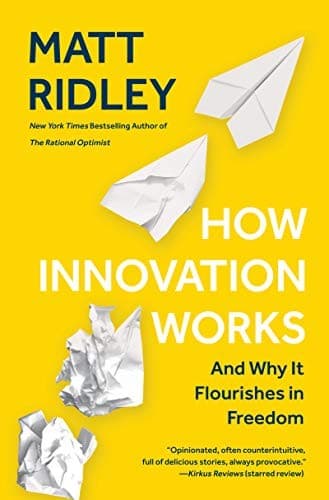
Core Idea
- Innovation is recombination + iteration, not sudden genius—combine existing ideas, test variations rapidly, tolerate failure.
- Affordability and reliability beat technical brilliance—practical adoption matters more than invention.
- Innovation thrives in connected ecosystems—trade, dense cities, and diverse contacts spark breakthroughs; isolation kills capability.
What Drives Innovation
- Serendipity and accidents are primary—Post-its, Teflon, genetic fingerprinting emerged from solving different problems.
- Teams beat solo genius—knowledge lives between heads; exchange and collaboration amplify results.
- Decentralized systems outpace centralized ones—city-states and competitive markets innovate faster than unified empires.
How to Build an Innovation Culture
- Open beats closed—source 50% of ideas externally (Procter & Gamble model); don't rely solely on in-house R&D.
- Use small, competitive teams—"two-pizza teams" (Amazon's model) reduce complacency and encourage experimentation.
- Implement reverse-veto policy—allow ideas to bubble up even if most oppose them; one dissenting voice shouldn't kill novel concepts.
- Fail fast and publicly—celebrate failures and share learnings transparently (Google X example).
Timing & Expectations
- Apply Amara's Law: Overestimate impact in 5–10 years; underestimate impact beyond 20 years—expect 15-year lag before predictions solidify.
- Practice precedes theory—steam engines came before thermodynamics; breed first, understand genetics later.
Remove Barriers, Not Ideas
- Patent thickets block progress—strengthen IP only where essential (pharmaceuticals); don't create hedges covering single molecules.
- Longer copyrights ≠ more creativity—music supply doubled post-Napster despite "piracy"; creators seek influence and fame.
- Copyrights on scientific papers stifle innovation—taxpayer-funded research shouldn't be paywalled; embrace open-access.
- Simple regulations enable entry; complex compliance favors incumbents.
- Permissionless iteration is non-negotiable—regulatory approval for every variant wastes years and kills beneficial tech (Golden Rice, cellular phones delayed 39 years).
What New Technology Faces
- Expect predictable resistance playbook: Safety fears + vested interests + political paranoia emerge for every breakthrough (coffee, margarine, GMOs).
- Precautionary principle backfires—higher safety standards for new tech vs. existing dangerous alternatives is backwards (copper sulfate still used by "organic" farmers).
Economic Reality
- Innovation increasingly means doing more with less—modern farming yields more food using less land, water, fertilizer.
- Sustainable growth is achievable through efficiency, not depletion.
- Inequality is about luxuries, not necessities—innovation makes basics universal; differentiation happens in premium markets.
Action Plan
- Redesign R&D: Allocate 50% of innovation budget to external sourcing and partnerships; shrink internal labs.
- Organize small competitive teams: Create "two-pizza units" with reverse-veto policies; celebrate transparent failures.
- Reduce regulatory friction: Permit rapid iteration on variants; don't require full approval for each test cycle.
- Open knowledge flows: Join or create trade networks, conferences, and dense collaboration spaces; isolate and you'll stagnate.
- Expect 15+ years for impact: Plan for serendipity in decade-scale horizons; don't kill ideas failing in year 3.
Generated with Claude Sonnet 4.6 · prompt legacy-pre-v6 · model inferred from repository history