Core Idea
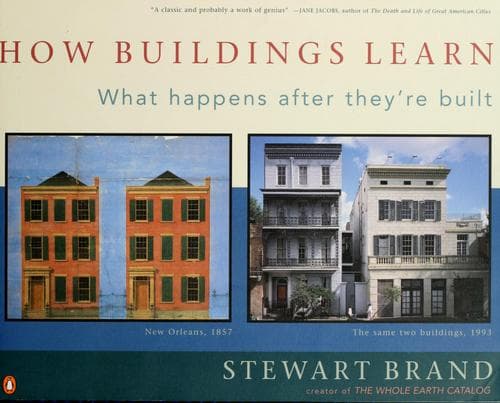
- Buildings are not finished objects; they keep changing after completion under pressure from use, money, technology, regulation, and fashion.
- Brand’s central claim is that architecture wrongly imagines permanence, while real buildings “learn” through repeated adaptation, repair, and reconfiguration over time.
- The book’s core framework is change at different speeds: buildings consist of layers that age and transform at different rates, and good design lets those layers slip against each other instead of locking them together.
How Buildings Change
- Brand develops Frank Duffy’s idea into six layers: Site, Structure, Skin, Services, Space plan, Stuff.
- These layers have very different lifespans: Site is effectively enduring, Structure is hard and expensive to change, Skin changes on the scale of decades, Services on the scale of years, Space plan changes quickly, and Stuff changes continually.
- The slow layers dominate the fast ones, but repeated changes in fast layers can eventually force changes in the slow ones, such as recabling leading to new floors or upgraded services.
- The key design lesson is slippage: buildings last better when their layers are not tightly fused, because over-integration makes future adaptation destructive.
- Brand illustrates the persistence of Site with examples like San Francisco’s Cliff House rebuilding on the same cliff and cities whose streets, lots, and property lines outlast individual buildings.
- He argues that cities often devour buildings while the underlying urban geometry persists, so lots and street patterns matter as much as any one structure.
- Services are a major engine of obsolescence because plumbing, wiring, HVAC, elevators, and energy systems wear out or become outdated and are often hardest to replace when buried in the building.
- Skin is increasingly mutable, with facadectomies and cosmetic reskinning driven by fashion, energy costs, or tenant competition.
- The interior Space plan changes even faster, especially in kitchens, bathrooms, and offices, where use patterns and utilities keep shifting.
- Buildings become beloved through age plus adaptivity: patina, accumulated use, and the ability to change coherently give them character.
Money, Property, Codes, and Vernacular Learning
- Buildings are shaped by three competing identities: habitat, property, and community asset.
- Property lines and lot patterns are silent but powerful, because they constrain what can be built and strongly influence whether neighborhoods evolve gradually or in big leaps.
- The conflict between use value and market value pushes buildings toward either highly adapted idiosyncrasy or standardized, easily sold conformity.
- Building codes are treated as collective memory under pressure: they embody lessons learned from recurring failures, especially fire and earthquakes.
- But codes can also become rigid and overprotective, making reuse or modest alteration nearly impossible.
- Much remodeling happens by evasion, and unpermitted work can leave hidden problems that later force expensive corrective work.
- Real estate finance is a central but often ignored force: high land values make buildings disposable, while low land values can lead to neglect, vacancy, and decay.
- The time value of money encourages haste, short payback horizons, and “blitzkrieg” construction, which produce shallow buildings with little flexibility.
- Brand criticizes financial assumptions that treat buildings as nearly worthless after 25–30 years, arguing instead that old buildings can become useful bargains.
- Reuse works because old buildings offer a misfit between old container and new use, and that slight mismatch can be productive, economical, and creative.
- Vernacular knowledge is building wisdom passed informally through a culture, and it improves by conserving proven solutions while adapting only where needed.
- Brand values vernacular methods because they accumulate practical intelligence across generations, especially where builders, clients, climate, and local traditions remain coherent.
- He distinguishes form from style: style is a statement, while form is a working language for adaptation.
- Historical examples like the three-aisled northern European building, the Cape Cod, the bungalow, and the mobile home show how durable forms survive because they are simple, growable, and easy for users to modify.
- The mobile home is especially important as a modern folk house because its success depends on user modification and incremental accretion, even though it is culturally stigmatized.
- Brand also shows how seemingly local “styles,” such as Santa Fe style, are often hybrids of vernacular forms, tourism, preservation, and market branding.
Designing for Time
- An adaptive building often starts out conservative and only later becomes distinctive because it remains open to future change.
- Scenario-based design asks the designer to imagine later uses, future occupants, and future tastes so the building does not get locked into one narrow path.
- Brand favors spending more on Structure and less on finish, while reserving budget and flexibility for future adjustment and maintenance.
- He repeatedly argues for square, simple, rectangular forms because they subdivide, expand, and adapt more easily than clever complexity.
- Columns are useful not only structurally but as a spatial and service-gridding device, because they make future re-partitioning easier and can carry services.
- Technology should be made modular and accessible, with spare conduits, accessible chases, and systems that can be replaced without tearing open the building.
- He praises design for reuse and design for disassembly, including screws over nails and timber framing that can be taken apart and reused.
- Materials and assemblies should be chosen for repairability, inspectability, and reversibility; burying services inside walls is usually a mistake.
- Brand also values records: photographs, logs, as-builts, and “treasure maps” of what is hidden in the building help future users remodel intelligently.
- Construction should be treated as a learning process, with cut-and-try mockups, post-occupancy feedback, and ongoing adjustment after the building is occupied.
- A building should not be regarded as complete at handover; “finishing is never finished,” and occupants should remain active shapers rather than passive recipients.
What To Take Away
- Durability is not sameness: buildings last by adapting, not by freezing.
- The best buildings separate layers so that fast-changing parts can evolve without destroying slow, costly ones.
- Old buildings are assets because they already contain structure, services, and history that new uses can exploit.
- The real challenge is temporal: good architecture is not only form-making in space, but design for change across decades.
Generated with GPT-5.4 Mini · prompt 2026-05-11-v6