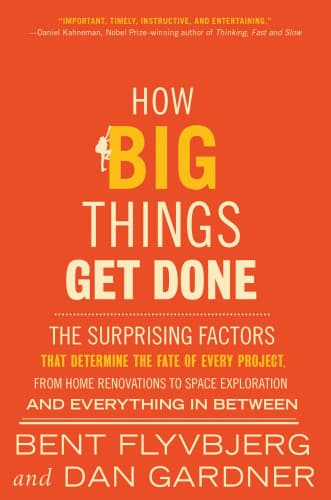
Core Premise
Why do most big projects fail? Based on the world's largest database of 16,000+ projects across 136 countries, Bent Flyvbjerg reveals a shocking truth: 91.5% of projects go over budget, over schedule, or both. Only 0.5% deliver on time, on budget, and with promised benefits. This book explains why projects consistently fail and, more importantly, provides a proven framework for success: Think slow, act fast.
The Iron Law of Megaprojects
The Brutal Reality
Flyvbjerg's decades of research uncovered what he calls the "Iron Law of Megaprojects": over budget, over time, under benefits, over and over again. The numbers are devastating:
- Only 8.5% of projects hit the mark on both cost and time
- A minuscule 0.5% nail cost, time, and benefits
- 91.5% go over budget, over schedule, or both
- 99.5% fail on at least one dimension
Examples of disaster:
- Boston's "Big Dig": 16 years late, 300% over budget
- NASA's James Webb Telescope: 19 years vs. 12 planned, 450% over budget
- Scotland's Parliament Building: 3 years late, 978% over budget
- Copenhagen Opera House: rushed to completion, became a "mausoleum"
The Fat-Tail Problem
Most people assume project risks follow a normal "bell curve" distribution. They don't. Project outcomes have fat tails—meaning catastrophic overruns are far more common than expected:
- IT projects: 18% have overruns above 50%, with an average overrun of 447% in that tail
- Olympic Games: 76% end up in the tail with 200% average overrun
- Nuclear storage: 238% mean cost overrun
This means that even if you build in a generous 60% buffer, you can still be wildly off. The risk isn't just failure—it's disaster.
Real-world impact:
- Kmart: Two IT projects contributed directly to its 2002 bankruptcy
- Levi Strauss: A \$5M IT project became a \$200M loss
- Mexico City metro: Rushed construction led to an overpass collapse killing 26 people
Think Slow, Act Fast
The Paradox of Speed
The conventional wisdom says: set aggressive deadlines, commit quickly, work furiously. This is backwards and dangerous.
The right approach:
- Planning phase: Slow, thorough, creative. This is relatively cheap and safe.
- Delivery phase: Fast, focused, disciplined. This is when costs explode and risks multiply.
Abraham Lincoln: "If I had five minutes to chop down a tree, I'd spend the first three sharpening the ax."
The Window of Doom
Project duration is an open window. The longer it stays open, the more opportunity for black swans to crash through:
- Elections, recessions, pandemics, technology shifts
- Even trivial events can cascade into disasters in complex systems
- The 2021 Suez Canal blockage by Ever Given froze $10 billion in daily trade
Solution: Close the window by executing quickly—but only after thorough planning.
Pixar's Approach
At Pixar, directors spend years in development (planning):
- Writing scripts, storyboarding, testing ideas
- Iteration costs are low in planning
- Once production starts, "costs explode"—so the plan must be bulletproof
Result: An unprecedented string of blockbusters, each delivered efficiently.
The Commitment Fallacy
Why Projects Start Wrong
Projects don't go wrong—they start wrong. Flyvbjerg identifies the "commitment fallacy": premature lock-in to a course of action before alternatives are explored, risks investigated, or solutions found.
The Pentagon case study:
- General Brehon Somervell picked the first site that came to mind
- No comparison of alternatives
- Rushed into construction
- Result: Had to relocate mid-project after discovering the site was unsuitable
Psychology vs. Politics
Two forces drive the commitment fallacy:
1. Psychological Biases:
- Optimism bias: We're overconfident about outcomes ("my small business will beat the odds")
- Planning fallacy: We systematically underestimate time and costs
- WYSIATI (What You See Is All There Is): System One thinking jumps to conclusions based on limited information
- Best-case scenarios: When asked for "most likely" outcomes, people describe best-case scenarios
Example: Students who said they were 99% confident of finishing a task on time only succeeded 45% of the time.
2. Strategic Misrepresentation (Politics):
- Deliberately lowballing estimates to get projects approved
- "In three out of four cases this sum does not correspond to anything in technical terms"—Jean Nouvel, architect
- Willie Brown, former SF mayor: "In the world of civic projects, the first budget is really just a down payment. If people knew the real cost from the start, nothing would ever be approved."
Start Digging a Hole
The strategy: Get contracts signed, break ground quickly, then make the hole "so big, there's no alternative to coming up with the money to fill it in."
Hollywood example: Director Elia Kazan's tactic was to "get the work rolling, involve actors contractually, build sets, collect props and costumes, expose negative, and so get the studio in deep."
Result: Heaven's Gate cost 5x the estimate, opened a year late, and bankrupted United Artists.
The Sunk Cost Fallacy
Once committed, people can't walk away because of "sunk costs"—money and time already spent. Logically, sunk costs should be irrelevant to future decisions. Psychologically, they dominate.
The blizzard test: Two friends bought expensive tickets to a basketball game. A snowstorm hits. The more they paid (sunk cost), the more likely they'll risk driving into the blizzard—even though the rational choice is to stay home.
California's high-speed rail is a textbook case: Gavin Newsom couldn't scrap it despite massive overruns because of billions already spent.
Think from Right to Left
Start with Why
The most critical question isn't how to execute a project—it's why the project exists in the first place.
- What problem are you solving?
- What is the desired outcome?
- Is there a better way to achieve it?
The Cobble Hill Health Center case:
- Problem: Aging nursing home building needed replacement
- Conventional solution: Build a new facility (estimated $300M+, years of work, high risk)
- Right-to-left thinking: Why do we need a new building? Answer: To serve elderly residents.
- Better solution: Renovate incrementally, upgrade systems, add features gradually
- Result: Goals achieved at a fraction of the cost and risk
The Box on the Right
Flyvbjerg uses a visual: Put your desired outcome in a "box on the right" side of the page. Then work backward:
- What needs to happen to reach that outcome?
- What are the options?
- Which path has the lowest risk and highest probability of success?
The Sydney Opera House tragedy:
- Rushed into construction without resolving the roof design
- Architect Jørn Utzon spent years trying to solve it mid-construction
- Cost overrun: 1,400%
- Utzon resigned in frustration, never saw the completed building
Lesson: If you can't see a clear path from here to the box on the right, don't commit. Keep thinking.
Masterbuilders and Modularity
Hire a Masterbuilder
The single best predictor of project success: experienced leadership.
Not general management experience—domain-specific experience delivering similar projects.
Frank Gehry:
- Guggenheim Bilbao: Wildly complex architecture, completed on time and on budget
- Secret: Gehry built 1:1 mockups, tested everything, used modular construction, collaborated tightly with builders
- "Build it twice"—once in models/mockups, then for real
Ed Catmull (Pixar):
- Unprecedented string of blockbusters
- Secret: Deep planning, rigorous testing, empowered teams, learning culture
Build with Lego (Modularity)
The most powerful risk-reduction strategy: Break big projects into small, standardized, repeatable modules.
Why modularity works:
- Reduces complexity
- Enables parallel work streams
- Allows experimentation and iteration
- Failures are contained and recoverable
- Scales predictably
Examples:
- Solar farms: Assemble thousands of identical panels. Mean cost overrun: 1% (lowest of all project types)
- Nuclear power plants: Custom designs every time. Mean cost overrun: 120%
- Madrid Metro extension: Standardized stations, predictable construction. Delivered on time, on budget.
Terminal 5, Heathrow:
- Used modular design and prefabrication
- On time, on budget (rare for airports)
- Contrast with Berlin Brandenburg Airport: years late, billions over budget
Take the Outside View
The Inside vs. Outside View
Inside view (default mode):
- Focus on the specifics of your project
- Build a scenario from the ground up
- Justify why this time is different
- Result: Optimism, underestimation of risk
Outside view (statistical, evidence-based):
- Look at similar past projects (reference class)
- Use base rates (empirical averages)
- Adjust for specifics only if justified
- Result: Realistic forecasts
Daniel Kahneman's curriculum project:
- Team estimated 2 years to complete
- Kahneman asked the expert: "How long did similar projects take?"
- Expert's answer: 7–10 years, and 40% never finished
- Actual result: 8 years
Lesson: Your project is not as unique as you think. Use base rates.
Appendix A: Base Rates for Cost Risk
Flyvbjerg's database provides empirical base rates for 25 project types:
| Project Type | Mean Cost Overrun | % in Tail (≥50%) | Mean Overrun in Tail |
|---|---|---|---|
| Nuclear storage | 238% | 48% | 427% |
| Olympic Games | 157% | 76% | 200% |
| Nuclear power | 120% | 55% | 204% |
| IT projects | 73% | 18% | 447% |
| Buildings | 62% | 39% | 206% |
| Solar power | 1% | — | — |
How to use base rates:
- Identify your project type
- Use the base rate as your starting estimate
- Adjust only if you have strong, specific evidence
- Ask: "Can we afford this risk?"
Key Principles for Success
1. Think Slow, Act Fast
- Invest heavily in planning—it's cheap insurance
- Execute delivery with speed and discipline
- Close the window of vulnerability quickly
2. Hire a Masterbuilder
- Prioritize domain-specific experience over general management skills
- Leaders who have "done it before" are invaluable
3. Ask "Why?"
- Start with the desired outcome, not the solution
- Work right-to-left
- Question assumptions
- Consider alternatives
4. Build with Lego
- Use modularity wherever possible
- Standardize, repeat, scale
- Avoid bespoke, one-of-a-kind designs
5. Take the Outside View
- Use base rates from similar projects
- Resist "this time is different" thinking
- Trust data over intuition
6. Watch Your Downside
- Assume fat-tailed risk
- Build in massive buffers (if you can afford them)
- Prepare for black swans
7. Say No and Walk Away
- If the path to success isn't clear, don't commit
- Saying no is a superpower
- Sunk costs are not a reason to continue
8. Get Your Team Right
- Collaboration, trust, and psychological safety
- Avoid heroic individualism
- Empower teams to raise concerns
9. Make Friends and Keep Them Friendly
- Projects depend on stakeholders
- Invest in relationships
- Anticipate and manage conflicts
10. Know That Your Biggest Risk Is You
- Acknowledge your biases
- Use structured decision-making processes
- Seek dissenting views
- Build in checks and balances
Conclusion
The record of big projects is dismal—but it doesn't have to be. Flyvbjerg's research reveals that success is not a matter of luck or genius. It follows a pattern:
- Slow, rigorous planning that explores alternatives, tests assumptions, and builds a bulletproof roadmap
- Fast, disciplined execution that closes the window of vulnerability
- Experienced leadership that knows how to navigate complexity
- Modular design that reduces risk and enables scaling
- Evidence-based forecasting using base rates and the outside view
The world is full of abandoned projects, bankrupt companies, and wasted trillions. But it's also full of Pixar movies, Frank Gehry buildings, and solar farms—delivered on time, on budget, and with benefits realized.
The choice is yours. Think slow. Act fast. Build it right.