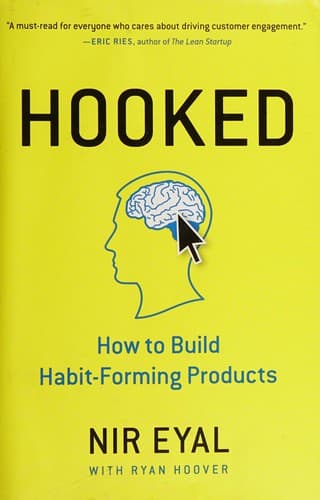
Core Idea
- Hooked argues that the most valuable products do not merely attract users; they become tied to routine behavior by linking themselves to emotions, cues, and repeated small investments.
- The central model is the Hook Model: Trigger → Action → Variable Reward → Investment, a cycle that can turn repeated use into habit.
- Eyal’s larger claim is that habit strength matters more than raw user count because habits raise customer lifetime value, reduce price sensitivity, speed growth, and protect against competitors.
How Habits Form
- Triggers start behavior and can be external (notifications, icons, links, emails) or internal (feelings and thoughts such as boredom, loneliness, frustration, stress, fear, or FOMO).
- The book stresses that the real goal is to connect a product to an internal trigger; the external cue only works well once the behavior becomes mentally linked to an itch the product relieves.
- The 5 Whys is used to uncover the emotional root cause behind behavior, not just the user’s stated reason.
- Action is the simplest behavior done in anticipation of reward, and the book relies on BJ Fogg’s formula that behavior happens when motivation, ability, and a trigger align.
- Eyal treats ability as the highest-leverage lever for many products: reduce steps, friction, and cognitive load before trying to increase motivation.
- His six elements of simplicity are time, money, physical effort, brain cycles, social deviance, and non-routineness.
- Examples of increasing ability include Facebook Login, Twitter’s embeddable Tweet button, Google’s minimalist search box, iPhone lock-screen camera access, Pinterest’s infinite scroll, and the gradual simplification of Twitter’s homepage.
- Motivation is organized around three core drivers: seek pleasure / avoid pain, seek hope / avoid fear, and seek social acceptance / avoid rejection.
What Makes Products Hooking
- Variable Reward creates craving; predictable rewards satisfy, but uncertainty and novelty keep attention alive.
- Eyal divides variable rewards into three types: rewards of the tribe (social validation and belonging), rewards of the hunt (unpredictable information or resources), and rewards of the self (mastery, completion, competence).
- Social platforms exploit tribal rewards through likes, comments, upvotes, badges, and status; examples include Facebook, Stack Overflow, and League of Legends Honor Points.
- Hunt rewards appear in slot-machine mechanics, endless feeds, and browsing experiences like Twitter and Pinterest, where the next interesting item is never fully knowable in advance.
- Self rewards show up in progress loops such as email inbox zero, World of Warcraft, and Codecademy, where people are pulled forward by the feeling of getting better or finishing.
- Variable rewards must match the user’s real itch; gamification fails when it rewards the wrong behavior, as in the book’s contrast between failed systems and more aligned ones like Quora’s upvotes.
- Autonomy matters: the book treats reactance as a real risk, and Quora’s “views” feature is given as an example of a feature that backfired when users felt exposed or auto-opted in.
- The reward loop works best when it keeps users wanting more without feeling manipulative; predictable “fixed” content eventually gets boring, while infinite variability is more durable.
- The book’s examples of durable variability include platforms where other users keep changing the experience, such as YouTube, Facebook, Pinterest, Twitter, World of Warcraft, and Dribbble.
Investment, Measurement, and Ethical Boundaries
- Investment is the final phase: users do a bit of work after the reward, which increases the chance they will return and also loads the next trigger.
- Small investments create commitment through three tendencies: people overvalue their own effort, seek consistency with past behavior, and rationalize choices to reduce cognitive dissonance.
- Examples of stored value include content, data, followers, reputation, and skill; these make products more useful over time and harder to leave.
- The book highlights iTunes playlists, Facebook timelines, LinkedIn profiles, Twitter follow graphs, eBay reputation, and learned skill in tools like Photoshop as forms of investment that accumulate switching costs.
- Investment can also set up future use, as in Any.do reminders, Tinder matches, Snapchat replies, and Pinterest notifications.
- The Bible app case study shows the full Hook Model in practice: mobile access creates triggers, reading plans and audio lower friction, uncertain next verses provide reward, and highlights/bookmarks/shares create investment.
- The app’s growth depended on making Scripture available in small, repeatable doses, with data-driven tweaks like shorter plans for new users and easier access for people who preferred listening.
- Eyal argues that habit-forming products should be tested by finding devotees, identifying their repeating Habit Path, and then modifying onboarding or features to move more users onto that path.
- His Habit Testing method asks teams to identify what “habitual” usage should look like, codify it with a rough threshold, and modify the product based on the sequence habitual users actually follow.
- New product ideas should often start from the founder’s own problem or “scratch your own itch,” because nascent behaviors are easy to misread before they scale.
- The book closes with a moral test called the Manipulation Matrix: ask whether you would use the product yourself and whether it materially improves users’ lives.
- This yields four roles: Facilitator (uses it and believes it helps), Peddler (believes it helps but would not use it), Entertainer (uses it but does not think it improves life), and Dealer (neither uses it nor believes it helps).
- Eyal’s ethical conclusion is that the best place to build is as a facilitator: create habit-forming products that genuinely improve people’s lives, because the same behavioral power can be used for good or for exploitation.
What To Take Away
- The book’s main thesis is that habits are built, not guessed: trigger, action, variable reward, and investment form a repeatable design pattern.
- Products become powerful when they shift from external prompts to internal cues and from one-time utility to repeated relief of an emotional itch.
- The most durable habit products are usually simple to use, rewarding in variable ways, and increasingly valuable to the user through accumulated investment.
- Eyal’s final message is not just how to build habit-forming products, but when to build them: use the model responsibly, and prefer products that help users more than they exploit them.
Generated with GPT-5.4 Mini · prompt 2026-05-11-v6