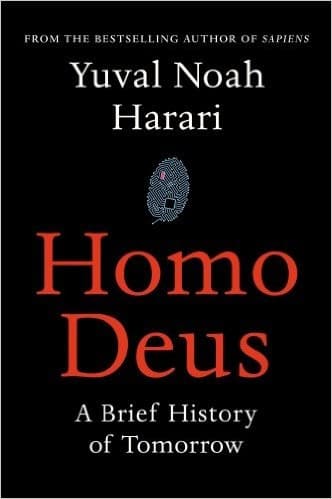
Core Idea
- Harari argues that famine, plague, and war are no longer inevitable masters of human life; modernity has turned them into manageable problems, freeing the agenda for new ambitions.
- The next human project, he says, is not survival but Homo deus: the pursuit of immortality, happiness, and divinity through science, technology, and redesign of the human organism.
- This future is unstable because the same forces that empower humans—biotech, AI, data, and growth—may also make ordinary humans economically, politically, and morally obsolete.
How Humans Came to Rule
- Harari frames history as the rise of Homo sapiens from one animal species among many to the dominant shaper of the planet, especially in the Anthropocene.
- He argues that humans dominate not because of a unique soul or magical spark, but because they cooperate flexibly in huge numbers through imagined orders.
- Money, nations, laws, corporations, and gods are intersubjective realities: they exist because many people believe in them and act accordingly.
- Writing, bureaucracy, and money let societies coordinate beyond the limits of individual brains; kingdoms, temples, and empires scale by turning stories into institutions.
- Harari uses cases like Sumerian temples, pharaohs, borders drawn in Berlin, Soviet collapse, and school grades to show how written fictions become social reality.
- The Scientific Revolution changed the terms of power by stripping away cosmic meaning while vastly increasing human ability to manipulate the world.
- Modernity, in his account, is a bargain: humans gain power by giving up the idea that the universe provides a ready-made purpose.
Humanism, Animals, and the Meaning Crisis
- Before modern humanism, theism and other traditional orders placed humans inside a divine or cosmic script; modern humanism replaces that with the command to look inward and create meaning.
- Harari distinguishes liberal humanism, socialist humanism, and evolutionary humanism, each of which treats human experience as the ultimate source of value while disagreeing over which experiences count.
- He argues that the modern world’s moral language—the voter knows best, beauty is in the eye of the beholder, the customer is always right—comes from this inward turn.
- At the same time, modern science undermines the humanist assumption that each person has a unitary, sovereign self; humans are better understood as bundles of algorithms and competing drives.
- Harari’s treatment of animals is central: hunter-gatherer animism put humans and animals in one communicative world, but agriculture and theist orders turned animals into production units.
- Industrial farming intensifies this domination: animals may get food, hormones, and shelter while their emotional needs and social bonds are ignored.
- He repeatedly asks whether humans really deserve special moral status if there is no soul or “magic spark,” and whether future AI should be allowed to exploit humans as humans exploit animals.
The Coming Break: Intelligence Without Consciousness
- Harari predicts a Great Decoupling between intelligence and consciousness: systems may outperform humans at cognition while remaining non-conscious.
- This matters because liberalism assumes the individual human is uniquely valuable; if machines can do most jobs, that practical basis weakens.
- He sees automation reaching beyond manual labor into law, medicine, education, driving, finance, and even strategic warfare.
- Autonomous systems may be more reliable than humans because they can avoid fatigue, fear, greed, and error; “intelligence is mandatory but consciousness is optional.”
- The deeper threat is not just job loss but a world in which humans become useful only as data sources, consumers, or biological baggage.
- Harari’s examples include self-driving cars, algorithmic trading, medical systems like Watson, personalized tutoring, and the use of data to know people better than they know themselves.
- He imagines a trajectory from oracle to agent to sovereign, where people first consult algorithms, then let them act, then let them shape decisions and behavior.
- This feeds two competing post-human religions: techno-humanism, which upgrades humans to stay relevant, and Dataism, which treats information flow as the highest value.
Dataism and the Possible End of Humanism
- Dataism is Harari’s name for a creed in which the universe is made of data flows and the value of any system lies in how well it processes information.
- In that worldview, human experience is no longer sacred in itself; it matters only if it contributes data to the larger network.
- Harari suggests that privacy, individuality, and inner authority may erode as continuous monitoring and algorithmic optimization become normal.
- He also warns that attempts to upgrade the healthy may produce a split between a small elite of enhanced superhumans and a large class of ordinary, possibly expendable humans.
- The deepest tension is that technology can now redesign desires themselves, so the liberal idea of an authentic inner voice may dissolve.
- Harari’s overall claim is not that this future is predetermined, but that the historical direction of science and capitalism makes it plausible—and that the price of power may be the end of the human-centered world.
What To Take Away
- Human supremacy is historical, not natural: it rests on cooperation, stories, and institutions rather than soul or essence.
- Modernity solved old catastrophes but replaced them with new ambitions and risks: longevity, engineered happiness, AI, and post-human inequality.
- Humanism is powerful but fragile: it gave modern life its moral center, yet biotechnology and data systems may undermine the very notion of a sovereign individual.
- The book’s central warning is that the tools used to make humans gods may also make Homo sapiens an obsolete species.
Generated with GPT-5.4 Mini · prompt 2026-05-11-v6