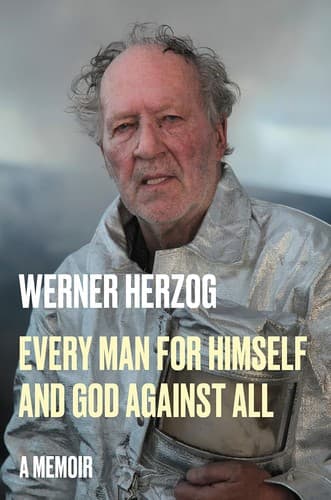
Core Idea
- Herzog presents his life as a sequence of roads not taken, but insists that certain forces remained constant: loyalty, duty, courage, and a pull toward abandoned or extreme places.
- The memoir is less a conventional self-portrait than a chain of vivid episodes showing how idyll and danger, technical improvisation, physical hardship, and spiritual hunger shaped both his life and his films.
- He frames art, memory, and history through his own term “ecstatic truth”: not factual literalism, but a deeper, sometimes invented, cinematic truth that can be more revealing than documentary exactness.
Life, Childhood, and Formation
- Herzog’s childhood in rural Bavaria after wartime displacement is central: poverty, cold, hunger, refugees, and war leftovers coexisted with freedom, independence, animal life, and the absence of strict authority.
- He recalls the village world as physically hard but formative: hauling milk and beer barefoot, fishing, working outdoors, and learning self-reliance rather than complaint.
- Several childhood images become lifelong moral anchors: seeing two men killed in a vendetta on Crete, a mother firing a pistol through a beech log to teach weapon discipline, and the stabbing of his brother Till during a rage-filled quarrel that forced him into self-control.
- His mother emerges as a decisive presence: scientifically trained, practically courageous, unromantic about hardship, and contemptuous of what he calls a “culture of complaint.”
- His father appears as cultured, ambitious, Nazi-entangled, and ultimately self-deluding, a man who imagined great work but never wrote it; Herzog contrasts this fantasy with his own compulsion to make things.
- Family memory matters: grandparents, aunts, half-siblings, and eccentric ancestral stories recur as a private archive, but also as a way of reading landscapes, temperament, and historical drift.
Cinema, Travel, and Risk
- Herzog repeatedly insists that many of his film images came from lived experience: the driverless car from parking work at Oktoberfest, the windmills in Crete for Signs of Life, and the mummies of Guanajuato for Nosferatu.
- Travel is not tourism but ordeal and revelation: walking, border crossings, mountain routes, sea voyages, and African journeys become ways of stripping life to essentials.
- Walking is one of his central practices and metaphors; it connects pilgrimage, dependence on strangers, endurance, and perception sharpened by fatigue, weather, and terrain.
- His 1982 walk around Germany’s border and his later walks with Bruce Chatwin are treated as acts of physical and mental testing, not wellness rituals.
- Extreme production conditions are normal in his account: broken batteries, customs fraud, missing negatives, flooded or frozen locations, and crews surviving through improvisation rather than institutional support.
- Helpers matter throughout, especially Lucki and Walter Saxer; Herzog repeatedly corrects the myth of the lone genius by showing the labor, logistics, and rescue operations behind the films.
- Scarcity and improvisation recur in film-making: stolen cameras, improvised finance, negotiated crossings, and crew tactics that rely on nerve and quick thinking more than planning.
Ecstatic Truth, Religion, and the World Beyond Facts
- Herzog rejects a narrow idea of truth in art and opposes cinema verité’s claim to total factual transparency; for him, filmmaking should pursue ecstatic truth.
- He values images or scenes that reveal something larger than what literally happened, whether through invention, compression, or stylization.
- He openly admits to inventing or reshaping details when a deeper truth seems at stake, including quotations and scene structures.
- Religion and transcendence are not incidental: his conversion to Catholicism came from inner hunger rather than rebellion, and his work is threaded with God, ritual, guilt, and metaphysical unease.
- His fascination with caves, cave art, and deep time reflects this same impulse; Lascaux and Chauvet become encounters with human imagination across 17,000 years.
- The cave project is also a lesson in fragility and discipline: extreme restrictions, sealed spaces, heat-sensitive lights, and the danger of disturbing ancient surfaces force a very different kind of filming.
- He treats images across time as resonant rather than merely historical, linking cave figures, myths, and recurring motifs in a way that makes culture feel cyclic and haunted.
Encounters, Collaborations, and Late Reflections
- Bruce Chatwin becomes the memoir’s key companion figure: both men are obsessed with walking, nomadism, and the stripped-down intelligence of the road.
- Chatwin gives Herzog his rucksack before dying, and the bag becomes a charged object of inheritance rather than a sentimental relic.
- The book repeatedly returns to collaborators and performers as singular presences: Christine, Martje, Lena, Kinski, Bruno S., Tom Cruise, and many others are treated as distinctive forces rather than generic personnel.
- Herzog’s working method is shown through production stories, but also through the people who carry, organize, or unsettle his projects; he admires practical intelligence, stamina, and nerve above social polish.
- He dislikes psychoanalysis, social-media saturation, and contemporary distraction; he prefers direct observation, physical books, and sustained attention to difficult things.
- The final chapters widen into speculation about disappearing languages, unreadable images, thought privacy, and the limits of human memory across deep time.
What To Take Away
- Herzog’s memoir is built from extremes: war and play, poverty and invention, transcendence and brute logistics, all held together by a stubborn artistic temperament.
- His signature idea is that film can reach a truth deeper than fact, but only through risk, selection, and sometimes fabrication.
- The book also functions as a tribute to the people who made his life and work possible: mothers, brothers, wives, friends, fixers, and collaborators.
- Beneath the anecdotes is a consistent worldview: reality is most revealing when encountered at its edges—on foot, in danger, in silence, or at the limit of what can be technically and morally sustained.
Generated with GPT-5.4 Mini · prompt 2026-05-11-v6