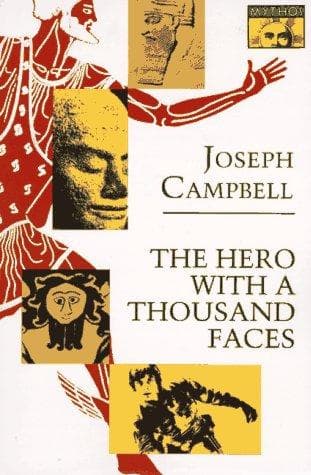
Core Idea
- Myth is a universal symbolic language that expresses recurring human truths; Campbell compares myths from many cultures to show a single underlying pattern, the monomyth or hero’s journey.
- The book’s wager is that myths, rites, dreams, and religious symbols are not dead curiosities but living forms of the psyche that reveal how people move from infantile dependence toward mature individuality and spiritual wholeness.
- Campbell uses psychoanalysis as a tool, but treats it as one approach among others; he wants symbolic meanings to emerge from comparison, not to reduce myth to a single explanation.
The Hero’s Journey
- The monomyth moves through departure, initiation, and return: the call to adventure, refusal, supernatural aid, threshold crossing, trials, goddess/temptation, atonement, apotheosis, the boon, and the hard return to ordinary life.
- Campbell reads many tales as versions of the same pattern: the hero leaves a limited world, is stripped or swallowed by danger, and comes back transformed with a power that can renew the community.
- The call to adventure often begins with a blunder, accident, or disturbing sign; figures like the frog in “The Princess and the Frog,” the Buddha’s Four Signs, or the hero’s dream of an unknown woman function as heralds of destiny.
- Refusal of the call traps people in the old order; Campbell links it to clinging, fear, maternal dependence, and the creation of a self-made “house of death” or labyrinth.
- Supernatural aid appears as an old woman, old man, goddess, hermes-like guide, or talismanic helper; Ariadne’s thread, Spider Woman, and Maymunah all mark the small assistance that makes passage possible.
- Threshold guardians and the belly of the whale symbolize the passage into a realm where the old identity dies; ogres, sea-monsters, caves, and temple doors all mark the same dangerous rebirth-zone.
- The road of trials purifies the hero through ordeals and tasks; Psyche, Inanna, and shamanic journeys show the initiate being stripped, tested, and remade.
- The meeting with the goddess and atonement with the father are central climactic forms: the hero confronts the power behind life, terror, and mercy, and learns to see opposites as one reality.
- The hero may attain the ultimate boon—fire, elixir, immortality imagery, the indestructible body, the hidden source of life—but the real point is not literal permanence, it is expanded perception and spiritual freedom.
- The hardest stage is the return: the hero must bring the boon back, cross back through the threshold, and become a master of the two worlds, able to move between depth and ordinary life.
Key Symbols and Interpretations
- Campbell treats mythic figures as vehicle symbols, not final truths: gods, goddesses, fathers, and monsters are translucent forms that point beyond themselves.
- The World Navel is the center where life-force enters the world; it appears as tree, mountain, hearth, altar, sun-door, cosmic serpent, or sacred city, and it can generate both order and strife.
- The World Mother is both nourishing and destructive; in figures like Kali, the goddess includes life, death, creation, preservation, and annihilation in one form.
- The ogre-father is the terrifying face of authority; Campbell often reads this as a projection of the ego’s own split-off forces, rooted in infantile conflict and the nursery triangle.
- Atonement with the father means passing beyond the split between “God as wrath” and “sin as repression,” so that the father is encountered as mercy, presence, and source.
- Apotheosis is often represented by androgyny or sacred union, as in Avalokiteshvara/Kwan Yin and Tibetan yab-yum imagery, where time and eternity, method and wisdom, male and female are reconciled.
- The indestructible body, the external soul, and the elixir of immortality are variants of one desire: a life not broken by decay, though Campbell insists the deeper issue is transcendence of attachment, not bodily permanence.
- The magic flight and rescue from without show that return may require trickery, transformation, or help from the unconscious and the community; Gwion Bach, Raven, Amaterasu, and Inanna each need outside assistance or a final ruse.
- The crossing of the return threshold is a translation problem: the hero has seen what is hard to speak, and must make the deep truth intelligible in the world of institutions, language, and daily life.
Myth, Society, and Cosmology
- Campbell argues that myth is not primitive error but a controlled, communal language that once aligned birth, initiation, marriage, death, and seasonal life with a larger cosmic order.
- The modern world has broken that symbolic continuity: science, democracy, and machinery have fragmented inherited meanings, leaving the individual with inward meaning but weakened cultural transmission.
- He criticizes nationalism and sectarian religion as secondary identifications that feed tribal ego rather than universal human realization.
- In contrast, he praises traditions of compassion, especially the Buddha’s detachment joined to mercy and Jesus’s “love your enemies,” as signs that realization should widen sympathy beyond the in-group.
- The book repeatedly links mythic cycles to cosmogony and eschatology: the world emerges from the void, unfolds into differentiation, and returns through dissolution, fire, flood, or apocalyptic upheaval.
- Creation stories from Hindu, Maori, Hebrew, Chinese, and other traditions express the same structure: the one becomes many, opposites separate, and the world is sustained by a hidden source behind form.
- Campbell uses the waking, dream, deep sleep, and “Fourth” model from Indian thought to suggest that myth points toward an ineffable ground beyond all states and categories.
- The final horizon is not a doctrine but a vision: the hero, god, and seeker are ultimately aspects of one mystery, and liberation means living in the world without mistaking any form for the whole.
What To Take Away
- The monomyth is Campbell’s master key: diverse stories recur because they dramatize one human movement from separation to transformation to return.
- Myths work by symbols, not literalism; they are meant to carry the mind beyond ordinary ego, not to be mistaken for biography, science, or doctrine.
- Transformation is costly: the hero must die to one identity, face terror, and re-enter society with a truth the community can use.
- The deepest lesson is unity beneath opposites: father/mother, life/death, creator/destroyer, self/world, and human/divine are not final divisions but forms of one reality.
Generated with GPT-5.4 Mini · prompt 2026-05-11-v6