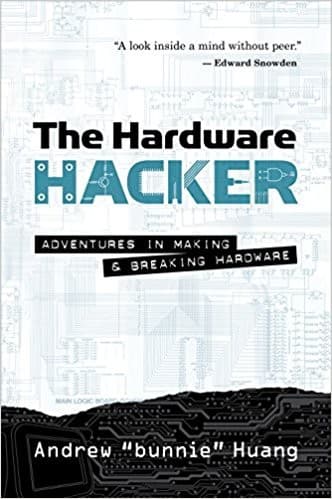
Core Idea
- Huang treats hardware hacking as a study of how devices are designed, built, copied, repaired, and legally constrained, using Shenzhen, shanzhai phones, reverse engineering, and biology as linked case studies.
- His central claim is that openness, reuse, and the right to inspect and reverse engineer can drive innovation, especially where formal IP systems are too rigid for fast-moving hardware ecosystems.
- The book’s stakes are practical and legal: if you do not understand manufacturing, supply chains, test limits, and IP boundaries, you cannot reliably build or modify real hardware.
Manufacturing in Shenzhen: How Hardware Actually Gets Made
- Shenzhen is Huang’s model for modern hardware creation: dense, fast, improvisational, and able to produce everything from boutique adapters to mass-market electronics and custom test gear.
- He emphasizes that factory success depends on on-site involvement, because vague requests, language gaps, and different assumptions can produce technically correct but unusable results.
- A recurring lesson is that many “quality problems” are really miscommunication, pressure, or specification mismatch, not malice; he summarizes this as Hanlon’s razor in manufacturing form.
- He argues that factory scale and process choice matter: manual labor, automation, chip shooters, injection molding, and tooling revisions each have different economics and lead times.
- His examples show why design for manufacturing (DFM) matters: tolerances, slop, brightness variation in LEDs, mold refinement, and the need to choose parts and assemblies that can survive production realities.
- Huang’s Chumby work illustrates his approach to production: strong test rigs, 100% feature coverage, serial-numbered logs, and remote auditing can dramatically improve yield and expose whether failures are in the factory or in the design.
- He argues factories should be treated as partners, not vendors, with open BOM quoting, realistic minimums, and careful accounting for parts, NRE, shipping, duties, and excess inventory.
- His rule of thumb is practical: for U.S. startups, China becomes compelling around 5,000–10,000 units, especially when molding and chassis work are involved; below that, domestic assembly can be better.
Fake Goods, Shanzhai, and “Gongkai” as a Hardware IP System
- Huang treats counterfeit electronics as a spectrum, including external mimicry, refurbished rejects, rebinned parts, ghost-shift production, factory scrap, and second-sourcing gone wrong.
- His forensic cases include a fake ST19CF68 that was actually a Fairchild 74LCX244 in a convincingly marked package, and suspicious Kingston microSD cards whose IDs, serials, and code patterns suggested irregular sourcing.
- He warns that better counterfeit quality makes package-level trust unreliable, especially in military and other long-lifetime procurement where old parts are hard to source.
- He critiques blunt anti-counterfeit laws as overbroad and unrealistic, arguing that customs or paperwork alone cannot reliably detect high-quality fakes.
- The shanzhai world is presented less as simple theft than as a remix culture of small Shenzhen firms that build, copy, improve, and resell phones under severe cost pressure.
- His key concept is gongkai: a networked, hardware-native openness where blueprints circulate as a practical currency of favors, orders, and custom work rather than through formal open-source licensing.
- He contrasts Western IP as a broadcast model with Chinese gongkai as a network model, where access to documents and factories matters more than formal legal permission.
- The $12 Shenzhen phone is his emblem of this ecosystem: astonishingly cheap, contract-free, and functional because parts were minimized, soldered directly, and optimized for manufacturing rather than elegance.
Reverse Engineering, Legal Boundaries, and Open Hardware
- Huang repeatedly argues that reverse engineering rights must be exercised or they will atrophy, and he treats legal constraints as part of engineering rather than as a reason to stop.
- His Fernvale project attempts to bring gongkai-derived hardware into a Western open-source framework by extracting factual information, rewriting it in original form, and avoiding DMCA/CFAA/EULA traps.
- He leans on Feist to argue that facts are not copyrightable, and he uses tools like Scriptic to force clean re-expression instead of subconscious copying.
- Fernvale also shows the limits of openness: a project can be technically valid yet still struggle if the ecosystem, market timing, or available contributors are weak.
- His broader open-hardware point is layered and pragmatic: even if the whole stack cannot be open “down to silicon,” sharing schematics, layouts, and useful abstractions can still materially expand what small teams can build.
- He sees Moore’s law slowing as an opportunity for heirloom laptops, repair culture, and longer-lived platforms, because slower change makes standardized, serviceable hardware more viable.
Hacking Silicon, Storage, Displays, and Biology
- In the hacking chapters, Huang starts from a simple rule: buy multiple copies, sacrifice one, and use the others as probe and control units.
- His PIC18F1320 work shows how packaging removal can expose security weaknesses; by decapping and UV-erasing fuses, he demonstrates that hardware security can be physically bypassed.
- His SD-card research reveals that memory cards are really small computers: some controllers accept firmware updates, expose hidden commands, and can be turned into interactive REPL-like shells for reverse engineering.
- That same mutability becomes a security warning: flash devices may hide code, accept firmware changes, or perform attacks that ordinary “secure erase” cannot address, so physical destruction may be the only safe wipe.
- NeTV extends the same mindset to HDMI/HDCP: rather than decrypting protected video, it overlays user content onto an encrypted stream, framing the project as an engineering solution that avoids direct circumvention.
- The biology section is not a digression but a continuation of the same method: Huang reads genomes like schematics, treats enzymes as components, and uses BLAST and decompilation-like reasoning to find function in DNA.
- He uses influenza, antibiotic resistance, CRISPR, and gene drive to show that biology now has the power of a destructive software exploit, but with no reliable rollback if something escapes.
What To Take Away
- The book’s unifying lesson is that hardware is shaped by manufacturing systems, not just by designs.
- Huang’s strongest practical insight is that measurement, logs, and testability matter as much as clever circuits.
- His broadest philosophical claim is that openness plus reverse engineering is a driver of innovation, especially in Shenzhen-style ecosystems.
- The warning underneath all of it is that once you understand real hardware, you also see how fragile supply chains, IP rules, and biological systems can be.
Generated with GPT-5.4 Mini · prompt 2026-05-11-v6