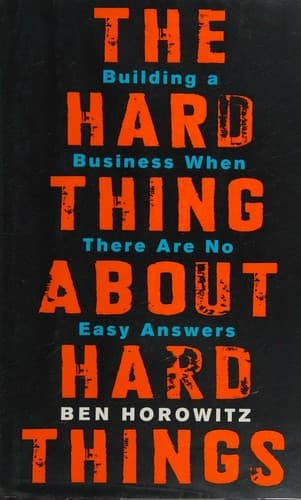
Core Idea
- Hard things are business problems with no clean formula: layoffs, executive firings, cash crises, strategy pivots, and leading when the company’s dream has turned into a nightmare.
- Horowitz’s central claim is that startup leadership is not about having answers in advance; it is about finding a way through reality, often under fear, ambiguity, and public pressure.
- The book is built from wartime CEO experience, not theory: it treats entrepreneurship as a sequence of ugly decisions where honesty, courage, and execution matter more than optimism.
What Makes Leadership Hard
- Horowitz learned early that surface impressions are unreliable, from childhood experiences, football coaching, and later startup chaos; in crises, there is often more than one plausible story about what is happening.
- A recurring lesson is that leaders must separate facts from perception, because the story people tell themselves can either help them survive or cause self-deception.
- He argues that CEOs should not pretend hard decisions are statistical exercises; in the Struggle, the job is to act, not to calculate odds and hope.
- The Struggle is the period when cash is running out, customers are leaving, employees are shaken, and the CEO has to keep going without a recipe.
- His advice in that phase is to tell it like it is, mobilize as many brains as possible on existential problems, and avoid letting fear or pride isolate the CEO.
- Horowitz repeatedly warns against self-deception: companies often rationalize bad outcomes, confuse optimism with truth, and lie to themselves about why they missed targets or lost deals.
- He distinguishes peacetime CEO work from wartime CEO work: peacetime is about optimizing, while wartime is about survival, focus, and alignment around the prime directive.
Managing People, Decisions, and Culture
- Horowitz treats leadership as a practice of making painful personnel calls well, including layoffs, demotions, and executive firings, because avoiding them creates management debt.
- His layoff guidance is blunt and procedural: get your head right, move fast, have managers do the layoff themselves, explain that it is a company failure, and stay visible afterward.
- He argues that executive mis-hires usually reflect a hiring and integration problem, not just a bad person; the real failure is often vague role definition, bad timing, or poor onboarding.
- Strong executive hiring requires knowing what the company actually needs, not hiring for “central casting,” lack of weakness, or imagined future scale.
- He is skeptical of importing big-company executives into startups without checking whether they can thrive in a role that is interrupt-driven, creating motion, and building from scratch.
- A recurring principle is to hire for the job at this scale now, not for what the role might become years later.
- He also warns against hiring from a friend’s company without extreme care, because even a “logical” hire can feel like betrayal and poison relationships.
- Horowitz’s Reflexive Principle of Employee Raiding says: if you would be horrified to see another firm hire several of your people, you should not hire from that firm lightly.
- Good management requires more than metrics; incentives can distort behavior, so leaders need white-box management that looks at the drivers behind results, not just the results themselves.
- Management debt accumulates when leaders take shortcuts like “two in the box,” counteroffering key employees, or skipping feedback systems; these fixes create long-term organizational damage.
- He treats HR as a form of management quality assurance, not a culture-policing function: its job is to detect breakdowns in management quality.
- Culture matters, but not as perks or slogans; it is built through a few high-impact mechanisms, and the right mechanisms must fit the company’s values.
- Horowitz is unusually pragmatic about profanity, arguing that banning it would shrink the talent pool, but it must not become a tool for intimidation or harassment.
- He emphasizes that trust depends on high-frequency, honest feedback; bad news must travel fast, and feedback should be direct, authentic, and aimed at helping the person succeed.
Strategy, Product, and Survival
- The book’s startup stories from Netscape, Loudcloud, and Opsware show how external shocks can radically reshape strategy: Microsoft’s bundling, the dot-com crash, September 11, and competitive pressure repeatedly forced hard choices.
- Horowitz’s rule for survival is “motherfuckin’ chess, not checkers”: there is usually another move, even if it is ugly, expensive, or humiliating.
- He also argues that sometimes there are no silver bullets, only lead bullets: hard, direct work on product, competition, and execution when a weak product must be fixed rather than waved away.
- A major lesson from Loudcloud and Opsware is that CEOs must be willing to change the company’s business model when the original plan no longer works.
- His sale of Loudcloud and preservation of Opsware illustrate his view that the CEO must be willing to make the company smaller, sell it, or restructure it if that is the only path to survival.
- He is explicit that public narratives matter: employee morale, stock price, and external confidence can shape the company’s ability to survive almost as much as the underlying financials.
- For product and operations teams, he uses Jim Barksdale’s ordering: take care of the people, the products, and the profits—in that order.
- Strong product management, in his view, means owning the what, understanding the market deeply, and writing clearly enough that the team can execute without ambiguity.
- Weak product management hides in excuses, vague opinions, and overfocus on “how” instead of “what.”
What To Take Away
- The hard thing about hard things is that there is no formula; the CEO has to make reality legible, decide under pressure, and live with the consequences.
- Great leaders combine truth-telling, courage, and operational discipline rather than relying on charisma or pure analytical brilliance.
- The company’s health depends on a few linked systems: hiring, feedback, culture, process, and executive quality all reinforce or destroy one another.
- Horowitz’s deepest message is that entrepreneurship is a struggle worth embracing, because the work is difficult precisely where growth, leadership, and meaning are found.
Generated with GPT-5.4 Mini · prompt 2026-05-11-v6