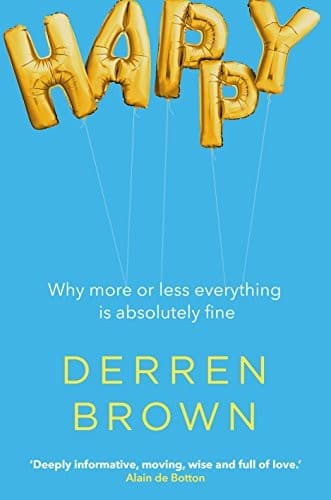
Core Idea
- Brown’s central claim is that happiness is not mainly produced by circumstances, but by the stories and judgements we attach to them.
- Much suffering comes from treating our private narrative as reality, then blaming the world, other people, or ourselves for the feelings that follow.
- His answer is a Stoic-inflected, psychologically grounded “it’s fine”: accept what is outside control, revise the inner story, and stop demanding that life, other people, or fate deliver perfect outcomes.
Happiness, Story, and the Self
- Brown opens with the idea that the mind edits experience into a coherent story, just as magic exploits selective perception and blind spots.
- The child insulted by a parent’s offhand remark about a photo shows how a tiny external event can become a lasting identity story.
- He connects this to confirmation bias and learned helplessness: once people are trained to expect failure, they begin performing that story.
- A key move in the book is to treat the self as partly a confabulation: useful, but revisable rather than sacred.
- He uses Kahneman’s split between the experiencing self and the remembering self to argue that we judge lives by memory and narrative, not just immediate sensation.
- The hedonic treadmill explains why gains quickly normalize; desire keeps moving unless we consciously question it.
- Much of what people want is socially induced, from status symbols to fame, and Brown repeatedly shows how comparison fuels dissatisfaction.
- He leans on Epicurus to distinguish natural, necessary needs from unnecessary ones; the latter are endless and usually manufactured by culture and advertising.
- Consumer culture, in his account, creates “anxiety relievable by purchase,” shifting our centre of gravity outside ourselves.
The Philosophical Toolkit: Socrates, Epicurus, Stoics
- Brown’s historical argument is that “happiness” is not a timeless obvious given; Western thought repeatedly redefined it.
- Socrates makes happiness a question of the considered life, turning self-examination into the basis of flourishing.
- Plato pushes truth “Out There,” via Forms and the cave allegory, which helps detach us from appearances but can also over-abstract the human world.
- Aristotle re-centres the human being, defining happiness as eudaimonia or flourishing through virtue, habit, and reason.
- Brown likes Aristotle’s practical clarity but thinks it underestimates the unconscious and is too socially exclusive.
- Epicurus offers a more accessible route: tranquillity, friendship, simple pleasures, reduced desire, and training oneself to desire what one already has.
- Stoicism becomes Brown’s main framework because it gives a way to handle emotion without denying it.
- Its first rule is that events do not directly upset us; our judgements about events do.
- Its second rule is the control fork: if something is not under our control, it should not govern our peace.
- Brown stresses that Stoicism is not passive resignation but disciplined effort plus emotional independence from outcomes.
- He repeatedly uses the same distinction in work, love, status, and health: focus on what you can do, and release the rest.
Anger, Control, and Emotional Practice
- Brown treats anger as the most destructive passion because it mixes pain with a wish for revenge.
- He is sympathetic to the modern claim that some anger seems morally justified, but argues that raw rage is rarely useful and often self-defeating.
- His preferred response is delay: wait for the heat to pass, then judge the situation more clearly.
- He warns against venting, which often reinforces aggression rather than releasing it.
- Many anger episodes are sustained by selective perception, mind-reading, and catastrophising: we add a hostile story to a neutral or ambiguous event.
- The Stoic remedy is to not add to first impressions.
- He also recommends lowering expectations, especially in consumer life and service encounters, because entitlement feeds resentment.
- Another major practice is prosoche: sustained self-attention that catches the mind before it spirals into fantasy, rumination, or blame.
- Brown is not asking for coldness; he argues for porous Stoicism—steady enough to be unshaken, open enough to understand other people.
- Empathy matters, but it must be tempered by realism: people act from their own fears, histories, and blind spots.
- The same framework applies to relationships, where partners often project childhood needs onto each other and then try to control what cannot be controlled.
- His practical point is not “never feel,” but “notice what story is generating the feeling and decide whether it is actually yours to carry.”
Fame, Mortality, and the Good-Enough Life
- Brown treats fame as a modern substitute religion: celebrity manufactures desire, worship, and projected meaning, but not stable happiness.
- Fame intensifies both pleasure and distress; it gives attention and opportunities while splitting the public persona from the private self.
- Its logic is relative and unstable, so chasing it directly is a treadmill with no destination.
- His more general warning is that many goals promising arrival—promotion, travel, money, image, perfect relationships—do not solve the self.
- In the chapter on death, he argues that facing mortality honestly can clarify values and reduce the pressure of perfectionism.
- He criticizes the culture of “fighting” death when that language burdens the dying person, and prefers humanistic care that helps them own their ending.
- Tolstoy’s Ivan Ilyich and Simone de Beauvoir’s account of medical overreach illustrate how denial and role-playing can worsen dying.
- Brown keeps returning to a good-enough life / good-enough death: stop demanding ideal conditions, and live with reality as it is.
- The book closes by connecting mortality, gratitude, and self-knowledge: a finite life is not tragic because it is finite, but because we spend so much of it refusing what is already here.
What To Take Away
- Happiness is not a reward for getting life right; it is largely a function of how you interpret, remember, and narrate life.
- The most durable freedom comes from separating what happens from what you tell yourself it means.
- Stoic practice in Brown’s version is practical, not heroic: control your judgements, reduce unnecessary desire, and let outcomes be outcomes.
- The deepest alternative to anxiety is not optimism, but a calm, realistic acceptance that more or less everything is, in the end, absolutely fine.
Generated with GPT-5.4 Mini · prompt 2026-05-11-v6