Core Idea
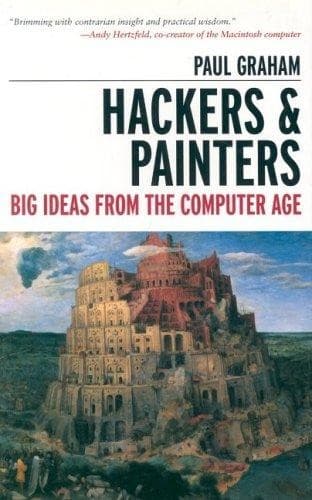
- Paul Graham argues that hackers are makers, not just technologists: programming is a creative craft like painting, architecture, and writing, and good software comes from taste, empathy, revision, and design judgment.
- The book’s larger claim is that the Computer Age is being shaped by hackers as much as by scientists or managers, and that the same forces that matter in software—freedom, leverage, language, and good design—also explain startups, wealth, spam, and taboos.
- Graham repeatedly contrasts real making with institutional distortion: schools, big companies, committees, and fashionable orthodoxies often suppress the conditions under which excellent work is done.
Hackers, School, and Intellectual Freedom
- In school, nerds are unpopular not mainly because others envy them but because they are playing a different game: they care about being smart, building things, or reading books while popularity demands full-time conformity.
- Teen social life is portrayed as a crude hierarchy with group bullying serving as a mechanism of status, while adults mistake the boredom and cruelty of suburbia for inevitable adolescent psychology.
- Graham treats hackers as naturally inclined toward free speech because innovation requires the willingness to entertain heretical or taboo thoughts.
- Chapter 3 develops methods for identifying moral fashions: the Conformist Test, the Trouble method, the Heresy method, and the use of words like “inappropriate” or “divisive” as signals that debate is being shut down rather than refuted.
- His advice is not to blurt everything out, but to think freely in private, keep a few trusted interlocutors, and avoid engaging zealots on their own terms.
- Chapter 4 defines the hacker as someone who can make a computer do what he wants “whether it wants to or not,” and links hacking’s rule-breaking spirit to American suspicion of authority and concern for civil liberties.
- Graham warns that patents and restrictive copyright laws can cripple the exploratory freedom needed to reverse-engineer existing systems and build the next generation.
Software as Craft: Languages, Design, and Taste
- Graham rejects the idea that programming is mainly science or engineering; it is closer to architecture or painting because the central task is deciding what to make, not merely proving or implementing it.
- He argues that programming language choice matters because code is text: languages shape what can be expressed, how programmers think, and how easily ideas can be revised.
- Good hackers work like painters: they sketch, iterate, and “beat code into shape,” so languages should be malleable pencils, not rigid pens.
- That is why he favors dynamic typing and low-friction experimentation for real hackers, even while acknowledging that static typing can help in more preplanned styles.
- He criticizes math envy and “software engineering” rhetoric that pushes programmers toward false precision, committee design, or implementer-only roles.
- His ideal language and workflow emphasize small cores, orthogonal libraries, rapid interactive feedback, and the ability to change direction without enormous rewrites.
- Chapter 9 argues that taste is real and learnable: good design tends to be simple, timeless, right for the problem, suggestive, slightly funny, and hard in the productive sense.
- Strong designs often resemble nature, embrace symmetry when it arises from structure, benefit from redesign, and are not afraid of being strange if the strangeness is truthful.
- Chapter 10 and 11 make the case for high-level languages, Lisp, and bottom-up programming: abstraction reduces code, layers of interpretation buy flexibility, and reusable languages can be built upward from application code.
- Lisp is presented as a secret weapon because its macros and code-as-data model let programmers write programs that write programs, while the Blub paradox explains why most programmers underestimate languages more powerful than their own.
- Graham argues that many mainstream languages are slowly converging toward Lisp-like ideas, and that future language design will be driven increasingly by application hackers, not compiler theorists.
Startups, Web Software, and Making Money
- Chapter 5 argues that server-based web software is the next major software model because it is easier to use, easier to update, easier to test-drive, and less fragmented than desktop software.
- Running software on the server turns the product into a city of code: apps, backups, monitoring, recovery, statistics, and support all become part of the system.
- Viaweb’s experience showed the advantages of continuous release, immediate bug isolation, close support-feedback loops, and direct observation of users instead of synthetic benchmarks.
- Graham thinks web software shifts the economic center from packaged binaries to subscriptions, hosted data, and recurring service, while also letting startups bypass Microsoft’s desktop control.
- Chapter 6 and Chapter 8 connect startups to wealth creation: the best route to riches is to join or found a startup because startups combine measurement and leverage in a small team.
- He distinguishes wealth from money: wealth is actual goods and services, and it can be created rather than merely divided; the “pie fallacy” is treating it as fixed.
- Startups work because a tiny group of strong people can have outsized impact, especially when they choose hard-to-duplicate technology that creates barriers to entry.
- The payoff is highly skewed and often zero at the median, so startups are all-or-nothing; selling early can reduce risk, but user growth remains the best signal of real value.
- Graham ties this to the rise of the middle class and rule of law: when creators can keep what they make, wealth creation outcompetes theft, confiscation, and zero-sum status games.
What To Take Away
- Programming is creative work, and its quality depends as much on taste, empathy, and revision as on raw technical skill.
- The most powerful environments are those that preserve freedom to explore, whether in thought, in code, or in business.
- Startups win when small teams combine measurable effort with technological leverage and build products that users actually want.
- Graham’s deepest preference is for systems—languages, companies, social norms, and software—that let good people make things directly instead of optimizing for bureaucracy, conformity, or prestige.
Generated with GPT-5.4 Mini · prompt 2026-05-11-v6