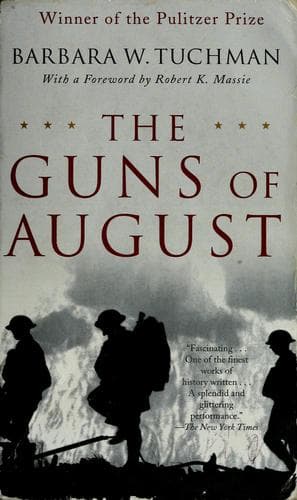
Core Idea
- The Guns of August argues that the First World War was not a preordained catastrophe but a chain of rigid plans, misread signals, and human vanity that turned a crisis nobody wanted into a war nobody could stop.
- Tuchman’s central dramatic claim is that August 1914 exposed the fatal gap between perfect systems and fallible men: the Schlieffen Plan, French Plan 17, Russian mobilization, and British indecision all collided with enormous, unintended consequences.
- The book treats war as suspenseful history: the outcome is known, but Tuchman makes the reader feel the uncertainty, contingency, and fragility of each decision as it happens.
How Tuchman Writes History
- Tuchman’s method is built on immersion in primary sources—letters, telegrams, diaries, memoirs, orders, and diplomatic records—plus battlefield travel to reconstruct terrain and timing.
- She prefers concrete, memorable facts over abstraction, using vivid portraiture to fix figures in the reader’s mind and to keep explanation grounded in evidence.
- Her history is deliberately anti-systematic: she distrusts theories that force facts into a scheme and argues that historians should let facts accumulate before asking “why.”
- She also rejects unsupported speculation, insisting that thoughts, motives, weather, and states of mind in the narrative have documentary basis.
- Tuchman’s style aims to make readers turn the page; she sees prose not as decoration but as the instrument of historical understanding.
- The book’s large reputation matters to her because it vindicates history written as literature without surrendering rigor or honesty.
The War Before the War
- Europe in 1910 still looked stable, but Edward VII’s funeral already symbolized a fading order of interlocking dynasties and diplomatic illusions.
- Edward’s sociable kingship had helped produce the Anglo-French and Anglo-Russian understandings, while Germany missed openings because it assumed every English overture was a trap.
- Tuchman contrasts two prewar mentalities: Norman Angell’s claim that war was economically irrational and Bernhardi’s belief that war was biologically necessary and Germany must choose “world power or downfall.”
- German strategy after 1871 was driven by fear of encirclement and by the wish to break France quickly through Belgium, while preserving strength against slower Russian mobilization.
- Schlieffen’s plan depended on speed, rail timetables, reserve troops used in the front line, and the expectation that Belgium would either not resist or could be coerced.
- French strategy after Sedan was shaped by humiliation and revenge, especially the desire to recover Alsace-Lorraine, but this became distorted into offensive à outrance, a doctrine that made offense almost a moral absolute.
- Plan 17 embodied that offensive faith while neglecting the real strength of the German right wing and leaving the Belgian frontier dangerously exposed.
- Russian military power looked gigantic from afar, but Tuchman shows it was the myth of the steam roller—large, fearsome, and badly supplied, with rail and communications weaknesses that limited what it could actually do.
- British planning was secret, hesitant, and politically delicate, but Staff conversations with France created a practical commitment long before the public admitted one existed.
August 1914: Decisions, Invasions, and Misreadings
- On August 1–4, Germany’s mobilization machine began moving with terrifying precision, but political leaders still imagined they might frighten others into neutrality without having to fight.
- The Kaiser wanted prestige and leverage, not necessarily battle; his behavior, notes, and diplomacy show a volatile mind fixated on encirclement and humiliation.
- Germany tried and failed to solve the two-front problem through diplomacy, including proposals involving France’s neutrality and demands that revealed the invasion of Belgium was already baked into strategy.
- Britain only moved decisively once Belgium made the issue morally and politically unavoidable; Grey’s House of Commons speech turned Belgian neutrality into the public case for war.
- Belgium’s King Albert rejects submission and insists on defending national honor, even though Belgium’s army is weak, underprepared, and constrained by neutrality.
- Churchill acts early at sea, moving the fleet to avoid surprise; this matters because naval posture, blockade, and imperial strategy quickly become part of the wider war.
- The escape of Goeben and Breslau is one of the book’s great examples of contingency: ambiguous orders, misread intentions, and missed interceptions helped push Turkey toward the Central Powers.
- Tuchman uses the Goeben episode to show how one warship’s escape could reshape the Mediterranean, the Black Sea, Gallipoli, and Balkan alignments.
The Fronts and the Collapse of the Plans
- At Liège, Belgian resistance delayed the German timetable and proved that the war would not be the clean march Berlin expected.
- German reprisals in Belgium and northern France are central to Tuchman’s moral argument: terror, hostage-taking, village burnings, and the destruction of Louvain did not shorten the war, but widened hatred against Germany.
- In France, the opening battles in Lorraine and the Ardennes destroyed the cult of the offensive; machine guns, artillery, and prepared defenses made mass attack suicidal.
- Lanrezac repeatedly sees the real danger on the French left and warns of the German envelopment through Belgium, but GQG remains committed to offensive doctrine too long.
- The BEF fights well at Mons, but its role is limited by confusion, secrecy, and the absence of a clear Allied command structure.
- Russia’s offensive helps by forcing German redeployment, but its mobilization errors, communications failures, and uneven leadership make the “steam roller” far less decisive than legend imagined.
- In East Prussia, German panic turns into opportunism; Tannenberg becomes a triumph made possible by radio intercepts, Russian separation, and command luck as much as by genius.
- Tuchman treats the Eastern victory as strategically real but not war-winning, since it did not remove Russia from the conflict.
The Marne and the Meaning of the War
- Paris becomes a fortified camp under Gallieni, who understands that the city must be defended as an operational base, not as a passive citadel.
- The crisis around Sir John French, Kitchener, Joffre, and Gallieni shows how close the Allies came to disintegration before the Marne.
- The battle is decided by the German right wing’s overextension, Allied reconnaissance and pressure, and a sudden willingness to counterattack when retreat would otherwise have continued.
- Gallieni’s taxi deployment became symbolic, but Tuchman’s real emphasis is strategic: the Marne stopped the German sweep, forced withdrawal, and led to the Aisne, the “race to the sea,” and trench warfare.
- The deeper consequence is deadlock: the failure of both great plans created a long war of attrition that no one in August 1914 had prepared to fight.
- The book closes by stressing how war transformed language, hopes, and moral assumptions; people entered the conflict expecting purification, liberation, or victory, but the lasting result was disillusion.
What To Take Away
- Tuchman’s lasting lesson is that modern war can be produced by rigid plans plus human blindness rather than by a single evil mastermind.
- Belgium, rail timetables, mobilization schedules, and command miscommunication mattered as much as grand strategy.
- The first month of the war shows how quickly doctrine collapses under contact with reality, especially when leaders refuse to revise assumptions.
- The book is as much about how historical catastrophe is made legible as about the war itself: careful narrative can reveal contingency without losing moral force.
Generated with GPT-5.4 Mini · prompt 2026-05-11-v6