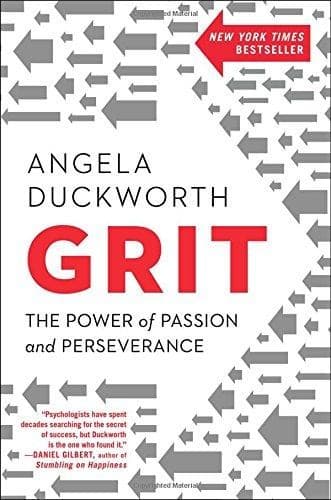
Core Idea
- Angela Duckworth’s central claim is that achievement depends more on passion and perseverance than on innate genius, and that grit is a mutable quality, not a fixed gift.
- Her repeated message is that potential is one thing; what you do with it is another, and talent alone does not reliably predict who finishes, improves, or succeeds.
- The book argues against naturalness bias: people say they value effort, but tend to overrate “naturals” and underrate strivers and sustained work.
What Grit Is and Why It Matters
- Duckworth defines grit as passion and perseverance for long-term goals: sustained commitment to an ultimate concern rather than short bursts of enthusiasm.
- In her West Point, sales, school, and Green Beret examples, grit predicted retention and completion better than SATs, class rank, leadership ratings, or other baseline aptitude measures.
- Her Grit Scale has two parts: perseverance items like “I finish whatever I begin,” and passion items about maintaining consistent interests over time.
- She emphasizes that perseverance and passion are related but not identical; the passion side is about consistency, not intensity, and gritty people do not keep changing what they care about.
- Grit is not stubbornness about every low-level goal; people should abandon or swap tactics and subgoals when they stop serving the higher aim.
- She uses examples such as Tom Seaver, Jeff Gettleman, and Bob Mankoff to show that grit is a coherent hierarchy of goals, flexible at lower levels but steady at the top.
How Grit Develops
- Duckworth’s formula is talent = how quickly skills improve with effort and achievement = skill × effort, with effort counting twice because it both builds skill and makes skill productive.
- A major theme is deliberate practice: improvement comes from better time on task, not just more years of experience.
- Deliberate practice means a stretch goal, total concentration, immediate informative feedback, and repetition with reflection; it is often difficult, solitary, and emotionally taxing.
- Her examples range from Benjamin Franklin copying and revising prose, to athletes and performers who target specific weaknesses, to the spelling-bee study showing deliberate practice predicted advancement better than reading or word games.
- Duckworth distinguishes deliberate practice from flow: practice is for preparation, flow is for performance; they are different states, though grittier people report more flow overall.
- She argues that people often think they are improving when they are actually in arrested development, accumulating experience without kaizen-like continuous improvement.
- The developmental sequence she highlights is interest, practice, purpose, hope: early curiosity, then disciplined improvement, then seeing the work as meaningful to others, and finally resilience after setbacks.
Where Grit Comes From
- Duckworth argues grit is shaped by both genes and experience; twin studies suggest partial heritability, but no single “gene for grit” exists.
- She stresses that heritability does not fix averages, because environments can shift whole populations, and adults often grow grittier with age through the maturity principle.
- Her view of interest development rejects the simple command to “follow your passion”; most people do not start with a fully formed passion.
- Instead, she says to foster a passion through experimentation, repeated exposure, mentors, peers, and positive feedback, because interests usually begin in adolescence and are triggered by the outside world.
- She uses examples like Julia Child, Will Shortz, and Jeff Bezos to show that passions often emerge gradually through sampling and repeated deepening.
- Early breadth can help before specialization, and support during the early years matters because play, encouragement, and autonomy can reveal fit.
- Duckworth’s practical advice for discovering interests is to notice what you like to think about, try broadly, and keep asking questions until a direction gains traction.
How Grit Is Built in Real Life
- Extracurriculars are “playing fields of grit” because they combine a demanding adult with opportunities to build interest, practice, purpose, and hope.
- The book favors follow-through over mere participation: sticking with one activity over multiple years and making progress in it predicts later outcomes better than dabbling.
- Studies she cites link sustained extracurricular involvement to graduation, volunteering, leadership, and later achievement, and Willingham’s work found follow-through outperformed SATs and grades in predicting honors and leadership.
- Duckworth uses Brent Roberts’s corresponsive principle to argue that personality and situation reinforce each other: people seek environments that amplify their traits, so grit can snowball or erode.
- Her “Hard Thing Rule” for her daughters captures the idea that hard work is learned through commitments with real friction, but only at natural stopping points rather than on bad days.
- She argues culture matters because shared norms make grit contagious; organizations like the Seahawks, West Point, KIPP, JPMorgan Chase, and UNC women’s soccer show how repeated standards and language shape identity.
- Strong cultures work through supportive challenge: high standards plus coaching, respect, and visible models of persistence.
- Culture becomes identity when people stop asking what is convenient and start asking, “What does someone like me do in a situation like this?”
What To Take Away
- Talent is not the main mystery of success; sustained effort is.
- Passion usually has to be developed, not merely discovered.
- Improvement requires deliberate practice, not just experience or effort in the abstract.
- Grit is built both from the inside out and the outside in: by developing interest, practice, purpose, and hope, and by surrounding people with demanding, supportive environments.
Generated with GPT-5.4 Mini · prompt 2026-05-11-v6