Core Idea
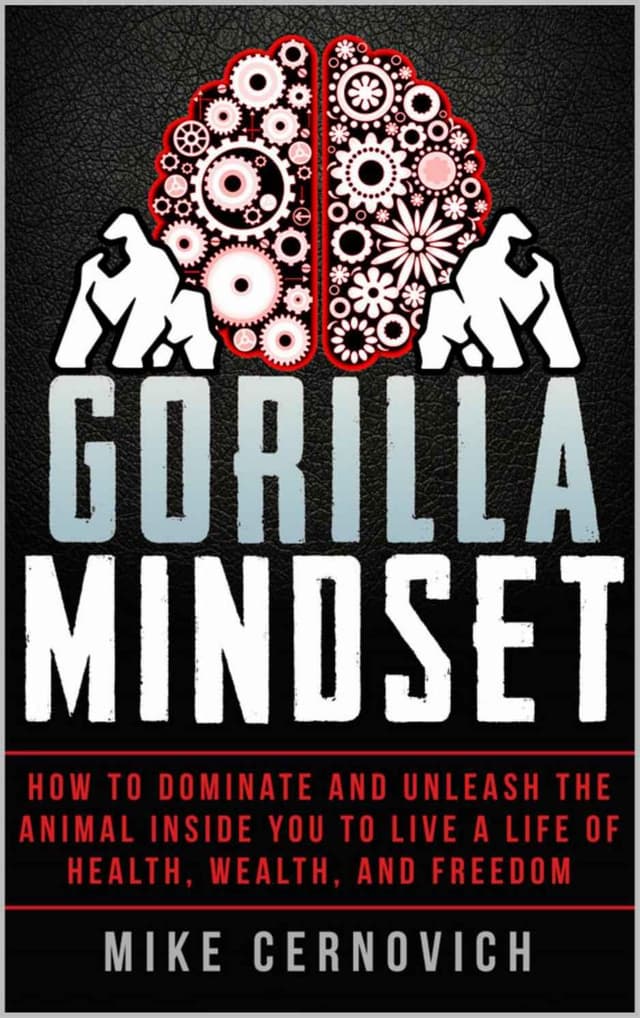
- Gorilla Mindset argues that you get more out of life by getting more out of yourself: take responsibility for your thoughts, emotions, body, and daily habits instead of blaming “the system.”
- Cernovich treats mindset as a practical system, not inspiration: mind and body are linked, so changing self-talk, framing, attention, posture, health, and routines can change outcomes.
- The book’s recurring contrast is abundance vs. scarcity: abundance sees options, growth, and agency; scarcity sees limitation, helplessness, and emotional drift.
The Mental Game: Self-Talk, Framing, Mindfulness, State, Focus
- Self-talk is the inner conversation, and he says negative self-talk is usually exaggerated and false, so you should speak to yourself like a trusted friend rather than an enemy.
- He pushes three tools for self-talk: talk to yourself in a mirror, record and replay negative self-talk, and replace ranting with questions such as whether you are acting like the person you want to become.
- He likes affirmations that force commitment, especially “I am going to ___, because ___,” and rejects the posture of “Mr. Maybe,” the voice of hesitation and rationalization.
- Framing means defining what a situation means before you react to it; the same event can feel empowering or crushing depending on the frame you use.
- His framing advice is to compare a problem to bigger possible problems, treat difficulty as training, and “embrace the suck” because hardship is preparation for a bigger moment.
- Mindfulness is not passive calm but active awareness of the present moment, including bodily sensations, posture, breath, and environment.
- He recommends noticing where you are, what your body is doing, and what your senses are picking up, because the “inner judge” fills gaps with negativity when you are not paying attention.
- He uses walking, gym work, podcasts, and even big natural spaces as mindfulness exercises because they pull attention out of worry and into the present.
- State is your current emotional condition, and state control means deliberately changing that condition instead of passively accepting mood.
- He describes state work as embodied: find where an emotion lives in the body, recreate it through movement, and use repeated physical triggers to return to a resourceful or empowered baseline.
- Focus is finite and fragile in a hyper-connected world, so he treats attention as something to guard by removing distractions and deciding what matters.
- His practical focus habits include the holy trinity check before leaving home—wallet, phone, keys—single-tasking, turning off the phone at the gym, and asking, “What am I focusing on?”
Lifestyle, Health, and Posture as Mindset Tools
- Cernovich treats lifestyle as a direct input into psychology: sleep, food, people, daily routines, and environment all shape the mindset you can sustain.
- He warns against negative people and “spiritual vampires,” argues that sleep is foundational, and recommends routines like no snooze button, immediate showering, and a morning warmup for the brain.
- Health is framed as mental performance: blood flow, breath control, posture, lymph movement, digestion, and exercise all influence mood, stress, and cognition.
- He argues that lifting weights is the single best fitness habit, with cardio and daily movement as supporting habits, and he repeatedly connects exercise to confidence, willpower, and brain health.
- His diet advice is strongly pro-plant: lots of fruits and vegetables, especially high-ANDI foods, with warnings about processed sugar/starch-heavy foods and “white foods.”
- He uses supplements as optional supports rather than magic bullets, but highlights NAC in particular as a tool he used for mild depression/anxiety and links it to glutathione and oxidative stress.
- Posture is not cosmetic in his view; it signals and shapes state, with open shoulders, upright chest, and an “abundance posture” used to create confidence and lower stress.
- He says desk work, smartphones, and habitual slouching create bad posture that cannot be undone by one gym session, so posture must be trained repeatedly throughout the day.
Money, Work, Authority, and Visualization
- Money is presented as a need, not a luxury: “money is like oxygen,” and the problem is not money itself but the way people use it or attach status meanings to it.
- Wealth has two sides: make money and keep money; the biggest leak is spending to buy status instead of buying things that genuinely improve life or income.
- He encourages a producer mindset over a consumer mindset: ask how to create value, get in between transactions, and become the person whose knowledge or recommendation can be monetized.
- Small-business and personal-brand tactics include recording expertise, making searchable city-plus-problem videos, and building trust through evidence rather than credentials alone.
- Reputation matters enormously because once trust is built it can be destroyed quickly; he repeats that your brand, transparency, and proof are the basis of authority.
- On investing, he recommends a conservative baseline: emergency cash, no credit-card debt, and dollar-cost averaging into low-cost index funds rather than trying to trade.
- He frames self-employment and side businesses as tax and wealth tools, but warns against pretending hobby spending is a business and says deductions should be legitimate.
- The “You, Inc.” idea treats the self as the best investment, urging readers to differentiate themselves, start their own projects, and stop waiting to be discovered.
- Visualization is presented as a concrete skill: build future scenes with sensory detail, use the same mental machinery as memory, and turn the imagined future into motivation.
- The book closes by pushing readers to design a “Perfect Day” and an “amazing day,” because a better life is built one deliberate day at a time.
What To Take Away
- The book’s central move is to treat mindset as a trainable operating system that includes thoughts, body, habits, and environment.
- Its most distinctive tools are self-talk, framing, mindfulness, state control, focus discipline, and physical cues like posture and breath.
- Its broader philosophy is aggressively personal-responsibility-based: stop waiting, stop rationalizing, create abundance, and build yourself like a project.
- The practical through-line is that daily repetition matters more than insight alone; the “gorilla” mindset is meant to be practiced, not merely understood.
Generated with GPT-5.4 Mini · prompt 2026-05-11-v6