Core Idea
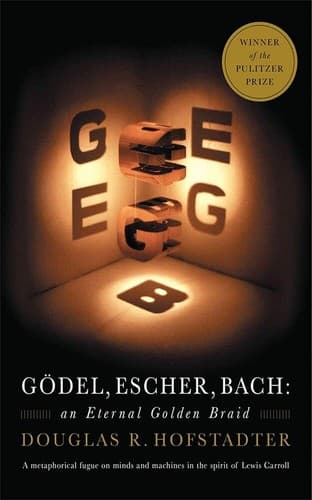
- Gödel, Escher, and Bach are treated as three manifestations of the same deep pattern: self-reference, recursion, and strange loops that cross levels and return unexpectedly to their starting point.
- Hofstadter’s central claim is that meaning, mind, and intelligence emerge from isomorphisms between symbols and what they stand for, not from symbols alone.
- The book’s structure mirrors its thesis: dialogues present metaphors and puzzles first, and chapters then unpack the formal, mathematical, musical, and cognitive mechanisms behind them.
Formal Systems, Self-Reference, and Incompleteness
- The early chapters build formal systems like MIU, pq, tq, and TNT to show how rigid symbol-manipulation can generate rich structure while remaining blind to its own meanings.
- Hofstadter emphasizes the Requirement of Formality: rules must be typographical and decidable, not smuggle in outside reasoning.
- The pq-system models addition, the tq-system models multiplication, and prime-number systems show that some properties can be captured only because they are monotonic enough to be checked in a fixed direction.
- The contrast between recursive enumerable and recursive sets supports one of the book’s recurring points: some symbol spaces have no terminating decision procedure.
- Gödel’s theorem is presented as the archetypal strange loop: by Gödel-numbering, a statement can refer to itself and assert its own unprovability.
- The result is incompleteness: any consistent, sufficiently expressive axiomatic system for arithmetic leaves true statements unprovable.
- Hofstadter repeatedly compares this with paradoxes such as Russell’s set paradox and the liar sentence, and with Carroll’s regress in “What the Tortoise Said to Achilles.”
- The formal work culminates in TNT, where induction restores some missing generalities, but Gödel’s construction still guarantees an unresolvable hole.
- He extends the logic with ω-incompleteness, ω-inconsistency, and supernatural numbers to show how alternative interpretations can preserve apparent consistency while changing what the symbols mean.
- The book insists that theorems, truth, and consistency must be kept distinct: a system can be syntactically sound yet still fail to capture all truths about numbers.
Meaning, Levels of Description, and Recursion
- A major recurring distinction is between information-bearers and information-revealers: grooves, DNA, and formal strings bear information, while players, cells, and interpreters reveal it.
- Meaning is often implicit rather than explicit: the mapping from sign to thing can be simple enough that it feels intrinsic, or complex enough that extraction requires a great deal of machinery.
- The record player, phonograph record, and DNA become master analogies for how a message can be physically present yet only become meaningful through a suitable interpreter.
- Hofstadter distinguishes frame message, outer message, and inner message in decoding problems; the outer message that tells you how to decode cannot itself be fully explicit without regress.
- This leads to the “jukebox theory of meaning,” the view that meaning is supplied entirely by an external decoder; Hofstadter rejects this as too extreme and argues for a more natural, embodied account.
- Recursive transition networks, nested fantasies in propositional logic, and music with modulating keys all illustrate the same logic of push/pop structure and stacked contexts.
- Recursion is not just repetition: it is sameness in differentness, where a pattern reappears across levels with changed scale, role, or interpretation.
- Escher’s pictures, Bach’s fugues and canons, and recursive mathematical sequences all model this layered self-similarity, especially when the whole structure loops back on itself.
Mind, AI, Language, and the Strange Loop of Consciousness
- The book’s psychological and AI chapters argue that intelligence depends on chunking, representation, and multiple levels of description, not brute-force symbol pushing alone.
- Hofstadter treats the brain as a system of active symbols and interacting subsystems, with higher-level symbol structures emerging from lower-level neural organization.
- He compares mind to ant colonies, computer systems, and layered software: each level has its own causal patterns, but higher levels can be sealed off enough to support their own laws.
- The self is modeled as a self-symbol or subsystem that lets the organism represent itself, producing the felt unity of consciousness and the experience of agency.
- Choice and free will are recast as high-level phenomena that arise when a system can model alternatives, reframe problems, and monitor its own processing.
- Artificial intelligence, for Hofstadter, is less about copying neurons than about building systems that can manipulate representations flexibly, revise their own strategies, and move across levels.
- He is skeptical of simple machine-or-mind equations, but equally skeptical of claims that thought cannot be mechanized; instead he stresses the importance of software isomorphism and representational structure.
- The Church-Turing Thesis, the Turing Test, and examples from SHRDLU, PLANNER, and checkers programs are used to probe how much of thought can be formalized.
- Language understanding, translation, and analogy are shown to depend on context, defaults, and slippage; meaning is not just syntax, but a negotiable alignment across levels.
- The book ends by tying creativity, mathematics, music, and consciousness back to the same theme: systems can partially understand and reproduce themselves, but never without leftover gaps, loops, and meta-level surprises.
What To Take Away
- Strange loops are the book’s master pattern: self-reference is not a bug to eliminate but a deep source of structure in logic, art, and mind.
- Meaning is relational: symbols mean what they do through preserved mappings to other structures, and those mappings may be implicit, layered, or interpreter-dependent.
- Formal systems have limits, and Gödel’s theorem is the sharpest demonstration that richer truth outruns any single complete axiomatic capture.
- Intelligence is hierarchical and self-modeling: the brain, like Bach’s fugues or Escher’s drawings, works through recursive levels that can turn back on themselves without collapsing.
Generated with GPT-5.4 Mini · prompt 2026-05-11-v6