Core Idea
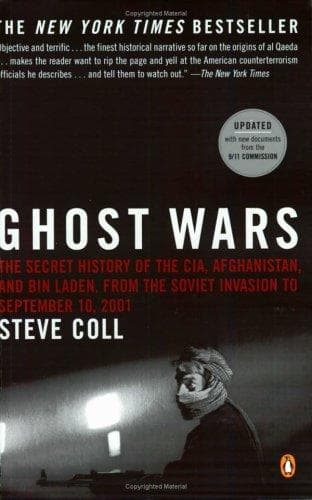
- Ghost Wars argues that the road to 9/11 was shaped by a long covert struggle in which the CIA, Pakistan’s ISI, Saudi intelligence, Afghan warlords, and Islamist militants repeatedly used one another for short-term advantage and then lost control of the forces they had empowered.
- Afghanistan is not presented as a side theater but as the central arena where Cold War covert action, post-Soviet abandonment, Pakistani proxy war, Saudi funding, and bin Laden’s rise converged.
- The book’s recurring thesis is that secrecy, liaison dependence, and strategic indifference produced a “war among ghosts”: hidden patrons, deniable clients, and elusive enemies that U.S. policy never fully understood.
How the Afghan Jihad Was Built
- Coll traces the story back to the late 1970s, when the Soviet-backed Afghan revolution, harsh modernization, and rural resistance led Moscow to invade in December 1979.
- The Carter administration’s first covert aid was tiny and indirect, but Brzezinski quickly saw the invasion as a chance to make the Soviets “pay a heavy price.”
- The anti-Soviet war became a CIA-ISI-Saudi alliance: the CIA provided money and weapons, Saudi Arabia matched U.S. funding dollar for dollar, and Pakistan controlled almost all access to the battlefield.
- Pakistan’s ISI insisted that no CIA officer cross into Afghanistan and used the war to strengthen its own regional agenda, especially support for Islamist clients such as Gulbuddin Hekmatyar.
- Saudi intelligence chief Prince Turki and aide Ahmed Badeeb were central, professionalizing Saudi intelligence while channeling cash, charities, and patronage into the jihad.
- The book emphasizes how blurry the line was between charity, religious activism, and intelligence work; bin Laden’s own early role emerged in that haze.
- Ahmad Shah Massoud is the great counterpoint: brilliant, disciplined, locally rooted, and militarily effective, but mistrusted by Pakistan and often undervalued by the CIA because he was not a pliable client.
- The anti-Soviet war escalated into an arms bazaar and then a political distortion machine, with Saudi, Pakistani, and American incentives favoring the most extreme and controllable factions.
From Soviet Withdrawal to Jihadist Blowback
- Once the Soviets left, Washington largely disengaged, even though the structures of Afghan warlordism and Islamist mobilization remained intact.
- CIA dependence on ISI meant that U.S. money often flowed through Pakistani channels that amplified extremists and marginalized figures like Massoud.
- The Stinger buyback program and later unilateral CIA support for Afghan commanders show the agency trying to repair the consequences of its own earlier indirectness.
- Bin Laden emerges from this environment as a Saudi patron and organizer who moves from anti-Soviet support work into global jihad after his break with Sudan and Saudi Arabia.
- His 1996 move to Afghanistan, then under Taliban expansion, gives him sanctuary and a stage for open anti-American declarations.
- Coll stresses that the Taliban were not simply a natural Afghan outcome; they were enabled by Pakistani strategic thinking, Saudi money, and the collapse of postwar Afghan order.
- The Taliban’s rise is explained as a reaction to chaos, predation, and civil war, but also as a product of Pakistani madrassas, Deobandi doctrine, and wartime patronage.
- The U.S. repeatedly misread the Taliban as potentially “moderate,” transitional, or useful for pipeline and trade politics, even as they hardened into a regime sheltering al Qaeda.
CIA, Counterterrorism, and the Failure to Connect the Dots
- The CIA’s Afghanistan presence shrank dramatically after the Cold War, leaving it without durable human intelligence or policy leverage just as bin Laden’s network expanded.
- Coll shows a pattern of fragmented U.S. counterterrorism: CIA, FBI, State, Pentagon, and White House often worked from different assumptions and legal authorities.
- The bin Laden Issue Station and later Cofer Black’s Counterterrorist Center represent a shift toward concentrated focus, but they still operated inside bureaucratic, legal, and diplomatic limits.
- The CIA’s best tools were often liaison relationships, tribal proxies, and technical surveillance, all of which were weak substitutes for true penetration.
- The agency repeatedly tried to build a capture, not kill posture, but the operational reality was always blurry and politically fraught.
- The 1998 Africa embassy bombings, the Zawhar Kili strike, and the al Shifa bombing show how hard it was to translate intelligence into decisive action without collateral damage, bad certainty, or diplomatic blowback.
- The Predator program is the book’s key technical turning point: it solved some problems of mobile-target surveillance but still left the U.S. uncertain about when to strike and what authority to use.
- Even by 2001, the White House had not settled the Afghan strategy; it wanted bin Laden pressure without fully committing to a broader Afghan war.
Massoud, the Northern Alliance, and the Final Missed Opportunity
- Massoud remains the main alternative to Taliban rule: militarily adaptive, politically cautious, and increasingly isolated yet still capable of rebuilding a resistance front.
- The CIA maintained a narrow relationship with Massoud focused on communications, intelligence, and battlefield access, while State repeatedly worried about wider political implications.
- Coll repeatedly contrasts Massoud’s broader view—that Taliban rule, ISI backing, Gulf money, and al Qaeda were one system—with Washington’s narrower fixation on bin Laden alone.
- The fall of Kabul to the Taliban, the Khost and Jalalabad battles, and later Northern Alliance setbacks show how Pakistani support and Islamist logistics shaped battlefield outcomes.
- By 2000–2001, CIA and White House officials finally accepted that Massoud was the only viable Afghan partner, but the support came too late and remained too limited.
- Massoud’s assassination on September 9, 2001, by operatives posing as journalists is the book’s brutal hinge: the one Afghan figure who could have complicated al Qaeda’s sanctuary was removed just before the attacks.
What To Take Away
- Ghost Wars is a history of how covert alliances can outlive the strategy that created them.
- The CIA did not “create” bin Laden alone, but the Afghan jihad’s patronage system helped produce the environment in which he could thrive.
- Pakistan’s ISI is not a background actor; it is a decisive co-author of the Afghan catastrophe.
- The book’s deepest warning is that when states prefer plausible deniability, they often get lasting blowback instead of control.
Generated with GPT-5.4 Mini · prompt 2026-05-11-v6