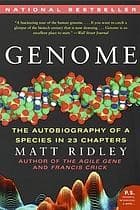
Core Idea
- Ridley treats the human genome as a historical autobiography: a digital record of how humans are built, how they evolved, and how biology works.
- His central claim is that genes are not a blueprint of destiny but an information system whose effects are mediated by development, environment, and evolutionary conflict.
- The book argues for genetic knowledge as broadly beneficial, while taking seriously the political and ethical risks of testing, selection, engineering, and insurance discrimination.
What the Genome Is, and Why It Matters
- The genome is framed as a book-like code of 23 chromosome pairs, where DNA letters, codons, genes, exons, and introns form a readable, copyable instruction set.
- Ridley emphasizes replication and transcription: complementary base pairing copies DNA, RNA splicing removes introns, and ribosomes translate genes into proteins that do most cellular work.
- He stresses that life is fundamentally information as much as chemistry, with errors, redundancy, and “junk” DNA all part of the system rather than signs of simplicity.
- Origin-of-life speculation centers on an RNA world, where RNA likely preceded DNA because it could both store information and catalyze reactions.
- The near-universality of the genetic code and the idea of Luca support one shared ancestry for all life, even if early evolution involved a gene-sharing community rather than neat species lines.
Genes, Traits, and the Limits of Simple Determinism
- Ridley repeatedly warns against the idea of one gene causing one trait; outside rare disorders, most traits arise from many genes plus environment.
- Mendelism reconciles Darwin with heredity by showing variation is particulate, not blended, and modern molecular genetics turns that into enzyme defects, repeat expansions, and protein changes.
- Huntington’s disease is his strongest example of genetic predestination: a CAG repeat on chromosome 4 gives near-perfect prediction of future illness, which raises hard questions about testing and knowing.
- By contrast, asthma shows complex, contested, multi-gene causation shaped by hygiene, parasites, pollution, housing, and immune miscalibration.
- Intelligence is treated as heritable but deeply tangled: IQ measures a real general factor, yet education, family history, womb effects, and self-selected environments also matter.
- Ridley rejects crude race-based extrapolations from IQ heritability and uses the Flynn effect to show that environments can raise scores substantially over time.
- He extends the same caution to personality: findings on novelty seeking, shyness, serotonin, and other traits suggest probabilistic genetic influence, not fixed essence.
Instinct, Language, Sex, Disease, and the Selfish Genome
- Chapter 7’s anchor is the language instinct: Ridley argues humans are born with a grammar capacity, not just the ability to learn vocabulary.
- Evidence comes from child overgeneralization, pidgins becoming creoles, Nicaraguan sign language, brain lateralization, aphasia, Williams syndrome, and specific language impairment.
- He places language within evolutionary psychology, arguing that universal mental machinery evolved by selection and that learning itself depends on innate constraints.
- The genome is also a battleground of selfish DNA: transposons, retroelements, minisatellites, and other sequences spread for their own replication and can both harm and illuminate biology.
- DNA fingerprinting, paternity studies, and sperm competition become examples of how genomic variation reveals hidden social and evolutionary processes.
- Ridley presents much human disease as an evolutionary tradeoff: ABO blood types, sickle-cell, thalassaemia, non-secretor status, and other polymorphisms persist because they balance protection against one threat with vulnerability to another.
- He extends this logic to MHC-based mate choice, suggesting that immune-gene differences may influence attraction and reproductive strategy.
- Sex itself is portrayed as a site of chromosomal conflict: X and Y can have competing interests, SRY determines maleness, and sex-specific evolution can produce arms races in behavior, reproduction, and even homosexuality.
- More broadly, Ridley thinks the body is a coalition of partly competing genetic interests rather than a perfectly unified machine.
Development, Aging, Cancer, Prions, and Engineering Life
- Ridley argues that stress changes biology through hormone cascades, especially cortisol, linking social rank, immune function, and cardiovascular risk in humans and monkeys.
- The same “genes plus environment” pattern reappears in personality and social behavior: neurotransmitters matter, but so do status, control, and feedback between social life and brain chemistry.
- Telomeres and telomerase explain one layer of cellular aging, but Ridley insists aging is mainly evolutionary “planned obsolescence”: selection weakens after reproduction, so late-life decline is only loosely constrained.
- Imprinting on chromosome 15 and related parental-conflict theories show that maternal and paternal genes can have different aims, especially in fetal growth and brain development.
- Learning and memory are tied to gene expression through cAMP, CREB, integrins, hippocampal systems, and synaptic remodeling; the brain is plastic, but that plasticity is itself genetically built.
- Apoptosis and TP53 are central to cancer: cells can self-destruct for the body’s sake, and tumors arise when growth-control and suicide pathways fail across multiple mutational hits.
- Ridley presents gene therapy, transgenic animals, cloning, and personalized medicine as technically plausible extensions of molecular genetics, though ethically and medically incomplete.
- The prion chapter shows that biology still exceeds the DNA model: misfolded proteins can transmit disease, as in scrapie, kuru, CJD, BSE, and new-variant CJD, through a self-amplifying chain reaction.
What To Take Away
- The book’s deepest claim is that genes are causal without being destiny: they build capacities, but those capacities unfold through development, environment, and evolution.
- Ridley’s recurring method is to use striking case studies—Huntington’s, asthma, language, prions, blood groups, telomeres—to show that simple gene stories are usually wrong, but genetic stories still matter.
- He is optimistic about genomics because it can clarify disease, ancestry, and human variation, while warning that the main dangers are coercive politics and bad institutions, not knowledge itself.
- The human genome, in his view, is less a code of fixed nature than a record of tradeoffs, conflicts, and historical accidents that together make a self.
Generated with GPT-5.4 Mini · prompt 2026-05-11-v6