Core Idea
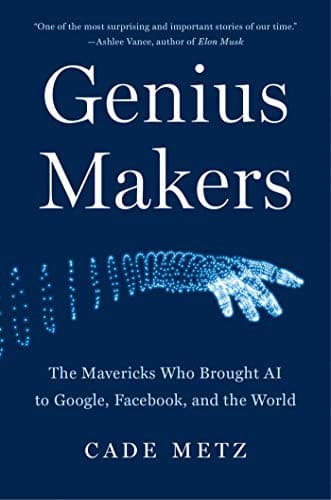
- Genius Makers traces how modern AI was rebuilt by a small group of contrarian researchers—especially Geoff Hinton, Yann LeCun, and Yoshua Bengio—who kept neural networks alive through decades when most of the field dismissed them.
- The book’s central story is not just technical progress, but the collision of deep learning with Big Tech scale: data, GPUs, cloud infrastructure, and later custom chips turned an academic idea into the engine behind speech, vision, translation, recommendations, and eventually surveillance, policing, and weapons.
- Metz treats AI as both a breakthrough story and a warning: the same systems that enabled dramatic gains also amplified bias, brittleness, opacity, misinformation, and military misuse.
How Deep Learning Won
- Early AI split into symbolic AI and connectionism; after the Perceptron backlash, most funding and prestige moved toward hand-coded rules rather than learned representations.
- Hinton’s work, inspired by Hebb’s “neurons that fire together, wire together,” helped revive neural nets through backpropagation, which made multilayer networks trainable and solved problems like exclusive-or that had defeated single-layer perceptrons.
- Hinton and Terry Sejnowski’s Boltzmann Machine pushed the idea further by letting networks learn from data and generate their own outputs, aiming at something closer to memory, imagination, and dreaming.
- The term deep learning became a rebranding and rallying point for multilayer neural networks after a long period in which the field was seen as obsolete or embarrassing.
- Yann LeCun made the case that neural nets could work in practice, especially in vision, with LeNet for handwritten digits and early hardware like ANNA.
- For years, neural nets were outcompeted in attention by methods like support vector machines, random forests, boosted trees, and statistical translation, and many researchers even avoided the word “neural.”
- The decisive shift came when deep learning scaled with labeled data, GPUs, and engineering discipline; the most famous proof was AlexNet, which crushed ImageNet competitors and made deep learning impossible to ignore.
- The book emphasizes that this victory was not a clean theoretical triumph but a kind of historical tipping point: evidence had accumulated for years, yet the field treated deep learning like a fringe idea until the results became overwhelming.
From Labs to Platforms
- Google’s and Microsoft’s early speech-recognition work showed how deep learning moved from theory to infrastructure: tiny prototypes built in MATLAB became vastly better when trained on GPUs instead of conventional hardware.
- Jeff Dean mattered as much as any researcher because he could marshal Google’s computing stack, and deep learning’s success depended on that level of organizational support.
- Google Brain’s famous “Cat Paper” showed both the promise and limits of unlabeled learning, but the real lesson was that deep nets became powerful when paired with vast labeled datasets and serious compute.
- Deep learning then spread across products: speech, search, photos, Gmail, AdWords, and translation, with RankBrain and other systems showing that neural nets could affect core business products.
- Google’s TPU represented the next step in the hardware-software race: a chip designed specifically for neural nets, linked to the larger strategy that TensorFlow would become the dominant ecosystem and pull work onto Google Cloud.
- In translation, sequence-to-sequence models and LSTMs showed that neural nets could represent whole sentences; once scaled, they beat Google’s earlier machine-translation system by a wide margin.
- The book repeatedly returns to the same mechanism: deep learning works best where there is abundant data, high compute, and a measurable objective, but it becomes shakier when the problem is open-ended or the feedback is indirect.
The Risks: Bias, Ethics, and Power
- As AI moved into the real world, the book stresses that data was not neutral: biased training sets produced biased outputs, and homogeneous engineering teams often failed to notice the problem.
- The Google Photos gorilla failure, biased face datasets at Clarifai, and Joy Buolamwini’s work on face analysis all show the same issue: systems trained on skewed data can perform dramatically worse on darker-skinned women and other underrepresented groups.
- Timnit Gebru and others argue that the AI field’s lack of diversity worsened these failures; her work helped create Black in AI and a broader critique of “groupthink, insularity and arrogance.”
- Metz treats face recognition as a key example of AI’s social consequences, because errors in this domain connect directly to hiring, lending, policing, surveillance, and other high-stakes uses.
- The book also shows how AI became entangled with the military: Project Maven at Google, Clarifai’s Pentagon-linked work, and concerns about drone targeting exposed the gap between engineers’ intentions and end uses.
- The Maven fight became a major internal revolt, with employee petitions, refusals to work on the project, and DeepMind staff joining the pushback; it showed that AI labs were no longer isolated technical groups but political actors inside global corporations.
- DeepMind’s agreement not to pursue military use and to create an ethics board reflected the field’s new self-consciousness, but the book suggests these safeguards were partial and contested.
- On social media, AI proved powerful but insufficient: Facebook could automate some moderation, yet still depended heavily on human contractors and struggled with context, abuse, and election interference.
What To Take Away
- The book’s hero narrative is really about persistence: Hinton, LeCun, Bengio, and their allies kept neural nets alive until the world’s data and compute finally caught up.
- Deep learning’s success came from a new marriage of algorithms, scale, and hardware, not from a single magic breakthrough.
- The same properties that made AI commercially dominant—massive data ingestion, pattern extraction, and black-box optimization—also made it hard to explain, easy to bias, and useful for surveillance or weapons.
- Metz’s larger warning is that AI is neither pure hype nor pure science fiction: it is a practical technology that keeps expanding into more domains, even where its limits remain visible.
Generated with GPT-5.4 Mini · prompt 2026-05-11-v6