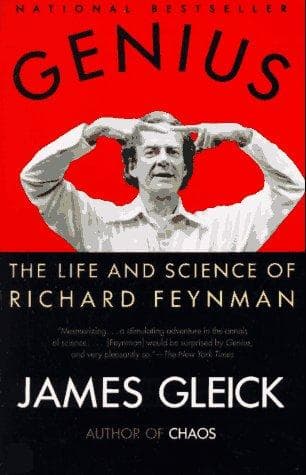
Core Idea
- Genius isn't innate—it's a work style: Deep curiosity, hands-on tinkering, ruthless questioning of authority, and relentless problem-solving produce original insights
- Feynman's method works across domains: The same principles that solved quantum mechanics also exposed O-ring fraud and mastered lock-picking
- Protect your time and integrity above all else: Say no to committees, honors, and administrative roles; say yes to problems others avoid
How to Think Like Feynman
Build Intuition First
- Learn by doing (radio repair, tinkering) before studying formalism—hands-on experience beats textbooks
- Distrust jargon and established authority; challenge explanations until you understand the mechanism, not just the name
- Use visualization and diagrams before equations; sketch mechanisms (vortex lines, particle collisions) to reveal what pure math obscures
- Reduce complex problems to their simplest form first (two springs before fields; atoms before taxonomies)
Create a Personal Toolkit
- Keep a "Notebook of Things I Don't Know" to identify gaps systematically
- Develop approximation methods and test them on known problems before deploying on unknowns
- Read primary sources selectively (or not at all)—reinventing wheels means you own them; understanding beats priority
When Stuck, Shift Context
- Give yourself permission to play with "useless" problems—pure curiosity breaks mental logjams
- Deliberately change environment or activity (spinning plates → new quantum insight) when blocked
- Embrace "semi-empirical shenanigans"—iterate through plausible approaches rather than waiting for perfect theory
How to Communicate and Teach
- Lead with formalism (silences critics), then translate to physical intuition for skeptics
- Explain without jargon—if you can't, you don't understand it
- Start physics education with observable phenomena (water, rainbows, clouds), not abstract definitions
- Make invisible problems visible through direct demonstration (ice water on O-rings)
- Avoid writing for peer approval; write to help people solve actual problems
How to Maintain Integrity
- Question assumptions relentlessly: When everyone accepts a "law," ask if it's actually been tested—parity conservation went untested for decades
- Name fraud and deception directly; refuse to participate in self-deception disguised as precision
- Challenge probabilistic hand-waving and multiplied guesses presented as certainty
- Accept unpopularity as evidence you're asking harder questions than consensus allows
How to Sustain a Creative Life
- Protect time fiercely: Refuse committees, honorary degrees, and "responsible positions"—administrative overhead kills originality
- Maintain beginner's mind across specialties; don't assume expertise transfers to new domains
- Stay alive by learning constantly across unrelated fields (physics, biology, lock-picking, samba)
- Face mortality without mythology—accept death as part of the process, not a tragedy demanding explanation
- Keep joy and intellectual play compatible with serious work; laughter isn't a distraction
Action Plan
- Pick one unfashionable problem nobody else is solving and spend 3 months on it without reading existing literature
- Build a "Don't Know" notebook and identify one mechanism you don't actually understand; diagram it before researching
- Say no to one administrative commitment this month—reclaim that time for focused work
- Explain one complex idea without jargon to someone outside your field; if you can't, you don't understand it
- Question one accepted assumption in your work—test it like Feynman tested parity conservation
Generated with Claude Sonnet 4.6 · prompt legacy-pre-v6 · model inferred from repository history