Core Idea
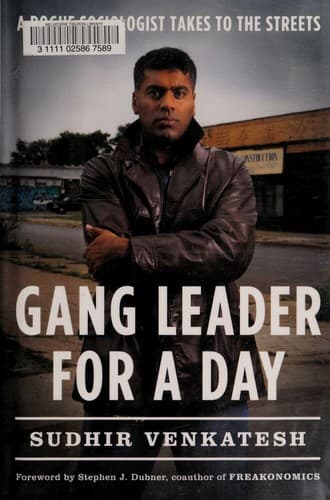
- Gang Leader for a Day is an ethnographic memoir about how Venkatesh learned to understand Chicago’s Robert Taylor Homes by “hanging out” with the Black Kings, especially leader J.T., instead of relying on surveys, abstract theory, or arm’s-length poverty research.
- The book’s central claim is that the projects were not simply a site of crime or decay; they were governed by overlapping systems of gang authority, tenant leadership, informal markets, police discretion, and mutual aid that together made daily life possible.
- Venkatesh also shows the moral cost of this knowledge: the deeper his access, the more he saw that his research could strengthen surveillance, taxation, and punishment inside the neighborhood he was studying.
How the Projects Actually Worked
- Venkatesh begins with his failed survey work and learns that his questionnaire questions—like “How does it feel to be black and poor?”—misread the world he wanted to study.
- J.T. rejects Venkatesh’s categories, insisting that the question is not racial abstraction but lived status, power, and survival; for him, “niggers” and “African Americans” are not the same social world.
- The Black Kings are run like a corporation: they have officers, lieutenants, a board of directors, rules, and a practical focus on money, territory, and risk management.
- J.T. frames crack dealing in business terms, weighing supply, security, and “the sure bet,” while Venkatesh sees that the gang’s public violence sits inside a more ordinary administrative routine.
- The gang functions as a de facto local government in Robert Taylor: it polices stairwells and lobbies, extracts “squatter tax,” manages prostitution, mediates disputes, and sponsors neighborhood events.
- Gang authority is not free-form chaos; it is enforced through punishments, inspections, informants, fees, and carefully managed fear.
- The beating of C-Note shows this clearly: J.T. uses violence not just to retaliate but to defend his authority in front of others, and Venkatesh realizes he has been too close to the gang to claim detachment.
- J.T. is not merely a street boss but a manager with obligations: he worries about friction, police pressure, product dilution, money laundering, and how to keep ambitious young members from destabilizing the business.
- Venkatesh’s “gang leader for a day” experience reveals the mundane work behind the street economy: assigning cleanup crews, settling disputes, handling storage space, and deciding punishments that preserve discipline without destroying revenue.
Tenants, Women, and the Neighborhood’s Informal Politics
- Ms. Mae and Ms. Bailey represent another layer of governance: tenant leaders who secure food, clothing, repairs, and emergency help by bargaining with stores, city agencies, gangs, and local allies.
- Ms. Bailey’s power comes from selective distribution and pragmatic deal-making; she insists on solving problems first and only then worrying about how the solution looks.
- The book repeatedly shows that survival depends on barter, favors, and “donations,” not clean lines between legal and illegal institutions.
- Venkatesh learns that women’s labor and women’s hustles are central to neighborhood life, even when male gangs dominate public space.
- Hustlers and sex workers are organized by local rules and hierarchies: “regulars” are more stable and strategic, while “hypes” are drug-driven and disruptive.
- Clarisse, Catrina, Cordella, and others show how women navigate abuse, children, rent, housing shortages, and the need for cash through a dense web of boarders, sex work, mutual aid, and institutional bargaining.
- The women’s stories make domestic violence and police unreliability impossible to ignore; formal protection is weak, and self-defense can escalate into further violence.
- Ms. Bailey’s enforcement can be brutal and arbitrary, but it also fills gaps left by the state, as when she mobilizes residents after assaults, secures replacement doors, or pressures officials to act.
Politics, Reform, and the Limits of “Community”
- The book treats gang politics as both cynical and sincere: J.T. wants legitimacy, helps with youth centers and voter drives, and talks about helping the community, but those efforts also protect drug sales and extend control.
- Community-based organizations, midnight basketball, and voter-registration drives appear as attempts to channel gang influence into civic form, yet they often look like machine politics, with gangs and tenant leaders trading money, favors, and control.
- Venkatesh’s strongest evidence for the gang’s economic logic comes from T-Bone’s ledgers, which show a low-margin, risky enterprise where even senior leaders make only modest incomes relative to the dangers.
- The ledgers and subsequent interviews reveal that the Black Kings’ business is fragmented by theft, bribes, police pressure, federal indictments, and the difficulty of expanding into already claimed neighborhoods.
- J.T.’s promotion opens access to high-level meetings and suburban respectability, but it also increases paranoia, federal exposure, and the need to look “legit.”
- Robert Taylor’s demolition is the decisive external pressure: residents face relocation, rumors, split-up families, and predation by brokers who want to profit from the upheaval.
- Venkatesh ends by showing that demolition does not simply “solve” the projects; it disperses residents into other poor neighborhoods and destroys a whole informal order that had governed life there.
What To Take Away
- The book’s deepest insight is that urban poverty is organized by interlocking informal systems, not by the absence of order.
- Venkatesh shows that gangs and tenant leaders can be simultaneously predatory, protective, and administratively necessary.
- He also shows that ethnographic access is never neutral: the researcher can become part of the field’s power structure and unintentionally change what he is describing.
- The title’s irony matters: “gang leader for a day” is less about empowerment than about how quickly one learns that leadership in the projects means balancing fear, money, legitimacy, and survival.
Generated with GPT-5.4 Mini · prompt 2026-05-11-v6