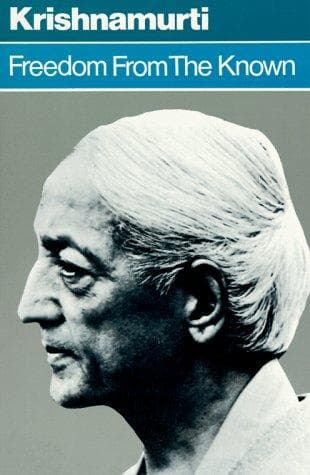
Core Idea
- The book’s central claim is that most human suffering comes from living through conditioning, authority, comparison, and thought instead of seeing life directly.
- Krishnamurti insists that truth has no path: no priest, tradition, ideology, system, or technique can lead to it.
- What is needed is not gradual self-improvement but a total psychological revolution in which the mind sees clearly enough for conflict, fear, and inner division to end.
Conditioning, Thought, and the Roots of Conflict
- Human beings become “secondhand people” when they live by inherited beliefs, rituals, labels, and respectability rather than direct discovery.
- Conditioning comes from nation, religion, class, education, family, culture, propaganda, climate, appetite, and experience, shaping response before conscious choice.
- This conditioning becomes most visible not in comfort but in disturbance: when desire is frustrated, fear appears, or life does not match expectation.
- Thought is necessary for practical life, but psychologically it is old because it is built from memory and time.
- When thought projects itself into past and future, it manufactures fear and sorrow.
- Krishnamurti argues that psychological time—the sense of becoming something later—is the engine of suffering.
- Comparison fragments the mind by making it measure itself against others or against an ideal, wasting energy in self-division.
- Desire is contradictory: it wants and resists at once, and this contradiction is a major source of conflict.
- The attempt to repeat pleasure turns a living moment into memory and continuity, which is why pleasure and pain are part of one process rather than simple opposites.
Seeing, the Observer, and Non-Fragmented Attention
- Krishnamurti’s method is really an anti-method: look directly, without authority, comparison, or the wish to become something else.
- Seeing is acting: when danger is perceived fully and immediately, action follows without inner debate.
- This matters especially for nationalism, fear, violence, and greed, which are not abstract problems but lived expressions of conditioning.
- Attention is not concentration; concentration excludes, while attention includes the whole field without choice.
- To understand the mind, one must observe thoughts, motives, and relationships without justification, condemnation, or the censor of ideals.
- Awareness means watching the whole field of consciousness—thoughts, hopes, pleasures, fears, dreams—without splitting it into superficial and hidden layers.
- A key insight is that the observer is the observed: the “me” that claims to watch fear or anger is itself made of the same memories, judgments, and reactions.
- When that inner division collapses, energy is no longer wasted in self-conflict, and fear and violence can end because the mind is no longer fighting itself.
- Krishnamurti treats humility as essential because the moment you conclude you know yourself, learning stops.
Love, Beauty, Silence, and Meditation
- Love is not possession, duty, jealousy, sentimentality, or dependence.
- Where there is fear, comparison, self-pity, or psychological reliance, Krishnamurti says there is no love.
- Beauty is inseparable from love and is not just in objects but in a mind free of the observer’s interference.
- Simplicity is not ascetic performance; it is looking at what is without fear, pretension, or self-image.
- Silence is not suppression of thought and not mere absorption in an activity.
- Silence comes when the mind understands its own movement and becomes empty of the known.
- Meditation is not a system, posture, mantra, or concentration technique.
- Meditation is choiceless awareness of thought and feeling until the meditator disappears.
- In that state the mind is “alone” in the sense of being free of social labels, psychological dependence, and accumulated memory.
What To Take Away
- The book’s radical wager is that freedom begins when the mind stops seeking security in the known—memory, authority, belief, and psychological habit.
- Krishnamurti’s deepest challenge is to see fear, anger, desire, or dependence completely and immediately, so the split between observer and observed ends.
- He rejects all spiritual shortcuts because any method that promises truth from outside only strengthens the conditioned mind.
- If the mind is freed from fragmentation, what remains is not a product of effort but energy, intelligence, love, and truth.
Generated with GPT-5.4 Mini · prompt 2026-05-11-v6