Core Idea
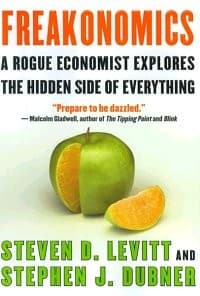
- Freakonomics argues that conventional wisdom is often wrong, and that seemingly disconnected events usually have hidden incentives, delayed causes, and information asymmetries behind them.
- The book’s method is to ask not “what seems to explain this?” but “what does the data actually show?”, even when the answer is surprising, politically uncomfortable, or morally charged.
- Levitt frames economics as a tool for measuring behavior, not just a study of money, and applies it to crime, parenting, cheating, discrimination, sex, naming, and everyday life.
Hidden Causes, Incentives, and Correlation vs. Causation
- A central theme is that correlation is not causation: more police and more murder can move together because crime creates demand for police, or because a third factor drives both.
- The book repeatedly shows that small incentives can change behavior, but not always in the intended direction; the Israeli day-care late-pickup fine increased lateness because it replaced guilt with a small fee.
- Levitt distinguishes economic, social, and moral incentives, and shows that paying for a “noble” act can weaken the moral reason to do it, as with blood donation.
- The book’s opening example of the 1990s crime drop argues that major social changes can have long lag times: Roe v. Wade is presented as reducing the future pool of high-risk children and helping explain the later fall in crime.
- A reverse example from Romania under Ceauşescu makes the same point: banning abortion doubled births quickly, and the resulting cohort later did worse in school, work, and crime, contributing to regime instability.
Crime, Policing, Guns, and the Abortion Hypothesis
- Levitt argues that the 1990s crime decline was real, broad, and unexpected, and that several popular explanations were only partial.
- Incarceration is treated as a major driver: harsher sentencing both deters crime and incapacitates offenders, and is estimated to explain about one-third of the decline.
- More police also mattered, with election-cycle hiring used as a quasi-random way to estimate effect size; police growth is credited with roughly 10% of the decline.
- New York’s crackdown under Bratton/Giuliani is described, but Levitt doubts it was the main national cause because the drop began before Giuliani and other cities fell similarly.
- Gun policy gets a skeptical treatment: guns matter, but many gun-control measures are weak against a black market, buybacks are mostly symbolic, and right-to-carry laws did not clearly reduce crime.
- The strongest and most controversial claim is that legalized abortion reduced crime by reducing the number of unwanted children born into high-risk environments; Levitt cites early declines in pre-Roe states and higher-1970s-abortion states having larger 1990s crime drops.
- He presents abortion as a selection effect, not a direct cause of crime reduction, and acknowledges the argument is morally explosive and likely to provoke revulsion.
Cheating, Information, and the Power of Data
- A large part of the book studies cheating as a rational response to incentives, from trivial theft to sophisticated fraud.
- Chicago public-school testing is used to detect likely teacher cheating by identifying impossible answer patterns, score spikes, and suspicious reversals; Levitt estimates cheating in more than 200 classrooms per year.
- The same data can also identify unusually effective teachers, showing how incentives can reveal both fraud and excellence.
- Sumo wrestling is another case where incentives create predictable cheating: 7–7 wrestlers on the final day won suspiciously often against 8–6 opponents, but not in later rematches, suggesting quid pro quo collusion.
- Paul Feldman’s bagel business provides a rare dataset on everyday honesty; payment rates were high but varied with office size, weather, holidays, and events like 9/11.
- The Ku Klux Klan is treated as an organization whose power depended on secrecy and information asymmetry; exposing its rituals and passwords weakened its mystique.
- The book contrasts that with the Internet, which shrinks information gaps in markets like term life insurance, funeral planning, and car buying.
- Corporate scandals like Enron and WorldCom are framed as “sins of information”: hiding facts is often easier than leaving a physical trail.
- Real-estate agents are a recurring example of incentive mismatch: they sell clients’ homes with less patience than their own, and ad-language analysis shows subtle wording differences that correlate with price.
People, Parenting, Names, and Social Signals
- Levitt argues that what parents are matters more than what parents do; many popular parenting strategies are overrated or unsupported.
- Large studies and adoption/twin evidence suggest that genes and background explain much of a child’s trajectory, while many common interventions—Head Start, museum trips, reading daily, spanking, TV rules—have weak or inconsistent links to early test scores.
- School choice is treated similarly: Chicago lottery winners did not outperform comparable losers overall, implying that much of the apparent benefit came from selection, not the schools themselves.
- The book emphasizes that bad schools matter, but mostly through the surrounding environment and peer effects rather than class size or computers.
- Names are treated as signals rather than destiny: black-sounding names rose after the early 1970s as a cultural marker, but names themselves mainly reflect parental context and class.
- Distinctive names can correlate with later outcomes, but Levitt stresses that the name is usually an indicator, not the cause.
What To Take Away
- Incentives matter, but they often work through unexpected channels and can backfire when they crowd out moral norms.
- Data beats intuition: many expert explanations fail once the numbers are examined carefully.
- Hidden structure matters more than surface stories: crime, cheating, prejudice, and market behavior often reflect incentives and information gaps rather than simple vice.
- The book’s lasting lesson is not that everything reduces to money, but that small changes in costs, risks, and information can reshape behavior in ways conventional wisdom misses.
Generated with GPT-5.4 Mini · prompt 2026-05-11-v6