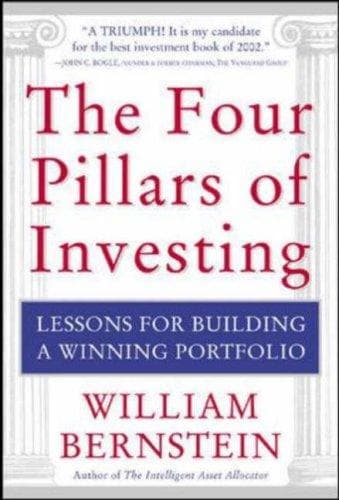
Core Idea
- Bernstein argues that sound investing rests on four pillars: Theory, History, Psychology, and Business; weakness in any one can wreck a plan.
- His central message is that investing is not a search for certainty or heroic skill, but a process of accepting risk for return, surviving your own mistakes, and minimizing what the financial industry takes from you.
- The book’s practical aim is to replace illusion with realism: most short-term market movement is noise, most active management is luck, and long-run success comes from broad diversification, low costs, and disciplined asset allocation.
How Markets Really Work
- In Bernstein’s discounted dividend model, a stock is worth the present value of its future cash flows; the Gordon Equation compresses this into a simple rule: long-term return equals dividend yield + dividend growth.
- The model’s usefulness is mainly diagnostic: it shows how higher discount rates, caused by greater risk, lower present value and expected return.
- This is why “good companies” can be bad stocks and “bad companies” can be good stocks: the market bids up safe, glamorous firms and leaves higher expected returns in riskier, unloved ones.
- He repeatedly stresses the difference between fundamental return and speculative return: dividends and growth drive long-term wealth, while changes in valuation multiples drive short-term price swings.
- Bernstein uses Black Monday and the tech bubble to argue that prices can move violently without any meaningful change in business value, proving that short-term forecasts are mostly guesswork.
- The historical record is used to puncture comforting myths: U.S. stocks looked spectacular over two centuries, but that return is distorted by survivorship bias, inflation, taxes, commissions, and the fact that real investors do not hold forever.
- Ancient and modern bond examples, from Greek bottomry loans to Venetian prestiti and British consols, show the same tradeoff: higher risk means higher yield, and inflation can devastate nominal bondholders.
- He distinguishes credit risk from interest-rate risk, and argues that long bonds are especially vulnerable when inflation rises or monetary regimes change.
- The 20th century was unusually brutal for bondholders because gold-linked discipline disappeared; Bernstein thinks future bond returns should be better, and credits TIPS with removing inflation risk from part of fixed income.
Why Investors Underperform
- Bernstein’s “Randomovia” parable says the average money manager cannot beat the market because managers as a group are the market; after fees, most lag.
- Cowles and Jensen’s studies, along with later fund research, support the same conclusion: many professionals may look good before costs, but expenses, loads, taxes, and turnover usually erase any edge.
- He treats persistent outperformance as rare and tiny; even top funds offer only weak evidence of repeatable skill, while survivorship bias makes the industry look better than it is.
- Asset bloat is a major hidden drag: once a fund gets big enough, market impact and liquidity constraints destroy the very advantage that made it successful.
- Market timing is presented as largely an illusion; strategists and newsletters tend to sound confident because they must sell forecasts, not because they can consistently make them.
- The Efficient Market Hypothesis in Bernstein’s telling is pragmatic rather than mystical: in a crowded market, obvious mispricings are rapidly arbitraged away.
- Berkshire Hathaway and Peter Lynch are acknowledged as real exceptions, but Bernstein treats them as rare outliers that do not overturn the general case.
- The industry’s business model is the problem: brokers, funds, and product sellers profit from commissions, spreads, loads, and complexity, not from improving investor outcomes.
- Vanguard and Jack Bogle matter because they changed the incentive structure, making low-cost indexing available through a mutual ownership model designed to serve shareholders.
Behavior, Allocation, and the Real Portfolio
- Behavioral finance explains why rational plans fail in practice: investors are overconfident, chase performance, hate losses, and are swayed by recent returns and social proof.
- Bernstein leans on Thaler, Kahneman, and Tversky to show that people systematically violate rational choice, especially through myopic loss aversion and base-rate neglect.
- The most damaging habit is performance chasing: the best-performing asset class or fund in one period is often close to the worst in the next, so recency is a poor guide.
- The right response is not prediction but asset allocation, which is the one major lever investors can actually control.
- Bernstein’s practical framework starts with the stock/bond split, because risk tolerance matters more than hoped-for return; if stocks and bonds are expected to be closer in return, all-stock portfolios become harder to justify.
- He then adds foreign stocks, arguing that global diversification can protect against domestic stagnation and slightly improve expected return, though it adds tracking error.
- He also allows size and value tilts, but only as modest additions: small and value stocks have historically offered higher expected returns, while growth stocks are often overpaid for.
- REITs and precious-metals stocks are optional diversifiers, but Bernstein emphasizes that their role is limited by tax treatment, volatility, and their own risks.
- Rebalancing matters both mathematically and psychologically: it forces the investor to sell winners, buy losers, and keep the portfolio aligned with policy weights.
- In retirement, sequence-of-returns risk is crucial: a bad market early in withdrawal years can do far more damage than the same average return spread over time.
- He repeatedly argues that the same market decline is good for a young accumulator and bad for a retiree, because contributions buy more shares while withdrawals magnify losses.
What To Take Away
- Diversification is not just about reducing volatility; it is protection against ruin, regret, and the unknown future.
- Costs are destiny in active management: expenses, taxes, spreads, and market impact reliably eat returns.
- History and psychology are as important as theory, because markets are social systems that can stay irrational far longer than investors can stay solvent.
- The book’s enduring rule is simple: own the market cheaply, keep expectations modest, and choose a portfolio you can actually hold through fear, euphoria, and boredom.
Generated with GPT-5.4 Mini · prompt 2026-05-11-v6