Core Idea
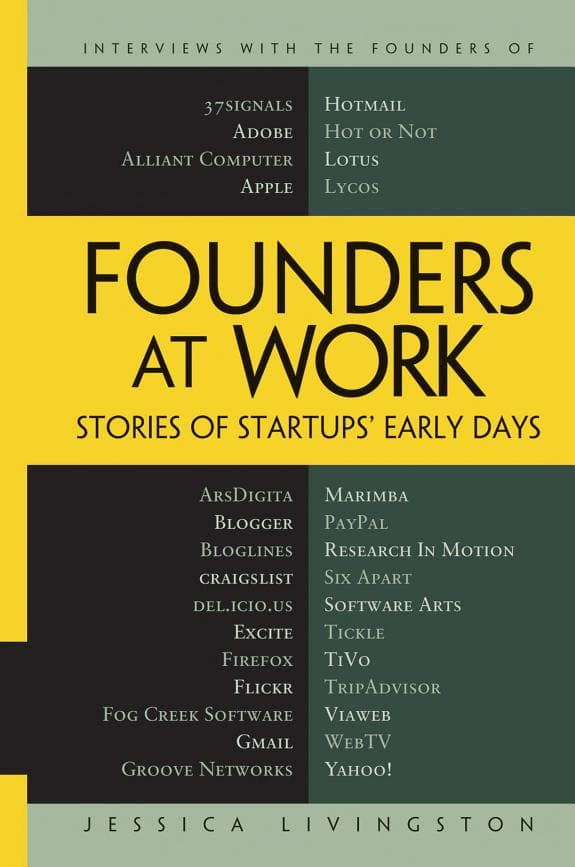
- Founders at Work argues that startups are most revealing in their earliest days, when a few people, little money, and a lot of uncertainty force real priorities into the open.
- Paul Graham’s foreword frames startups as the opposite of corporate performance: they waste less energy on appearances, and that stripped-down state can make them the economy’s most productive units.
- Jessica Livingston’s interviews aim to capture the founders’ actual early experiences—the accidents, pivots, near-failures, and doubts that are usually hidden once a company becomes famous.
What Startup Founding Really Looks Like
- A recurring pattern is that successful founders were often not confident or certain at the start; many began almost by accident and succeeded through determination rather than grand self-belief.
- Livingston treats perseverance as the key founder trait because early startup life is isolating, ambiguous, and full of rejection from investors, journalists, and established companies.
- Many landmark startups changed direction repeatedly: PayPal moved from crypto/security tools to payments, Hotmail came from a practical email problem, Flickr grew out of a game, and Blogger emerged from Pyra’s internal tools.
- Founders repeatedly describe ideas as things they discovered by solving their own problems and watching what users actually needed, not by following a fixed master plan.
- The book’s founders are usually motivated by more than money: they care about craftsmanship, control, pride in building something useful, and in many cases a desire to change the world.
- The interviews repeatedly show how startups are shaped by cofounder chemistry; strong pairs or small teams help founders survive crises, disputes, and investor pressure.
Repeated Mechanisms Behind Success
- The most common early mechanism is product-market fit discovered through iteration: founders start with a rough idea, listen to users, and pivot until demand becomes obvious.
- Many stories hinge on building something people can try immediately, whether that means a browser-based app, a free consumer service, or a demo that makes the value concrete.
- Several founders stress that a startup should solve a problem that is already painful and personal to the founder, because that makes the product easier to understand and improve.
- Growth often comes from a product’s built-in dynamics: Hotmail spread through outgoing-message branding, PayPal through network effects on eBay, Flickr through tagging and public sharing, and Yahoo through directory-style discovery.
- Technical constraints force important product choices: VisiCalc fit into tiny memory budgets, Gmail treated email as a reliability and storage problem, and Basecamp succeeded by staying simpler than heavyweight project tools.
- A strong theme is that startups often win by making something simpler, cheaper, or more usable than the incumbents’ solutions, not by being more impressive in a corporate sense.
- Several founders emphasize that the first version is often not the final business; PayPal, Hotmail, Viaweb, Marimba, Blogger, and others all pivoted materially before finding their lasting form.
- Many founders describe infrastructure and scale as existential challenges: fraud at PayPal, server load at Hotmail and Bloglines, bandwidth costs at Hot or Not, and reliability/data integrity at Gmail and Shareholder.com.
- The book also shows that execution often depends on a founder’s willingness to do unglamorous work—customer support, legal wrangling, fundraising, ops, hiring, and even furniture moving.
Culture, Money, and the Tradeoffs of Growth
- The interviews repeatedly contrast startup cultures with bureaucratic ones: founders like the speed of small teams, direct responsibility, and fewer layers of presentation.
- Less PowerPoints is one of the book’s recurring instincts: founders often believe culture scales best by preserving small, accountable units rather than corporate theater.
- Financing is shown as useful but dangerous: VCs can provide credibility, introductions, and money, but they also introduce pressure, power struggles, and the risk of losing control.
- Some founders, like Craig Newmark, David Heinemeier Hansson, and Joshua Schachter, deliberately resisted outside money or heavy monetization to preserve simplicity and values.
- Others learned that outside capital can accelerate learning but also distort incentives, as in conflicts over management, valuations, or product direction at companies like ArsDigita, Six Apart, and Tickle.
- The book repeatedly warns that business models are often unclear at the beginning; founders start with user value first and sort out monetization later, sometimes painfully.
- A number of founders stress that business plans are mostly communication tools, useful for thinking clearly and persuading others, but not reliable predictions.
- Several stories end with acquisition or IPO, but the founders rarely present exit as the core goal; more often, the exit is a consequence of building something that users want and larger companies want to buy.
What To Take Away
- The book’s main lesson is that startups are not polished mini-corporations; they are messy, fragile, and often irrational-looking until the product suddenly works.
- Success usually comes from combining technical insight, persistence, and responsiveness to users, not from charisma or a perfect original idea.
- Many of the biggest startup wins came from founders who solved a real problem for themselves, then kept iterating until the solution spread beyond them.
- Livingston’s interviews make startup founding feel less mythical by showing that even famous companies were built by people who were often uncertain, under-resourced, and learning as they went.
Generated with GPT-5.4 Mini · prompt 2026-05-11-v6