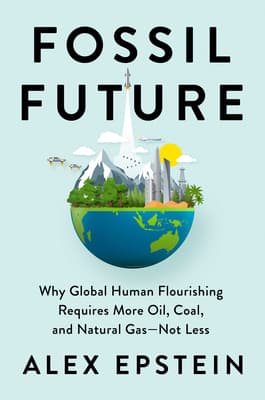
Core Idea
- Epstein argues that human flourishing, not “minimizing impact,” should be the standard for judging energy systems.
- His central claim is that the world still needs more fossil fuels, not less, because they remain the only source of ultra-cost-effective energy: low-cost, reliable, versatile, and globally scalable.
- He says the dominant climate debate is distorted by an anti-impact framework that treats human influence on nature as inherently bad and ignores the benefits of energy.
Epstein’s Framework: Flourishing vs. Anti-Impact
- Epstein contrasts the human flourishing framework with the anti-impact framework.
- The anti-impact view is often hidden behind phrases like “save the planet,” “protect the environment,” “green,” and “net zero,” which he says often really mean minimizing human impact rather than maximizing human welfare.
- He calls Earth not a delicate, already-optimal nurturer but a dynamic, deficient, and dangerous world that humans have improved through productive transformation.
- A key target of his critique is the delicate nurturer assumption: the idea that nature is generally safe until humans damage it, when he says nature is already dangerous and human development has made it safer.
Why Fossil Fuels Matter
- Fossil fuels power the “hydrocarbons and human flourishing hockey sticks”: as fossil fuel use rose, so did life expectancy, income, population, and overall livability.
- Their special value is that they provide machine labor, multiplying human labor and freeing people for mental labor such as science, engineering, medicine, and innovation.
- They also underpin modern materials and systems, including plastics, fertilizers, synthetic fabrics, medical supplies, infrastructure, water purification, sanitation, heating, cooling, and transportation.
- Epstein repeatedly stresses that billions still live in the unempowered world or barely empowered world, where access to abundant energy is not a luxury but a prerequisite for basic safety and development.
- He argues fossil-fueled systems make the environment safer and cleaner by enabling disease control, sturdy buildings, garbage systems, clean water, irrigation, and communication at scales manual labor cannot match.
Climate, Risk, and Energy Alternatives
- Epstein acknowledges that fossil fuels emit CO2 and that CO2 has caused warming, but says the relevant question is whether the side-effects outweigh the benefits and whether humans can master them.
- His concept of climate mastery is using energy-rich systems to reduce climate harms through heating, cooling, irrigation, storm warnings, evacuation, flood barriers, and resilient construction.
- He points to a 98% decline in climate-related disaster deaths over the last century as evidence that climate danger has become more manageable, not less.
- He argues the mainstream system—especially major media, the IPCC, and prominent advocates—often selectively emphasizes harms while omitting benefits such as greening, adaptation, and mastery.
- He says past experts also issued confident but wrong predictions about catastrophic warming, cooling, pollution, and resource depletion, which he uses to question the credibility of current alarmism.
- Solar and wind, in his account, are dilute and intermittent and therefore require extra land, materials, transmission, and backup, so they are not close substitutes for fossil fuels.
- He says claims about 100% renewable systems rely on partial cost accounting or even energy accounting fraud, because real grids still need fossil, nuclear, or hydro support.
- Biomass can work as residue or waste, but scaling it as a global fuel competes with food and land.
- Hydro and geothermal have real but limited potential; hydro is geographically constrained and often opposed, while geothermal is promising only in special locations for now.
- Nuclear is his most promising long-term alternative because it shares fossil fuels’ abundance and concentration, but he argues it has been crippled by regulation, fear of radiation, and anti-nuclear politics.
- He rejects CO2 capture as a near-term global fix because direct air capture and offsets are too expensive or too small relative to emissions.
Policy, Freedom, and How He Wants the Debate Framed
- Epstein’s policy rule is that government should restrict a side-effect only if it is demonstrably and significantly harmful and reasonably preventable without causing greater harm.
- He argues for energy freedom built on four freedoms: freedom to trade, freedom to develop, freedom to compete, and freedom from endangerment.
- He wants governments to remove subsidies and mandates for preferred “green” options and let cost-effectiveness determine winners.
- He ties energy progress to broader freedom: weak property rights, weak contracts, and anti-development ideology keep the unempowered world poor and energy-starved.
- His persuasion advice is to “reframe the conversation and argue to 100”: do not accept the premise that the goal is to eliminate CO2, but instead make human flourishing the positive goal and energy deprivation the negative pole.
- He criticizes fossil-fuel defenders who “argue to 0” by accepting the opponent’s moral frame and only disputing tactics, which he thinks leaves the anti-fossil-fuel side in control.
What To Take Away
- Epstein’s book is a defense of fossil fuels as the present-day basis of global human flourishing, not merely as an inconvenient necessity.
- Its distinctive move is moral: judge energy by whether it expands safety, prosperity, and opportunity, rather than by whether it reduces human impact on nature.
- The book’s empirical case is that modern life, disaster resilience, and environmental cleanliness have improved alongside fossil-fuel expansion and CO2 emissions.
- Its policy conclusion is not “use energy carefully” but expand energy freedom and let energy sources compete on real-world usefulness and cost-effectiveness.
Generated with GPT-5.4 Mini · prompt 2026-05-11-v6