Core Idea
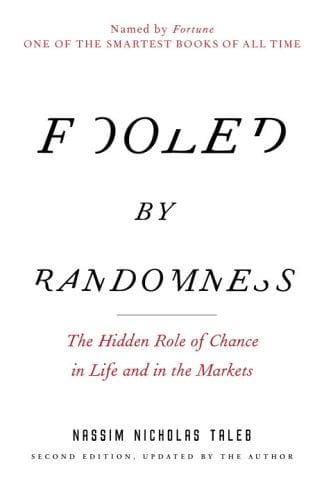
- Luck is routinely mistaken for skill, especially in markets, business, media, and other noisy environments where the winners are the most visible.
- Taleb’s central target is the human habit of reading determinism into randomness: we explain outcomes after the fact as if they were planned, predictable, or deserved.
- The book is less a finance manual than a study of uncertainty, skewness, survivorship, and epistemic humility—how to think when the hidden alternatives matter more than the observed result.
How Randomness Fools Us
- Taleb’s recurring contrast is between the real world and the simplified, deterministic world people imagine they inhabit; hindsight makes events look cleaner and more inevitable than they were.
- He treats probability not as a classroom calculation but as an applied skepticism: a way to reason under ignorance, missing alternatives, and unobserved histories.
- The key analytical move is to judge outcomes against alternative histories: a result only looks impressive if you ignore the many other sample paths that could have occurred.
- His Russian roulette example shows why a large gain can be meaningless if five out of six possible histories end in death; the distribution of possible lives matters more than the observed winner.
- Taleb uses Monte Carlo simulation to manufacture artificial histories and inspect how strategies survive across many sample paths, not just in the one that happened.
- He argues that markets are a laboratory for this problem because they reward people who confuse visibility with validity and survival with skill.
- The book repeatedly attacks hindsight bias, availability, and media-driven simplification: vivid risks feel larger than they are, while less dramatic but more important dangers get ignored.
- He also emphasizes nonstationarity and the peso problem: a long calm period can hide latent risk, so historical averages may stop being informative precisely when people become most confident.
- News is treated as especially toxic because it is high-frequency noise; Taleb prefers old ideas, old people, and long-tested patterns as filters against random error.
Traders, Skewness, and Blowups
- Nero Tulip, Carlos, and John are not just characters but case studies in how success can be manufactured by favorable randomness and then reversed by a hidden tail event.
- Nero survives because he trades conservatively, keeps losses small, avoids ruin, and values longevity over maximization; his modest wealth reflects survival, not inferiority.
- John and Carlos look richer and more impressive during favorable cycles, but their styles embed blowup risk: leverage, averaging down, denial of stop losses, and overconfidence in one’s own models.
- Taleb’s distinction between loss and blowup is crucial: a trader can be wrong many times and still live, but once the downside forces exit from the game, the career is over.
- A recurring warning is that markets select for the people who fit the latest regime, so the richest visible traders at a given moment may be the least robust in the long run.
- Taleb stresses skewness and asymmetric payoffs: strategies should be evaluated by the size and shape of gains and losses, not by win rate alone.
- This is why he keeps returning to options: they often lose small amounts frequently but can protect against ruin or exploit rare large moves.
- He is skeptical of people who obsess over the bottom line while ignoring the hidden path that produced it; the proper unit of analysis is the full set of possible outcomes, including unobserved failures.
How Humans Reason Poorly About Probability
- Chapter 11 is the book’s most explicit account of probability blindness: the mind struggles to represent weighted mixtures and instead prefers single vivid outcomes.
- People can hear “72% five-year survival” yet mentally hear only “not dead,” not “28% dead”; the same distortion appears in medical testing, consumer framing, and financial judgments.
- Taleb draws on Herbert Simon’s satisficing, but pushes further: human thinking is not simply imperfect optimization, it is often a different kind of process altogether.
- Kahneman and Tversky are central because they documented systematic heuristics and biases that persist even when incentives are present.
- The book highlights the gap between System 1 and System 2: fast, automatic, emotional judgment often outruns slow, abstract, self-aware reasoning.
- Anchoring, representativeness, availability, simulation, and affect all distort estimates by making one state of the world feel more salient than its statistical weight.
- Taleb is especially interested in conditional probability and joint probability, where common intuitive answers are often wrong because people ignore base rates and multiplicative structure.
- His test-case medical example shows how a rare disease with a positive test can still imply a much smaller chance of illness than intuition suggests.
- He also notes that option sellers and other steady earners can look safer than they are because their risk is concentrated in rare but catastrophic tail events.
What To Take Away
- Observed success is not proof of skill unless you compare it against the unobserved alternatives that randomness erased.
- Survival is a signal: many apparent winners are simply people or strategies that avoided ruin long enough to look intelligent.
- Skew matters more than average in many real systems; a high win rate can still be a terrible bet if rare losses are large enough.
- The book’s lasting warning is epistemic and moral at once: be skeptical of neat stories, respect hidden risk, and judge performance by the distribution of possible outcomes, not by the winner you happened to see.
Generated with GPT-5.4 Mini · prompt 2026-05-11-v6