Core Idea
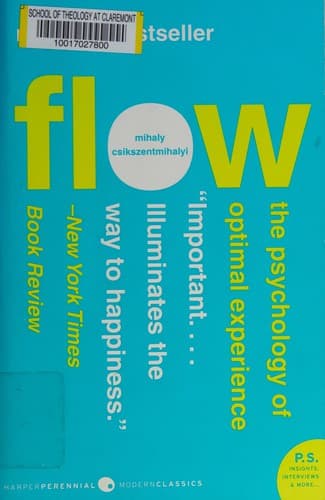
- Flow is the state of optimal experience: complete absorption in an activity that is challenging, structured, and meaningful enough that it becomes worth doing for its own sake.
- Csikszentmihalyi argues that happiness is not primarily produced by wealth, power, or comfort, but by how we organize consciousness and invest psychic energy in the stream of experience itself.
- The book’s stakes are existential: modern life often expands material comfort while leaving people vulnerable to anxiety, boredom, and meaninglessness unless they learn to create order inside experience.
How Flow Works
- Flow emerges when challenge and skill are balanced near the edge of boredom and anxiety, so attention is fully engaged without being overwhelmed.
- Its classic features are clear goals, immediate feedback, concentration, control, loss of self-consciousness, altered sense of time, and deep involvement.
- Flow is not passive relaxation; it usually comes from stretching skills in activities like art, sport, surgery, work, conversation, or even thought.
- The opposite of flow is psychic entropy: consciousness becomes disordered when information conflicts with goals or scatters attention.
- The self is strengthened by flow because attention becomes ordered around a chosen aim; the author repeatedly contrasts pleasure with enjoyment, where enjoyment implies growth, complexity, and effort.
- Flow can also become addictive if a person becomes dependent on one kind of control or order and loses flexibility.
Activities, Cultures, and the Making of an Autotelic Self
- Flow is easier in structured activities that have rules, goals, feedback, and opportunities for control; Csikszentmihalyi uses Caillois’s four game forms: agon (competition), alea (chance), ilinx (vertigo), and mimicry (role-play).
- Competitive activities only remain enjoyable when attention stays on the task itself; if the aim shifts to beating others, impressing audiences, or winning contracts, flow is interrupted.
- The book insists that flow is not limited to elite leisure: it appears in ordinary work, parenting, walking, reading, cooking, music, and conversation when these are taken up as skill-based challenges.
- Human cultures have always built flow-rich forms—art, ritual, dance, music, games—and the quality of a culture can be judged by how much optimal experience it enables, not by its official values.
- But flow-rich cultures are not automatically moral: the same attention-shaping power can support Sparta, fascism, or other destructive “great games.”
- Individual differences matter: the autotelic personality can transform ordinary or harsh conditions into flow by finding opportunities for action and setting self-chosen goals.
- The family can foster this personality when it provides clarity, centering, choice, commitment, and challenge; poor family conditions trap psychic energy in self-protection or conformity.
- Severe adversity does not eliminate flow; disabled people, prisoners, exiles, and the poor sometimes build meaningful lives by redefining limits as challenges and using imagination, discipline, and tiny goals.
Work, Solitude, Relationships, and Symbolic Skills
- Work is often more flow-friendly than leisure because it usually contains built-in goals, feedback, rules, and challenge, while leisure is frequently unstructured and therefore apathetic.
- ESM data cited in the book show people reporting flow on 54% of work signals versus 18% of leisure signals, even though culturally they still prefer more free time.
- Some jobs become flow through mastery and redesign: the book’s examples include Joe Kramer the welder, Ting the cook, surgeons, weavers, and village laborers whose work is meaningful because it is skillful, visible, and self-structured.
- Solitude is a major test: without external tasks or feedback, many people fall into worry, TV, drugs, or compulsive distraction, but a disciplined person can turn solitude into a source of complexity.
- Family and friendship are both flow domains when they combine shared goals, open communication, differentiation, and integration; they fail when they become mere dependency, validation, or role-playing.
- The broader community can also be an arena of flow, especially when people invest energy in ethnic, civic, national, or political purposes that genuinely improve conditions for others.
- A major thread in the book is the cultivation of symbolic skills—memory, words, conversation, poetry, history, science, philosophy—because thinking itself can become an intrinsically rewarding flow activity.
- The author rejects reductive explanations that treat all motivation as disguised pleasure-seeking or sublimated sex/aggression; he argues that humans discover new rewards by extending skills into new domains.
- The practical implication is not a formula for happiness but a discipline of attention: a life becomes good when one learns to control consciousness, create meaningful challenges, and keep experience from collapsing into entropy.
What To Take Away
- Flow is Csikszentmihalyi’s name for the best form of experience: ordered, absorbing, skillful involvement that makes life feel worth living.
- The central problem is not lack of material goods but lack of inner order, because attention can be captured by boredom, anxiety, or passive consumption.
- The book’s most important distinction is between external rewards and autotelic enjoyment: the latter comes from self-chosen challenges that build a stronger, more complex self.
- Its enduring claim is that happiness is less something we chase than something that ensues when consciousness is disciplined, engaged, and actively shaped.
Generated with GPT-5.4 Mini · prompt 2026-05-11-v6