Core Idea
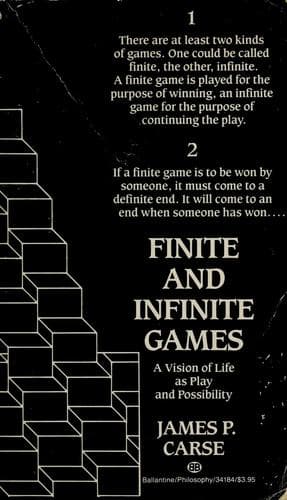
- Carse’s central distinction is between finite games, played for the purpose of winning, and infinite games, played for the purpose of continuing play.
- Finite games depend on fixed boundaries, agreed rules, and recognized winners; infinite games refuse closure and treat every ending, limit, or loss as something to be taken into play.
- The book’s larger claim is that much of society, politics, and power is organized as finite play, while culture, creativity, and freedom belong to infinite play.
Finite Play: Winning, Titles, and Closure
- Finite games are marked by temporal, spatial, and numerical boundaries: a set time, a set place, and a defined set of players.
- Their rules are externally fixed, published before play, and cannot legitimately change during the game; victory exists only because the players accept those rules.
- Finite players seek to become Master Players, foreseeing and controlling the whole field, so that surprise becomes a threat rather than a gift.
- What finite players win are titles, not living names: titles memorialize past victory, require public recognition, and depend on emblems, inheritance, and social validation.
- Finite “death” is not just bodily death but the end of one’s status as a player, because no further play, recognition, or title is possible.
- Carse treats power as finite and comparative: it is measured within closed fields and becomes visible only after others defer to the winner.
- He also argues that finite play tends toward theatricality, seriousness, and scripted outcomes, with players identifying so completely with roles that they veil their own freedom.
Infinite Play: Playfulness, Surprise, and Shared History
- Infinite games have no fixed beginning or end, no rigid membership, and no final winner; anyone who wishes may enter, and play continues only if it keeps opening.
- Infinite rules are not fixed laws but more like the grammar of a living language: they must change when needed to keep play alive and prevent closure.
- Infinite players do not deny limits such as fatigue, hostility, or death; they take them into play rather than treating them as absolute barriers.
- Instead of seriousness, infinite play depends on playfulness: roles are worn as masks, but never mistaken for the whole person.
- Infinite players are not trained into a completed past but educated into an unfinished one, so surprise is expected rather than feared.
- Their aim is not dominance but strength, understood as the capacity to let others do what they wish within a shared game.
- Infinite players may die, but they do so in the course of play, choosing mortality so that play can remain open for others.
- Carse’s paradox is that infinite players continue only by allowing others to continue, becoming least necessary when they play best.
Society, Culture, Myth, and Violence
- Carse’s sharpest social contrast is that society is a finite game, while culture is an infinite game.
- Society is bounded, ranked, proprietary, patriotic, and built on self-forgetting; culture is unbounded, horizonal, and renewed through deviation, making, and reinterpretation.
- Property is theatrical in this framework: it displays ownership, stores past victories, and converts social relations into visible signs of rank.
- Poiesis names creative making that invites further making; societies try to domesticate it through museums, patronage, propaganda, and national culture.
- Poietai—artists, poets, storytellers, original thinkers—are central because they can expose society as cultural and keep culture from hardening into property.
- Patriotism is treated as belligerent because it tries to contain all other finite games within one boundary.
- Carse’s ethical line is drawn at evil: evil is not competition within rules but the termination of infinite play, the silencing of other cultures, languages, and futures.
- He contrasts machine and garden: machines are driven from without and train operators into control, while gardens grow from within and preserve spontaneity.
- Modern technology can become especially dangerous when it disappears into invisibility, making control feel effortless; modern weapons intensify this by enabling unseeing killing.
- The alternative to machine culture is gardening, travel as self-change, and seeing nature as spontaneous rather than as merely resource or order.
Myth, Story, and Resonance
- In the second half of the book, Carse treats myth as the deep form of story that provokes explanation but is never exhausted by it.
- A story becomes myth when it is retold for its own sake and begins to resonate in listeners so that they become narrators rather than mere observers.
- His strongest claim here is that if we cannot tell a story about what happened to us, then nothing has happened to us in any meaningful sense.
- Myths do not merely have meanings; they give meanings, and they make both individual and collective experience possible.
- He treats the Torah, Oedipus, Abraham, the Buddha, and Jesus as examples of stories that structure listening, culture, and historical consciousness.
- Myth works by resonance, not amplification: a choir or bell resonates, while a loudspeaker or cannon amplifies by silencing other voices.
- Ideology is the amplification of myth, claiming to know history’s beginning and end and thereby shutting down further conversation.
- Sacred and enduring texts are heard as if authorless or only partly authored, because myth survives by becoming language that enters history and history that enters language.
- The deepest form of myth is listening itself: speech becomes infinite when it is address rather than command, and when it makes room for response instead of obedience.
What To Take Away
- The book’s governing lens is that winning and continuation are different purposes, and confusing them distorts politics, culture, and self-understanding.
- Finite systems depend on titles, boundaries, and closure; infinite life depends on openness, surprise, and the willingness to let one’s own roles remain provisional.
- Carse sees the gravest danger not as ordinary conflict but as any force that ends play altogether by silencing other voices and futures.
- His deepest alternative is not anti-institutional rebellion but a way of being that keeps history unfinished: playful, resonant, and open to others.
Generated with GPT-5.4 Mini · prompt 2026-05-11-v6