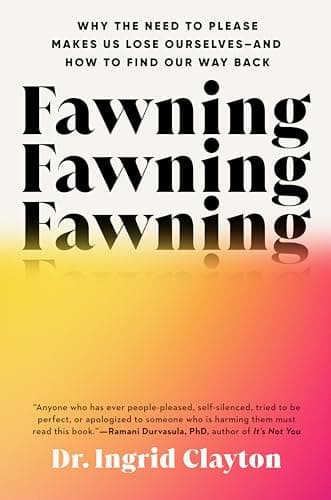
Core Idea
- Fawning is Clayton’s “fourth F” trauma response: when fight, flight, and freeze are unavailable, the body moves toward safety by becoming more appealing to the threat.
- Its core logic is “connection is protection”: especially in dependent or predatory relationships, appeasing, merging, and self-silencing can be the only workable survival strategy.
- The cost is self-abandonment: fawning can look like niceness, competence, caregiving, or success while quietly erasing needs, boundaries, values, and authentic voice.
How Fawning Works
- Clayton treats fawning as a body-based, rapid survival response, not conscious manipulation or a personality flaw; it often combines hypervigilant tracking of others with shutdown from one’s own self.
- The book repeatedly emphasizes the double bind: the person is told to be themselves, but also to be pleasing, compliant, productive, and non-disruptive.
- Fawning often produces shame because survivors later believe they “participated” in their own harm or should have done more to stop it.
- Clayton distinguishes fawning from codependency and generic people-pleasing by arguing that those labels describe behavior, but not the trauma-driven reason the behavior formed.
- The book places fawning in the context of complex trauma: repeated interpersonal threat, not a single event, often normalized inside families and cultures.
- Clayton links common problems such as anxiety, depression, addiction, disordered eating, and boundary trouble to this trauma pattern.
- Her opening personal example with stepfather Randy shows how grooming and coercive danger can feel “soft” on the surface while the body knows something is wrong.
- Her own healing began only after years of trying to “fix” herself through sobriety, therapy, yoga, and self-help, and then finding Pete Walker’s definition of fawning.
Where Fawning Is Learned and Rewarded
- Clayton argues that fawning is not just individual pathology but a response rewarded by power structures that punish dissent and reward compliance.
- Patriarchy trains women to manage others’ comfort and trains boys and men to hide feeling, both of which can produce self-betrayal.
- Racism shapes fawning through code-switching, masking, and the protective use of “cool,” especially when open expression can be dangerous.
- Family systems are central: children learn that love may depend on adapting to dysregulated, abusive, neglectful, or narcissistic caregivers.
- The book also names gaslighting, self-gaslighting, toxic positivity, and spiritual bypassing as forces that intensify fawning by making harm seem unreasonable to question.
- Clayton’s “double bind” chapter shows how impossible choices keep survivors stuck, including her own conflict between choosing herself and meeting her mother’s caretaking needs.
- She uses examples like Anthony, Francis, Sadie, Lily, Davis, Mia, Grace, and her own story to show that fawning can appear as elite success, overfunctioning, sexual compliance, self-erasure, or chronic validation-seeking.
Trauma Bonds, Sexual Fawning, and Reenactment
- Clayton argues that fawning can become a bodyguard state that keeps running even when danger is absent, which is why it can also recreate abuse.
- Trauma reenactment means the brain translates present relationships through old danger, leading people toward unavailable, hot-and-cold, or addictive partners.
- Trauma bonding is described as intermittent reinforcement: abuse and relief alternate until the victim confuses fear, attention, and dependence with love.
- She names tactics such as gaslighting, love bombing, future faking, and hoovering as engines of these bonds.
- The book treats sexual fawning as especially fraught: sex can become currency, appeasement, or a way to secure relief, belonging, or protection rather than an expression of desire.
- Clayton’s examples include faking orgasms, tolerating pain, having sex without protection, and treating sex as something needed “like oxygen” to keep connection alive.
- She argues that the deeper issue is not a “broken picker” but unresolved relational trauma; fixing symptoms without addressing trauma just repeats the loop.
- Worth injury is another recurring theme: over-achievement, under-achievement, money struggles, and external validation all become ways of trying to solve a felt lack of value.
What Healing Looks Like
- Unfawning is not a finish line but a process of reclaiming self-trust, flexibility, and choice.
- The first move is often bottom-up: orienting to the present, using resourcing, making space, noticing triggers and nudge-like cues, and letting the body register safety enough to think clearly.
- Clayton names several trauma therapies as useful in different ways: Somatic Experiencing to complete unfinished survival responses, IFS to relate to parts without shaming them, EMDR to shift entrenched beliefs, and cautious, trauma-informed use of meds or psychedelics.
- Grief is part of healing because survivors must mourn masks, lost time, unmet needs, and fantasies that an abuser will finally validate the harm.
- Reparenting means becoming the safe adult one needed: validating the child self, meeting needs, and replacing “Are you my mother?” with internal care.
- Clayton repeatedly stresses that a safe relationship with one trustworthy person can be transformative, but it does not require pretending unsafe relationships are safe.
- Safe relationships are defined by mutual responsibility and the ability to tolerate truth, not by perfect harmony or constant transparency.
- Anger is rehabilitated as useful and necessary: it can restore agency, clarify “I’m not okay,” and mobilize boundaries, even though many fawners were taught to fear it.
- Boundaries are less about perfect wording than about stopping overfunctioning, stating what you will and won’t accommodate, and accepting that others may not like it.
- Clayton is explicit that boundaries do not control other people; they reveal information about whether a relationship can meet you.
- She also insists on accountability: fawning can harm others too, so unfawning includes repairing ruptures rather than just self-soothing.
What To Take Away
- Fawning is a sophisticated survival adaptation, not a character defect, but it becomes costly when it hardens into a life strategy.
- The book’s central move is from appeasing to authentic agency: feeling anger, naming truth, taking up space, and choosing relationships that can survive the real self.
- Healing is shown as both internal and relational: body-based regulation matters, but so do boundaries, rupture-and-repair, and leaving relationships that cannot become safe.
- Clayton’s deepest claim is that survivors do not need to become “perfectly healed”; they need more room to choose, more access to themselves, and less shame about how they survived.
Generated with GPT-5.4 Mini · prompt 2026-05-11-v6