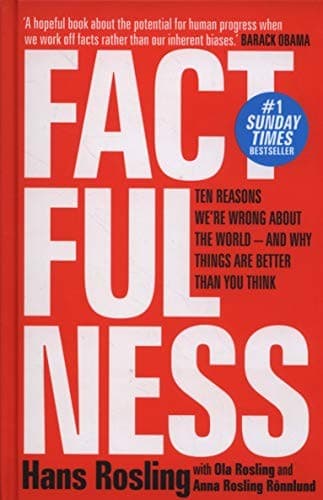
Core Idea
- Rosling argues that most people, including experts, carry an overdramatic worldview that is systematically wrong, not because they are stupid, but because human instincts distort how we read data.
- Factfulness means replacing drama-driven assumptions with a calm, evidence-based worldview that is neither naive optimism nor cynicism.
- The book’s stakes are practical: bad global instincts lead to poor decisions in business, policy, aid, health, and everyday judgment.
The 10 Instincts That Distort Reality
- The gap instinct makes us split the world into two boxes, but Rosling says income, health, and living conditions are usually a smooth range, not a binary “us and them.”
- He replaces the old rich/poor divide with four income levels: Level 1 is extreme poverty, Level 2 is fragile improvement, Level 3 is stable middle-income life, and Level 4 is wealthy consumer life.
- Most of humanity is in the middle two levels, so seeing the world only as “developed vs developing” is a major error.
- Rosling warns that gap stories are often signaled by averages, extremes, and “the view from up here,” where Level 4 observers flatten crucial differences below them.
- The negativity instinct makes the world seem like it is getting worse, because bad news is more visible and dramatic than slow improvement.
- Rosling’s response is possibilism: acknowledge real problems while recognizing measurable progress, such as falling extreme poverty, rising life expectancy, declining child mortality, and fewer deaths from disasters and war.
- The straight line instinct makes people assume trends continue in the same way, when many important trends follow S-curves, humps, or doubling patterns.
- He stresses this with population: the world is not headed for infinite growth, because births have already leveled off and population is likely to flatten around 10–12 billion by century’s end.
- He links fertility decline to escaping extreme poverty, girls’ education, and access to contraception and sexual education, not to punishment or collapse.
- The fear instinct magnifies threats by focusing attention on dramatic dangers, so people overestimate risks like war, terrorism, contamination, and disaster.
- Rosling contrasts fear-driven perception with evidence: natural disaster deaths, aviation risk, and war deaths have all fallen dramatically, even though the news keeps the worst cases vivid.
- The size instinct makes people misjudge lonely numbers, totals, and identifiable victims, so Rosling insists on dividing by totals and comparing per-person rates.
- He uses examples like hospital deaths versus community deaths, CO2 totals versus per-capita emissions, and falling child mortality rates despite rising absolute numbers of births.
- The generalization instinct is necessary for thought but dangerous when categories are treated as reality itself; countries, groups, and cultures vary more within than many people assume.
- His core method is to question categories, look for within-group differences, cross-group similarities, and beware of treating one group’s experience as normal.
- The destiny instinct assumes people, countries, and cultures are fixed by innate traits, but Rosling argues societies change steadily, even when the change is slow enough to miss.
- He uses examples such as fast fertility decline in Iran, social change in Sweden, and shifting views on same-sex marriage to show that values are not permanent.
- The single perspective instinct narrows judgment to one lens, whether Western, national, class-based, or professional, and Rosling counters it with global comparisons and images from Dollar Street.
- The blame instinct pushes people to seek a villain instead of a system, but Rosling repeatedly points to interconnected causes and cumulative progress rather than simple heroes and enemies.
- The urgency instinct makes people act before thinking; his antidote is to slow down, check the numbers, and ask what evidence would change your mind.
How Rosling Wants You to See the World
- Rosling treats global misconceptions as optical illusions: the facts are there, but the brain misreads them through evolved instincts tuned for small-group survival, not a modern, connected world.
- He calls his approach data as therapy, because accurate numbers can reduce anxiety and improve decisions without requiring cheerfulness.
- Business is a major use case: executives who assume the world is mostly poor or permanently fixed miss the growth of middle-income consumers and misread markets.
- He highlights the growing importance of Level 3 consumers and the need for products that fit the realities of people who are moving upward, not just rich niche markets.
- Dollar Street, Anna Rosling Rönnlund’s project, is his visual antidote to stereotypes: households are lined up by income, showing that income often predicts daily life better than nationality or religion.
- The photos reveal ordinary similarities across countries at similar income levels, from toothbrushes and toilets to food storage, roofs, and electricity.
- Rosling also attacks lazy global labels like “Africa” or “developing countries,” which flatten huge variation and hide the real distribution of living conditions.
- His broader claim is that slow change is still change: even small annual improvements compound into major transformation over decades, so history is often moving faster than it feels.
What To Take Away
- The world is not split into two camps, and most people are not where stereotype-driven maps place them.
- Good judgment requires checking whether a scary or hopeful story is supported by rates, totals, per-person comparisons, and long-term trends.
- Many “fixed” realities—fertility, education, health, social norms, and even national trajectories—are more changeable than instinct suggests.
- Factfulness is Rosling’s discipline of resisting drama and using evidence to see both the world’s remaining problems and its real progress.
Generated with GPT-5.4 Mini · prompt 2026-05-11-v6