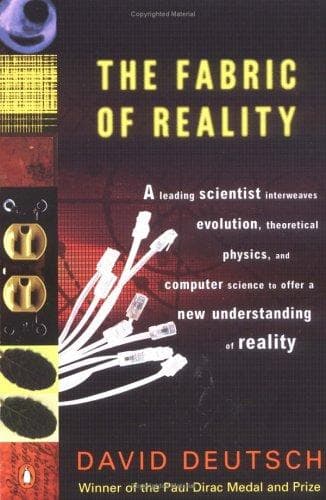
Core Idea
- Deutsch argues that science should aim not just to predict, but to explain reality, and that deep theories should be used to build a coherent world-view rather than treated as mere instruments.
- The book’s central thesis is that four strands—quantum theory, the theory of computation, evolution, and epistemology—fit together into a single explanatory framework that may be the first real Theory of Everything.
- His recurring contrast is between understanding and mere prediction, description, or data accumulation: one good explanation can subsume vast numbers of facts.
How Reality Is Structured
- Deutsch rejects instrumentalism, positivism, and reductionism as distortions of scientific explanation; prediction is useful, but it is not the point of science.
- He uses general relativity as the model of explanation: it does not just predict planetary motion, it explains gravity as curved spacetime.
- Real explanations often invoke unobserved entities and emergent levels—atoms, laws, past and future states, life, minds, computers—because these are part of reality, not fiction.
- He argues that higher-level phenomena are not merely shorthand for lower-level physics; emergence is real, and many explanations run “upward” as well as downward.
- The deepest theories are not necessarily the most microscopic ones: physics is important, but its role in the structure of knowledge is more modest than reductionists claim.
- Deutsch’s broader Theory of Everything means one framework that unifies all known explanations, not just a particle-physics theory that predicts everything in principle.
Quantum Theory, Multiverse, and Computation
- Quantum theory is introduced through interference: single photons produce patterns that cannot be explained by splitting, collisions, or classical paths.
- Deutsch’s distinctive move is the multiverse interpretation: what looks like one photon is accompanied by many shadow photons in parallel universes, and interference arises from their collective behavior.
- The ordinary “universe” is only the tangible part of physical reality; parallel universes are equally real, and tangibility is relative to an observer.
- “Observation destroys interference” is rejected as a consciousness story; the real issue is environmental interactions that make interference inaccessible.
- This multiverse picture is not presented as a mere interpretation choice, but as the best explanation of quantum phenomena.
- Computation is physical, not abstract: a universal computer matters because physics determines what can be computed.
- Deutsch’s Turing principle says it is physically possible to build a universal computer that can perform any computation any physical object can perform.
- From that follows a universal virtual-reality generator, since any physically possible environment can in principle be rendered by the right computation.
- Quantum computation is not just faster classical computation; it exploits interference across branches of the multiverse to perform tasks classical computers cannot do tractably.
- This matters because many physically important tasks are intractable classically, especially factorization and simulation of quantum systems.
- Shor’s algorithm makes factorization tractable on a quantum computer, threatening RSA-style cryptography; quantum cryptography offers a different kind of security because eavesdropping is physically detectable.
Knowledge, Life, and Time
- For Deutsch, knowledge is physically embodied and preserved by processes like genes, brains, and computers; life is important because it is a knowledge-creating and knowledge-bearing process.
- Genes are treated as programs: they replicate by implementing adaptations that work across many possible environments, not merely because they are copied.
- The multiverse makes knowledge visible as structure that remains regular across nearby universes, unlike junk sequences that vary aimlessly.
- He links this to the future significance of intelligent life, suggesting knowledge may eventually shape stellar and even cosmic evolution.
- Scientific progress is framed as problem-solving by conjecture and criticism, not induction: scientists propose explanations, test them, and discard failures.
- Popper’s evolutionary epistemology is endorsed because it mirrors biological evolution: variation, selection, and retention of the best current solution.
- Deutsch uses this to reject the problem of induction; observations do not prove theories, but good explanations survive criticism better than rivals.
- His criterion for reality is a version of Dr Johnson’s kick: if something can kick back, it exists; more generally, if the simplest explanation requires an entity to behave autonomously and complexly, it is real.
- This also underwrites virtual reality: a simulator can generate genuine experiences because the response is produced by real physical computation.
- Time travel is then rethought through the multiverse and quantum theory: future-directed travel is easy via time dilation, while past-directed travel, if possible, would involve branching across universes rather than a single self-contradictory timeline.
- Classical paradoxes such as the grandfather paradox and knowledge paradox are treated as symptoms of the wrong model of time, not as refutations of time travel itself.
What To Take Away
- Deutsch’s core move is to treat explanation, not prediction, as the aim of science, and to insist that reality is best understood through deep, unified theories.
- His most distinctive claim is that quantum theory, computation, evolution, and epistemology are not separate subjects but mutually reinforcing parts of one world-view.
- The multiverse is central: it explains quantum interference, makes universal computation possible, and reshapes how we think about reality, knowledge, and time.
- The book’s broad message is optimistic: human understanding can deepen and unify, and the structure of reality is such that knowledge can keep growing.
Generated with GPT-5.4 Mini · prompt 2026-05-11-v6