Core Idea
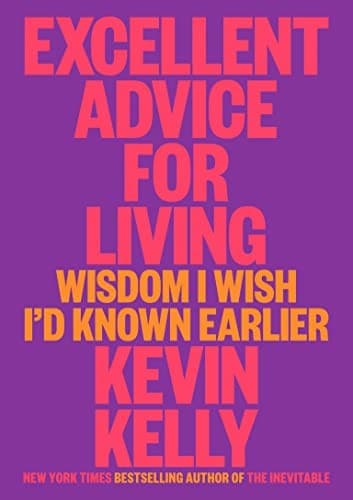
- Kevin Kelly frames the book as a field guide of proverbs: short, reusable lines of advice collected and refined over time, first for his family and then for broader use.
- Its central claim is that wisdom is practical and behavioral: what you repeatedly do, how you treat people, and how you manage attention matter more than abstract opinions.
- Each line is meant as a seed, not a doctrine—something to test, extend, and adapt as life, age, and circumstances change.
How to Think and Work
- Kelly repeatedly shifts the reader from intention to action: you are what you do, habits outrun inspiration, and repeated behavior is more reliable than self-image.
- He urges a clear split between creating and judging: make first, edit later, because prototypes, drafts, sketches, and remaking are how real insight appears.
- He recommends using the body and the world to think: walk to think, write to discover what you think, draw to discover what you see, and sleep on hard problems.
- Constraints are treated as creative aids, not obstacles; deadlines, subtraction, simplification, and leaving room for change often produce better results than open-ended freedom.
- He is alert to attention management: protect productive hours, do not let inboxes or urgency run your day, and focus on what matters rather than what is merely loud.
- Progress is mostly a matter of small consistent acts: daily practice, tiny yearly improvements, and showing up beat bursts of intensity.
People, Character, and Relationships
- Kelly’s advice is deeply social: listen well, keep asking “Is there more?”, and use the Rule of 3 in conversation by going three levels deeper to reach the truest answer.
- He prefers kindness, empathy, and humility over winning; he says to choose kindness over being right, be strict with yourself, and learn even from people you dislike.
- A recurring distinction is respect over likability: aim to be respected, tell people what you expect, and set standards that help them rise.
- Forgiveness is presented as self-healing rather than generosity toward the offender, while grudges and hatred are described as poison to the person who keeps them.
- Relationships should be treated as more valuable than transactions: eat with people, compliment behind their backs, give credit publicly, take blame quickly, and remember that friends often outperform money.
- His family advice includes making rites of passage, naming what makes your family distinctive, loving your spouse for your children’s sake, and keeping regular screen-free meals together.
Work, Risk, and Time Horizons
- Kelly treats success as long-term compounding: the most meaningful achievements take years, and small gains accumulate into large differences.
- He distrusts short-term thinking, fame, and urgency; if a goal has no schedule it is only a dream, and the urgent is often a tyrant rather than a guide.
- Work should fit identity and contribution, not just pay; do not choose the highest salary by default, and do not work for someone you do not want to become.
- Money is a tool for creating, not the point of life, and he stresses aptitude, attitude, and training over credentials alone.
- He values exploration alongside optimization: roughly one-third exploring and two-thirds optimizing, because discovery still requires wandering even as age makes exploration harder.
- He also favors unfinished or non-obvious paths: the best jobs may be the ones you are unqualified for, breakthroughs can look ridiculous at first, and childhood oddities may become adult advantages.
Practical Judgment and Self-Management
- Kelly is blunt about risk and preparation: keep backups, know emergency exits, avoid consumer debt, carry less, and remember that real costs include setup, maintenance, and disposal.
- He recommends a low-drama readiness: do not rush, do not buy late at night, do not respond to urgent phone solicitations, and verify sensitive things through channels you control.
- Good judgment means reality-testing assumptions: ask what you would believe in 25 years, demand extraordinary evidence for extraordinary claims, and remember that your first explanation of other people may be wrong.
- He repeatedly warns that most things are more ordinary than they feel: most interruptions are not emergencies, most worries never happen, and most people are too busy to dwell on you.
- He emphasizes repair and responsibility: fix mistakes quickly, make the first apology specific and sincere, take ownership, and accept that the final details of a project often take another “90%.”
- Everyday courtesy matters: say less than necessary, keep things visible so you do not lose them, return what you borrow cleaned, and reduce avoidable friction.
What To Take Away
- Behavior outruns belief: your habits, calendar, and repeated actions reveal and shape you more than your stated intentions.
- Patience and humility compound: deep listening, quick apology, forgiveness, and learning from odd or difficult people all make life better over time.
- Think in long horizons: Kelly’s advice favors processes that pay off later in work, money, parenting, and creativity rather than short-term optimization.
- Use the book as a toolbox: these lines are meant to be tried, kept, or discarded as fits your life, not obeyed as a rigid system.
Generated with GPT-5.4 Mini · prompt 2026-05-11-v6