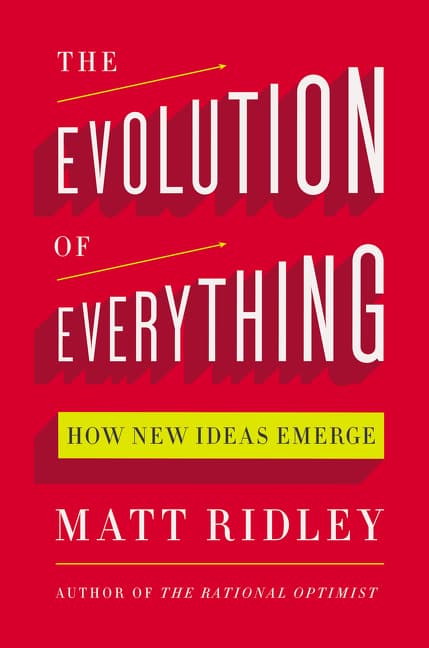
Core Idea
- Ridley’s central claim is that evolution means far more than biology: it is any gradual, bottom-up, trial-and-error unfolding of order in culture, institutions, technology, language, morality, economics, and politics.
- He argues that people systematically over-credit planners, leaders, and designers, when many important outcomes are really “the result of human action, but not of human design”.
- The book’s big contrast is between cranes and skyhooks: real explanations build complexity from below, while skyhooks pretend order is imposed from above.
The Evolutionary Pattern Behind Nature, Mind, and Society
- Ridley traces a long anti-skyhook lineage from Epicurus and Lucretius through Newton, Locke, Hume, Adam Smith, and Darwin, treating them as thinkers who explained order without invoking a hidden designer.
- Lucretius is a hero figure: anti-supernatural, empiricist, and proto-Darwinian in seeing nature as endless variation and selection; Ridley says Christianity suppressed this materialism for centuries.
- Darwin’s breakthrough was to replace the argument from design with natural selection, showing how cumulative complexity can arise without foresight or intention.
- The classic eye problem is treated as solved by gradations, comparative biology, and gene evidence such as Pax6 and opsins.
- Ridley extends the same logic to the origin of life, favoring RNA World and vent-based chemistry over any mystical spark, while admitting the first proto-cells remain the hardest case.
- At the genomic level, he leans on Dawkins’s selfish gene view: organisms are vehicles for genes, while much of the genome, including transposable elements and repetitive DNA, may be self-serving rather than body-serving.
- He rejects intelligent design, irreducible complexity, and directed-mutation stories as modern skyhooks that smuggle in a hidden planner.
- On evolution and inheritance, he treats Lamarckism as largely unpersuasive, allows only limited epigenetic effects, and prefers the Baldwin effect as the non-mystical route by which learned behavior can shape later genetic adaptation.
How Evolution Explains Human Life: Morality, Violence, Law, Language, Cities
- Morality, for Ridley, is not handed down by God or deduced from abstract ideals but emerges from reciprocal social life, a point he takes from Smith’s “impartial spectator” and the desire for mutual sympathy.
- He says moral teachers usually codify existing norms rather than invent them, just as grammar books codify language.
- He presents the long decline in violence as an evolutionary process: commerce, state centralization, etiquette, and self-control gradually made societies less brutal.
- Montesquieu’s doux commerce and later writers like Deirdre McCloskey are used to argue that trade civilizes and that richer market societies tend to be calmer and more cooperative.
- Common law is a favorite example of bottom-up order: judges, precedent, and incremental revision produce a living system unlike centrally designed civil law.
- Language is the clearest cultural analogue of biology: it is digital, rule-governed, and endlessly reshaped by use, not by classroom design.
- Children acquire language bottom-up through immersion and correction, while short frequent words and slow-changing core vocabulary show evolutionary regularities.
- Music, marriage, and cities are all treated as evolving systems with variation, selection, and descent with modification.
- Cities are especially important because they are dense networks where recombination produces innovation; Ridley uses Jane Jacobs and Geoffrey West’s scaling laws to show why larger cities are more creative and productive.
- He contrasts organic urban growth with sterile planning examples like Brasilia, Islamabad, and Canberra.
Prosperity, Markets, Education, and the Digital Age
- Ridley’s economic history centers on the great enrichment: real incomes have risen many-fold since 1800, bringing cheaper essentials, longer lives, lower child mortality, and falling extreme poverty.
- He argues that nobody planned this transformation; it emerged from decentralized exchange, innovation, and institutional freedom.
- In his reading of Adam Smith, prosperity comes from division of labour, specialization, and the invisible hand of consumer coordination, not from hoarding or state direction.
- Markets are presented not as selfish chaos but as a system of mass cooperation sustained by prices, trust, rivalry, and consumer sovereignty.
- He prefers “innovationism” to “capitalism,” since the decisive force is market-tested innovation rather than mere capital accumulation.
- Economic growth is explained through creative destruction and increasing returns, not the classical fear of permanent diminishing returns.
- He treats technology as the main source of postwar growth, and argues that demand, not official planning, pushes firms to improve and recombine ideas.
- Education is one of his sharpest critiques of centralization: state schooling is described as a historically contingent, Prussian-style system built for obedience, not the natural form of learning.
- He emphasizes the persistence and success of private low-cost schooling in poor countries, and he praises self-organized learning approaches such as Sugata Mitra’s experiments.
- The internet is his modern model of evolution: nobody planned its current form, and its most powerful features arose from open, peer-to-peer, permissionless experimentation.
- He extends this to bitcoin and blockchain technologies, which he treats as promising attempts to build decentralized money and institutions without trusted intermediaries.
- The political implication is that digital tools can weaken old gatekeepers, though states and regulators constantly try to re-centralize control.
What To Take Away
- Ridley’s general theory is that complex order usually grows from below, through selection among variants, not from a master plan.
- He sees the same mechanism at work in biology, markets, law, language, cities, money, and the internet.
- His recurring warning is that top-down certainty often produces coercion, stagnation, or even catastrophe, while open-ended evolution tends to be more adaptive.
- The book’s final stance is radically anti-creationist in the broadest sense: whenever we see useful order, we should first ask how unplanned evolution might have made it.
Generated with GPT-5.4 Mini · prompt 2026-05-11-v6