Core Idea
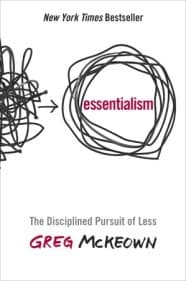
- Essentialism is the disciplined pursuit of less but better: identify the vital few, eliminate the trivial many, and invest your limited time and energy where you can make your highest contribution.
- The book argues that Nonessentialism—saying yes by default, chasing too many options, and yielding to social pressure—creates “a millimeter of progress in a million directions,” while Essentialism creates clarity, control, and meaningful results.
- McKeown’s central claim is that this is not minimalism for its own sake or simple time management; it is a way of living by design, not default.
The Essentialist Mindset
- The book’s roadmap is Essence, Explore, Eliminate, Execute: clarify what matters, examine options carefully, cut the rest, and build systems that make the essential easy to do.
- Essence rests on three truths: I choose to, only a few things really matter, and I can do anything but not everything.
- McKeown ties Nonessentialism to three forces: too many choices, too much social pressure, and the myth that you can have it all.
- He argues that modern abundance creates decision fatigue and that if we do not choose our priorities deliberately, other people—bosses, clients, colleagues, family—will choose for us.
- The book repeatedly returns to the paradox of success: clarity creates success, success creates more options and demands, and those options erode the clarity that produced success in the first place.
- Choice is framed as an action, not a thing we possess; even when circumstances are constrained, we still choose how to respond.
- McKeown uses learned helplessness to show how people forget their agency after repeated powerlessness, and he warns that organizations can show this as either passivity or frantic overcommitment.
Explore, Eliminate, and Decide With Extreme Selectivity
- Essentialists explore more deeply before committing, because they want to go big only on the vital few; the key questions are what inspires you, what you are talented at, and what meets a significant need.
- The vital few / trivial many and Pareto logic underpin the book: not all effort has equal payoff, and some work produces far greater returns than the rest.
- McKeown illustrates this with examples like El Bulli, which reduced dishes and scale to pursue culinary essence, and Warren Buffett, who bets on a small number of investments.
- A recurring rule is that trade-offs are unavoidable; strategy means making deliberate choices, not pretending everything can coexist.
- Business examples like Southwest Airlines show that coherent strategy requires explicit trade-offs, while Continental Lite failed by straddling incompatible approaches.
- In work and life, the question is not “How can I do both?” but “Which problem do I want?”
- Essential intent is the solution to vague mission statements: a concrete, inspiring, measurable aim that can guide a thousand later decisions.
- McKeown favors specific ends over broad aspirations, whether that is a company goal like getting everyone online or a life-defining purpose like Mandela’s long commitment against apartheid.
- Explore also means making room for thought: create space to look, listen, think, sleep, and see what is actually happening rather than reacting to noise.
- The book treats play as essential, not optional, because it broadens options, reduces stress, and supports creativity and learning.
- It also treats sleep as part of contribution, not indulgence: “protect the asset” means preserving the mind, body, and spirit that make performance possible.
- To select opportunities, McKeown urges extreme criteria: “If the answer isn’t a definite yes, then it should be a no.”
- The 90 Percent Rule says that if an option scores below 90% on your most important criterion, treat it as a no.
- Saying yes to everything is shown to be dangerous because it crowds out better opportunities and turns implicit pressure into a calendar full of accidental commitments.
Eliminate, Uncommit, Edit, Limit, Buffer, Subtract, and Focus
- Eliminate requires courage, because every yes to something nonessential is a no to something better.
- Chapter 12’s key move is uncommit: cut losses instead of defending sunk costs, even when time, money, or pride has already been invested.
- McKeown uses the Concorde as a warning about sunk-cost bias, and the mug experiment as evidence of the endowment effect, where ownership makes us overvalue what we already have.
- His practical antidote is to ask: If I didn’t already own this, how much would I pay for it?
- He also warns against status quo bias and casual yeses, recommending a pause before committing and even a reverse pilot to test whether an initiative can be removed without harm.
- Edit is presented as the “invisible art” of subtraction: cut out options, condense, correct, and edit less.
- Limit means chosen boundaries are freeing, not constraining; without them, other people set the terms of your life.
- Buffer builds slack into plans to absorb uncertainty, because people chronically underestimate time and complexity.
- Subtract means identify the bottleneck—the slowest hiker or constraint—and remove that obstacle instead of trying to push harder everywhere.
- Focus is about asking “What’s important now?” and resisting the illusion that multitasking is real concentration.
- Practical focus tools include clearing clutter, turning off the phone, writing down competing thoughts, and using a pause or transition ritual to leave work fully and enter the next context.
- Flow in the book is routine-based execution: design triggers, automate useful habits, and do the hardest thing first so essential work happens with less friction.
- Progress matters because small wins build motivation; visible markers and minimal viable steps keep momentum alive.
- Be is the culmination: Essentialism becomes identity, not a project, and the model is a life organized around a singular purpose rather than around busyness.
What To Take Away
- The book’s deepest warning is that success can become its own enemy when it multiplies demands faster than it multiplies clarity.
- McKeown’s standard is not productivity in general but contribution: do less, but make what you do count more.
- The discipline of Essentialism is mostly the discipline of saying no well, uncommitting without guilt, and protecting the conditions that let the essential happen.
- The final invitation is existential as much as practical: life is short, so ask what is truly essential and remove everything else.
Generated with GPT-5.4 Mini · prompt 2026-05-11-v6