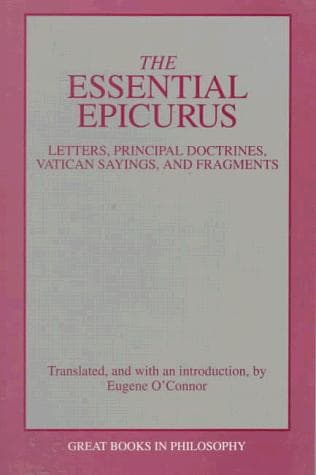
Core Idea
- Epicurus’ central claim is that the good life is pleasure, but pleasure means the absence of bodily pain and mental disturbance, not luxury, excess, or nonstop stimulation.
- Philosophy matters because the chief obstacles to happiness are fear, limitless desire, and social insecurity; Epicurean thought is a therapy for these disturbances.
- A stable life of pleasure depends on prudence, self-sufficiency, justice, and friendship, which function as conditions of tranquillity rather than as rivals to it.
Pleasure, Desire, and the Limits of Want
- In the Letter to Menoeceus, Epicurus says philosophy is for both young and old, because there is no age too early or too late to care for the health of the soul.
- Pleasure is the alpha and omega of happiness: the goal is to be free from pain and fear, with the soul’s “tempest” calmed.
- He distinguishes genuine, kindred and natural pleasure from the false pleasures of indulgence and sensual excess.
- Not every pleasure is to be chosen, and not every pain is to be avoided, because some pains lead to greater pleasure and some pleasures bring later disturbance.
- The Principal Doctrines say bodily pleasure has a limit once pain is removed, while mental pleasure depends on removing the fears created by false belief and anxious thought.
- Desires are divided into natural and necessary, natural but not necessary, and neither natural nor necessary.
- The last class arises from empty opinion, and many of these desires seem urgent only because people falsely believe they are required.
- Epicurus repeatedly praises simple living, plain food, and limited wealth, because contentment with little reduces dependence on fortune.
- Nature’s wealth is “limited and easy to procure,” while the wealth of vain fancies is infinite and therefore never satisfied.
Fear, Death, Gods, Justice, and Friendship
- Epicurus’ argument that death is nothing to us is foundational: when we exist, death is absent, and when death comes, we do not exist.
- Fear of death is irrational because it is fear of a future state that will never be experienced as pain by the person who has died.
- He insists that the gods exist, but they are blessed and indestructible and do not become angry or intervene as human rulers do.
- To attribute human passions or arbitrary favoritism to the gods is, for Epicurus, a kind of impiety.
- The study of nature is therefore useful because it frees people from fear of divine punishment, the underworld, and terrifying celestial signs.
- Justice is not eternal or absolute; it is a useful covenant among people so they do not harm or suffer harm in association.
- Laws are just only insofar as they remain useful for communal life; when they cease to serve that purpose, their justice ceases too.
- Injustice is harmful mainly because it creates fear of detection and punishment, not because it violates an abstract moral order.
- Friendship is one of the greatest goods and a major source of security, and the confidence of friends matters almost as much as their practical help.
- Epicurus values the wise person’s calm community and private withdrawal more than public fame, since the best security comes from a life sufficiently protected to remain quiet.
Physics and the Cure of Superstition
- In the Letter to Herodotus, Epicurus recommends memorizing physics in compact outlines so the mind can quickly return to the main doctrines.
- Reality consists only of bodies and void; nothing comes from nothing and nothing is destroyed into nothing.
- Bodies are made of indivisible, unchangeable atoms with shape, weight, and size, and all change comes from rearrangement, addition, and subtraction.
- The universe is infinite, with infinite atoms, infinite void, and an infinite number of worlds.
- Sensation is a criterion of truth, so error enters when opinion is added to what the senses have not yet confirmed or disproved.
- Epicurus explains perception through images or films flowing from objects, which account for sight, dreams, and appearances.
- Falsehood is not in the image itself but in the mind’s extra movement of judgment beyond what is presented.
- The soul is bodily, composed of fine atoms spread through the body, and therefore mortal rather than incorporeal.
- Time is not a substance but a way of speaking about duration attached to events, motions, rest, pleasures, and pains.
- In natural philosophy, Epicurus refuses to force a single explanation where several are compatible with the evidence.
- The Letter to Pythocles says astronomy and weather science should aim at peace of mind, not speculative certainty for its own sake.
- For sun, moon, eclipses, thunder, lightning, earthquakes, comets, rainbows, snow, hail, and winds, multiple plausible causes may be accepted if they preserve tranquillity.
- This pluralism is meant to reject myth and divine over-interpretation, not to leave the world unexplained.
What To Take Away
- Epicurus makes pleasure compatible with discipline by redefining pleasure as stable freedom from pain, fear, and disturbance.
- The cure for human misery is to reduce life to what is natural, limited, and knowable, and to reject infinite craving and superstition.
- Prudence, justice, and friendship are not separate from happiness; they are among the conditions that make secure pleasure possible.
- The physics is not an optional extra, since a truthful view of nature is part of the therapy that protects the mind from myth, panic, and the demand for absolute certainty.
Generated with GPT-5.4 Mini · prompt 2026-05-11-v6