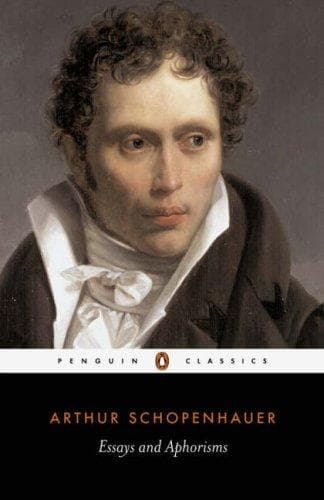
Core Idea
- Schopenhauer’s philosophy treats life as suffering: pleasure is only the temporary relief of want or pain, while distress, boredom, and frustration are basic to existence.
- Behind the world of appearances lies will, the blind, unitary force that objectifies itself in nature, desire, sex, conflict, and individuality, while the intellect is only a secondary instrument of survival.
- The ethical consequence is denial of the will-to-live: true wisdom lies not in optimism, progress, or worldly success, but in disillusionment, ascetic detachment, and a sober acceptance of mortality.
Schopenhauer’s Metaphysics of Suffering
- He inherits the long philosophical split between an apparent world and a more real hidden one, from Greek thinkers through Kant’s distinction between phenomenon and thing in itself.
- Schopenhauer’s distinctive move is to identify the thing in itself with will, known inwardly through the body and felt as “my body and my will are one.”
- Because space, time, and causality belong to appearance, the noumenal world cannot be many separate things in the usual sense; it is one underlying will, while the world as experienced is representation or idea.
- Metaphysics, for him, is an attempt to infer the interior of nature from its outward show, but it must not smuggle in the rules of appearance as if they governed reality itself.
- He treats the intellect as a physical, practical organ of the organism, made to preserve the individual, not to discover ultimate being; only in genius does intellect rise above mere utility.
- The world therefore has a double explanation: physically by causes, metaphysically by will; even intelligence and character can be read both biologically and metaphysically as expressions of primal willing.
Ethics, Religion, and Human Life
- Schopenhauer’s ethics flows from metaphysics: since all creatures are manifestations of will-to-live, existence is a field of universal conflict, and happiness is only negative, the absence of suffering.
- He repeatedly insists that want and boredom are the twin poles of life, and that time itself torments us by forcing constant striving, decay, and disappointment.
- Human beings suffer more than animals because thought multiplies fear, hope, ambition, shame, memory, and anticipation, making pain more conscious and boredom more acute.
- Sexual desire is central: it sharpens longing, causes brief gratification, and then produces prolonged misery, because generation is nature’s deepest aim and the “node of the universe.”
- Life is a desengaño, a process of disillusionment; youth hopes, adulthood labors, and old age sees that the whole affair was a cheat.
- His preferred ethical ideal is not happiness but non-volition: salvation in Indian thought, Christian asceticism, and his own system all point toward willing less, not more.
- He presents the world as a kind of penal colony or place of atonement, using images from Buddhism, Brahma, Ormuzd and Ahriman, and the Fall to describe existence as morally fallen.
- Death does not annihilate the thing in itself; it only ends the individual appearance and its cerebral consciousness, so fear of losing personality mistakes a limitation for a treasure.
- He distinguishes metempsychosis from palingenesis: what persists is not the same empirical person, but the underlying will that can be reobjectified in new form.
- Suicide is not endorsed as redemption; his main objection is ascetic, since suicide merely escapes one appearance while leaving the will-to-live untouched.
- His comments on women are sharply hostile and essentialist: he praises them mainly as mother, nurse, and comforter, claims they are more present-oriented and sympathetic than just, and argues they are naturally subordinate to men in intellect and public life.
Religion, Books, and the Life of the Mind
- In the dialogue on religion, Demopheles defends religion as folk-metaphysics and a necessary public symbolism for the many, while Philalethes insists that truth cannot honor “a pack of lies.”
- Schopenhauer’s key objection is that religion freezes early childhood indoctrination into lifelong prejudice, replacing inquiry with authority and making doubt seem sinful.
- He allows that religion can console, restrain, and support political order, but he thinks its alliance with power turns inquiry into something suspect and keeps humanity in intellectual childhood.
- Religion, in his ideal future, should eventually pass away by euthanasia of religion as knowledge matures.
- His hostility to modern literary culture is equally sharp: most books, reviews, and newspapers are driven by money, public fashion, or vanity rather than thought.
- He distinguishes writers by whether they have something to say, whether they think while writing, or whether they have already thought the matter through before writing; only the last group produces durable work.
- Style is the physiognomy of the mind: clear, objective, concise prose reveals clear thought, while vagueness, affectation, and obscurity usually signal muddled thinking.
- Reading is valuable only when it serves thought; otherwise it becomes mental dependency, and the art of not reading means ignoring the public’s current enthusiasms and avoiding bad books.
- He repeatedly values what is thought for oneself over what is merely learned from books, comparing acquired truths to artificial limbs and personally discovered truths to natural limbs.
What To Take Away
- Schopenhauer’s central claim is that the world’s visible order hides a deeper will whose essence is striving, conflict, and suffering.
- His pessimism is not decorative but structural: pleasure is negative, boredom is oppressive, and mortality confirms the vanity of worldly desire.
- His ideal response is intellectual honesty plus ascetic detachment, not social reform, optimism, or religious consolation.
- The book’s practical literary lesson is that genuine thinking, clear style, and disciplined reading matter because most public culture obscures rather than reveals truth.
Generated with GPT-5.4 Mini · prompt 2026-05-11-v6