Core Idea
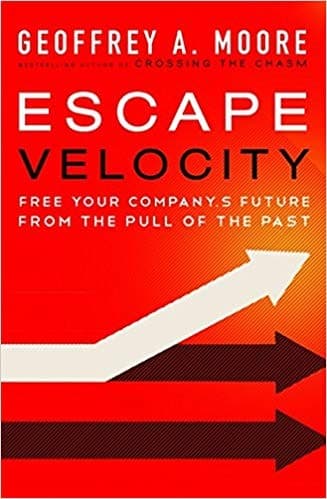
- The book’s central problem is how a company escapes the pull of the past and gets free of last year’s operating plan, budget, and internal inertia.
- Moore’s answer is to use a Hierarchy of Powers—category power, company power, market power, offer power, execution power—to see where value comes from and where it is being lost.
- The key warning is that these powers can reinforce or cancel one another, so strong execution cannot save a weak category, and a great category does not guarantee success without the right offer and operating model.
How Competitive Power Works
- Category power is the strongest predictor of long-run company performance because no business can outperform its category over time.
- Category work is portfolio work: leaders must decide where to enter, stay, or exit, and must free resources to move into better categories instead of letting last year’s plan lock in the current mix.
- Company power is a vendor’s standing inside a category, usually signaled by market share, and it depends on crown jewels—unique assets or capabilities under direct control that can create durable advantage.
- Moore argues that company power requires asymmetrical bets and external focus; leaders must be willing to favor the strategically core even when it is internally unpopular.
- Market power is leadership within a specific segment, measured by word-of-mouth reputation and local share, and it matters most when a market is in transition or a company needs a comeback.
- A segment strategy works when the segment is big enough to matter, small enough to lead, and a good fit with crown jewels.
- Target market initiatives (TMIs) are multiquarter or multiyear efforts to win a segment, built around real customer communities, a “whole offer,” and a small set of plausible suspects rather than broad, undirected selling.
- Market power usually requires ecosystem support and a price premium, but it rarely scales to billion-dollar size on its own.
Offer Power and the Three Kinds of Innovation
- Offer power is demand for a specific product or service relative to competitors, including the status quo in early markets.
- In volume businesses, the offer itself must achieve escape velocity, and Moore says many hit products fail because they do not win enough follow-on resources.
- Moore distinguishes three kinds of innovation returns: productivity innovation, neutralization innovation, and differentiation innovation.
- Productivity innovation frees resources from the past by rationalizing the long tail of low-value offers that consume disproportionate attention.
- The long-tail playbook is to centralize end-of-life decisions, hide legacy offers from the main go-to-market motion, and use external governance to break internal webs of favors.
- Neutralization innovation is about being good enough in the right areas quickly, not about being best in class everywhere; spend should be aligned with the purchase quadrant that matters—premium, performance, cost, or convenience.
- Differentiation innovation aims for a 10X effect that changes buying criteria and shifts category power; Moore treats this as the hardest and most valuable kind of bet.
- The recurring distinction is mission-critical vs. enabling: the mission-critical core must be solved first, while enabling context can often be outsourced or deferred.
- Examples of 10X moves include Salesforce.com, Skype, TelePresence, Wikipedia, VMware, and Apple’s iPod/iPhone/iPad ecosystem plays.
Execution Power and the Transition Problem
- Execution power is the final requirement for escape velocity because good strategy is useless if the firm cannot execute a next-generation initiative at scale.
- Moore separates execution into invention, deployment, optimization, and a fourth phase, transitioning.
- In complex-systems businesses, the arc runs from project to playbook to product; in volume-operations businesses, it runs from product to partners to processes.
- Invention is led by inventors using a fully integrated team and rapid experimentation; deployment is led by deployers using line functions and clear accountability; optimization is led by optimizers using hierarchy, standardization, and cost discipline.
- The hard part is the two transitions, especially handoff from inventor to deployer, because organizations tend to keep the same people and incentives in place across very different modes.
- Transition programs are not “best effort”; they are one-time, executive-sponsored interventions designed to drive the business to a tipping point where momentum flips and the new model becomes self-sustaining.
- Moore stresses that catalytic programs need monthly operational review and quarterly executive oversight; annual budgeting alone is too weak to overcome the pull of the existing operating plan.
- The orchestrator is the key transition leader: a cross-functional, influence-based role that coordinates change across functions and keeps the future-state vision intact.
Evidence, Cases, and Implications
- Cognizant shows project-to-playbook execution through Cognizant 2.0, which captures work artifacts in workflow and uses pull-based knowledge sharing instead of static knowledge management.
- Apple shows product-to-partners execution: the iPod depended on iTunes and music-industry cooperation, the iPhone on carriers and the App Store, and the iPad on the existing app ecosystem.
- IBM shows how a mature company can break from the past by shifting from products to end-to-end solutions, buying crown jewels, and exiting commoditized businesses like printers and PCs.
- BMC, Rackspace, Sybase, Symbol, and Adobe each illustrate a different power lever, from core redefinition to segment focus to offer redesign to ecosystem-led growth.
- Moore’s broader claim is that modern competition happens in disaggregated global value chains, so advantage increasingly depends on collaboration, ecosystem design, and the ability to identify the pivotal role first.
What To Take Away
- The book’s framework is not a machine but a vocabulary for strategic dialogue: it helps leaders ask what the world wants now, where they have power, and what must change to break inertia.
- The most important discipline is to decide explicitly which power level matters most in the situation—category, company, market, offer, or execution—rather than treating all problems as execution problems.
- Escape velocity comes from asymmetry: concentrating resources on the core, making nonconsensus bets, and accepting that fairness across all programs often protects the past.
- The end goal is a business that can create a new future while freeing itself from the gravitational field of its own legacy.
Generated with GPT-5.4 Mini · prompt 2026-05-11-v6