Core Idea
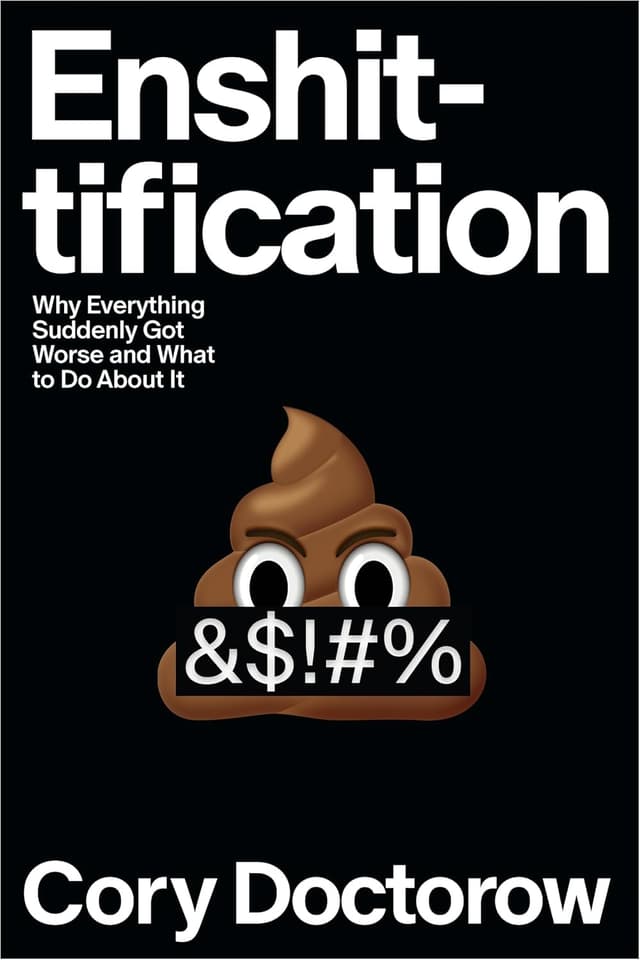
- Enshittification is Doctorow’s name for the platform decay pattern where services start out good to users, then shift value to business customers, then finally extract value from both until the platform becomes “a giant pile of shit.”
- He treats this as a material, predictable process with symptoms and mechanisms, not a law of nature, and argues it can be reversed by restoring competition, regulation, interoperability, and worker power.
- The book’s central claim is that platforms get worse because they can: once gatekeepers can trap users, suppliers, and workers, they move surplus away from everyone else and toward themselves.
How Platforms Rot
- A platform is a two-sided intermediary between users and business customers, and the danger is not mediation itself but mediation with gatekeeping power.
- The canonical sequence is: good to users → good to business customers → hostile to both; network effects and switching costs make each stage hard to escape.
- Facebook began as a useful, subsidized social tool, then monetized users through surveillance and ad inventory, and later degraded feeds, publishers, ad quality, and link reach while pushing more ads and boosted posts.
- Amazon used below-cost prices, subsidized shipping, Prime, and easy returns to lure users, then squeezed merchants through fees, fulfillment pressure, and marketplace dependence, while also cloning successful products and ranking paid placements above true search results.
- Apple’s iPhone/App Store started as a high-quality, privacy-forward walled garden, then turned the App Store into a tollbooth with a 30 percent App Tax, anti-steering rules, and selective favoritism for its own services.
- Twitter/X moved from an open, API-first ecosystem to a value-extraction machine under Musk, with moderator cuts, ad decay, paid verification, feed manipulation, and tougher exit barriers.
- These systems persist as zombie platforms because people cannot easily leave without losing communities, audiences, data, or customers.
Mechanisms of Control
- Doctorow emphasizes that enshittification is enabled by the erosion of four constraints: competition, regulation, interoperability, and tech-worker power.
- Competition disciplines firms by giving users, suppliers, and workers real alternatives; monopoly lets firms abuse each group separately.
- Regulation matters when it is enforceable and concrete, while vague, harm-intensive rules are easy to evade or capture.
- Interoperability is the technical and legal ability to connect to dominant systems against the owner’s wishes; Doctorow treats it as the key user-side backstop.
- Because computers are universal, manufacturers increasingly use IP law, especially DMCA 1201, plus trademark, trade secret, and contract law to criminalize repair, reverse engineering, and aftermarket tools.
- DRM, VIN locking, parts pairing, subscription features, and cloud control all turn ownership into ongoing rent extraction, as with printers, cars, bassinets, Adobe, Unity, and Office365.
- Doctorow argues “with an app” often functions as a legal shield for conduct that would otherwise be ordinary abuse, fraud, or anticompetitive behavior.
- The physical world is becoming an “internet of shit,” where cars, appliances, shelf labels, and medical devices inherit the same surveillance and tollbooth logic as apps.
Evidence and the Larger Political Argument
- Doctorow repeatedly rejects simple explanations like bad timing, founders aging out, or the end of cheap money; the deeper issue is that firms were allowed to exploit their power.
- He links ad-tech dominance to cheating and collusion, not magical mind control: Google and Meta control both sides of the ad market, use secret deals, and take a much larger share of ad revenue than historical intermediaries did.
- Antitrust doctrine, especially the consumer welfare standard, is criticized for letting firms present abuse as pro-consumer efficiency while extracting from workers, merchants, and publishers.
- He treats concentration as a political problem too: fewer firms can coordinate, outspend regulators, and use law to entrench themselves against rivals.
- The book reads Big Tech as deeply rent-seeking, and partly as an early form of technofeudalism, though Doctorow stresses the struggle between rent and profit rather than a clean historical replacement.
- The same system that creates platform power also creates labor abuses: reverse-centaurs and chickenization describe workers who borrow, submit to algorithmic control, and bear all risk while a dominant buyer sets terms.
What Resistance Looks Like
- Doctorow’s most concrete positive remedy is a right to exit: users should be able to leave platforms with their data, contacts, and social graphs intact, so switching costs stop functioning as captivity.
- He favors structural separation and other rules that remove conflicts of interest rather than hoping gatekeepers will self-restraint.
- He also argues for adversarial interoperability and user-side self-help, where reverse engineering and third-party tools restore functions platforms withhold.
- The Beeper Mini/iMessage episode is his emblem of this logic: Apple used iMessage as lock-in, while outside developers showed that secure cross-platform messaging was technically possible.
- Real-world repair fights—right-to-repair laws, anti-parts-pairing rules, printer and device interoperability, and state-level victories—matter because they normalize the idea that purchased goods belong to buyers.
- Doctorow pairs antitrust with union power, arguing that tech workers, drivers, warehouse workers, and call-center workers can fight “disenshittification” as part of labor organizing.
- He sees the recent antitrust revival, especially under Lina Khan and allied enforcers, as proof that public anger can still be converted into institutional pressure.
What To Take Away
- Enshittification is not an accident; it is the predictable result of concentrated power plus weak constraints.
- The book’s key analytic move is to show how platforms first win loyalty, then exploit dependence, then extract from everyone once exit becomes hard.
- The strongest remedies are not moral appeals to nicer executives but interoperability, competition policy, repair rights, and collective labor power.
- Doctorow’s bottom line is that the internet and connected devices can still be made usable and humane, but only if users and workers reclaim leverage from the firms that have turned connection into rent extraction.
Generated with GPT-5.4 Mini · prompt 2026-05-11-v6