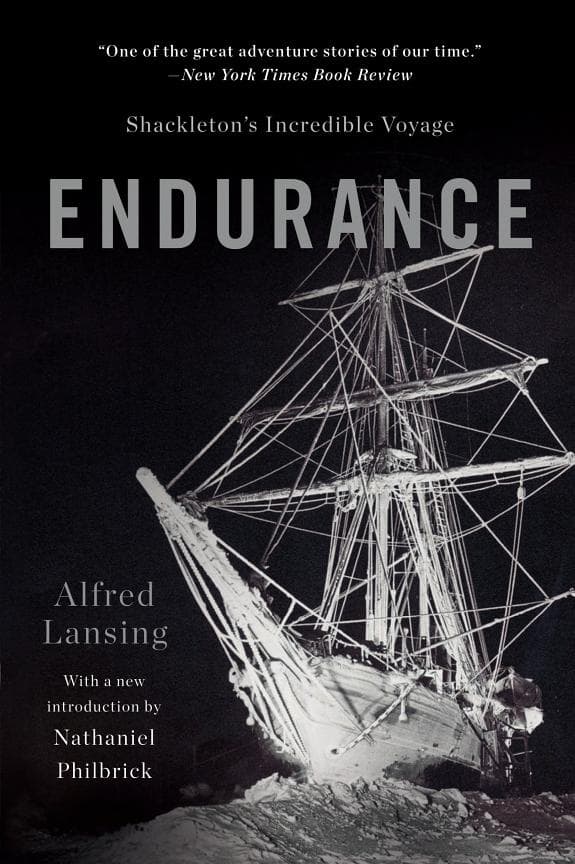
Core Idea
- The book’s central claim is that Shackleton’s Imperial Trans-Antarctic Expedition failed absolutely as a crossing but became extraordinary as a story of survival, leadership, and endurance.
- Lansing presents the account as rigorously factual, reconstructed from diaries and interviews, and repeatedly emphasizes that the men’s reactions and language are preserved as closely as possible.
- The expedition’s original ambition was immense: to cross Antarctica overland, with one party supported from the Weddell Sea and another laying depots from the Ross Sea.
Shackleton, the Plan, and the Leadership Problem
- Shackleton is portrayed as a paradox: not the best scientist or fastest explorer, but the man to trust when everything has gone wrong.
- He was driven by glory, status, and money as well as adventure, but Antarctica was the one arena where his “monstrous ego and implacable drive” became useful rather than misplaced.
- The crossing plan was classic Shackleton: bold, orderly, and executed with a confidence that assumed success despite severe unknowns.
- He built the expedition around a veteran core—Wild, Crean, Cheetham, Marston, McLeod—and chose many others by instinct, often in minutes.
- His recruitment style was capricious but effective; Lansing repeatedly suggests that Shackleton’s intuition for compatible men “rarely failed.”
- The expedition depended on a mixture of public heroism and private financial scramble: donors, advance book and film rights, lectures, and government support all rested on the expectation that he would return.
- The ship Endurance was exceptionally strong wood-built polar craft, but not truly designed to rise free of pressure like Fram, a difference that later mattered enormously.
From Beset Ship to Ice Camp
- The expedition became trapped in the Weddell Sea, which Shackleton had already come to suspect was a kind of ice trap formed by land barriers, currents, and prevailing winds.
- Once beset, the crew’s slow realization that they were imprisoned is one of the book’s major psychological shifts: the phrase “getting themselves out” becomes almost meaningless.
- Lansing shows the men passing from ship routine to ice-camp routine with grim adaptability: dogs in floes, officers in The Ritz, hunting seals and penguins for meat and blubber.
- The crew’s survival depended on improvisation, scavenging, and constant labor, from hauling supplies to building shelters and maintaining morale.
- The dogs decline tragically through neglect and parasites, and the expedition’s practical animal economy becomes a recurring pressure point.
- The ship survives repeated pressure attacks longer than anyone expects, fostering dangerous overconfidence, until eventually the hull is wrecked and abandonment becomes unavoidable.
- Shackleton’s orders to reduce possessions, sacrifice clothing and personal items, and even cut biblical pages show how stripped-down survival became.
- Food management dominates life after abandonment: blubber, seal stew, hoosh, ration cuts, and the calculation of how long stores might last become the expedition’s central facts.
Elephant Island and the Open-Boat Escape
- After the ice camp breaks apart, the men drag boats and sledges across brutal ice and finally reach Elephant Island, the first solid ground they have stood on in 497 days.
- Elephant Island is not salvation but a temporary refuge: exposed, storm-battered, and useless for likely rescue.
- Shackleton decides the only realistic rescue is to take a small crew in the James Caird to South Georgia, a decision that divides the expedition into those left behind and those risking everything.
- The six men chosen for the boat voyage are selected for usefulness and survival value, and the boat is hastily modified with canvas decking, supplies, tools, and navigation gear.
- The open-boat journey across the Drake Passage is rendered as a brutal test of body and nerve: freezing spray, green seas, ice loading, bailing, and constant fear of capsizing.
- The men reach South Georgia alive only after a long sequence of storms, near-losses, water shortages, and navigational risk.
- Shackleton then chooses an overland crossing of South Georgia’s mountains rather than risk the sea again, making a second extraordinary passage on foot.
- The overland trek is marked by fog, false routes, glaciers, crevasses, and exhaustion, until they finally hear a steam whistle and reach the whaling station at Stromness.
- Shackleton’s quiet identification of himself—“My name is Shackleton”—is the book’s most famous release of tension, because it announces survival after total uncertainty.
The Men Left Behind and the Return
- Meanwhile the 22 men on Elephant Island endure a “trial by patience,” building a crude hut from overturned boats, rocks, canvas, and whatever salvage remains.
- Their life becomes one of endless waiting, minor routines, sickness, and improvisation, with tobacco, food, warmth, and hygiene all dwindling.
- Lansing emphasizes both the misery and the social resilience of the camp: argument, prankery, lectures, rituals, and shared labor keep the group psychologically intact.
- The medical and bodily costs mount, including gangrene and surgery, but the men continue to function as a cooperative community.
- Hope repeatedly rises and collapses with the weather, drifting ice, and signs of open water; the crew learns that hope itself can be dangerous when it outruns reality.
- Rescue attempts from other ships fail before the Yelcho finally reaches Elephant Island and evacuates the castaways.
- The rescue ends not with triumphal fanfare but with the quiet, practical efficiency that defines much of the book: boats, ferries, departures, and the sudden ending of a long ordeal.
What To Take Away
- Endurance is less a tale of exploration success than of leadership under catastrophic failure, where judgment, morale, and human compatibility matter more than technical brilliance.
- Lansing’s account makes clear that Shackleton’s greatest talent was not conquest but keeping men alive and together when every larger objective had collapsed.
- The book’s enduring tension is between hope and realism: optimism keeps the group moving, but overconfidence can become fatal.
- Its final effect is to turn a failed expedition into a lasting model of courage, adaptation, and disciplined mutual dependence.
Generated with GPT-5.4 Mini · prompt 2026-05-11-v6