Core Idea
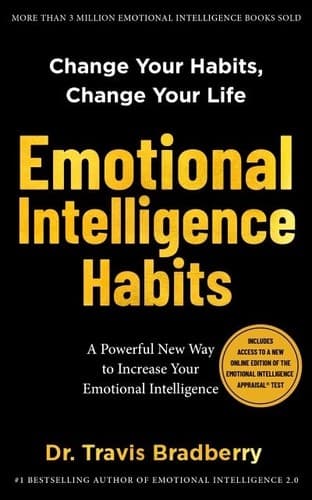
- Emotional intelligence (EQ) is the ability to notice emotions in yourself and others, then use that awareness to choose better behavior, manage relationships, and handle stress.
- The book’s central claim is that EQ is more important and more trainable than IQ for life outcomes, performance, health, leadership, and relationships.
- Bradberry frames EQ as a set of habits rooted in brain plasticity: repeated emotional responses can become more automatic, just like a road becoming a superhighway.
The EQ Model
- EQ is divided into four skills: self-awareness, self-management, social awareness, and relationship management.
- Self-awareness means accurately reading your emotions in the moment and knowing your triggers, tendencies, and patterns.
- Self-management means using that awareness to stay flexible, regulate impulses, and choose constructive responses instead of just suppressing outbursts.
- Social awareness is reading other people well through listening, tone, facial expression, posture, and body language.
- Relationship management combines the other three skills to handle communication, conflict, influence, and long-term connection.
- A high-EQ person is described as curious, self-reflective, emotionally literate, open to change, and able to be assertive without aggression.
- Low EQ shows up as quick stress, blame, feeling misunderstood, poor trigger awareness, and easy offense.
Habits That Shape Emotion, Performance, and Self-Control
- The book repeatedly treats stress as a major EQ enemy because prolonged stress harms gray matter involved in self-control and can create a vicious cycle of worse emotion and worse performance.
- Stress-management habits include gratitude, positive reframing, breathing, sleep, saying no, disconnecting from work and technology, and not holding grudges.
- Sleep is presented as a nonnegotiable performance tool: losing sleep hurts mood, creativity, problem solving, emotional regulation, and physical health more than it helps productivity.
- The author emphasizes that sleep loss is tied to obesity, heart problems, diabetes, weaker immunity, and economic losses through reduced workplace performance.
- Sleep hygiene is built from concrete habits: cut caffeine, reduce evening screen light, keep a consistent wake time, avoid late work, limit interruptions, and use meditation when insomnia is a problem.
- Caffeine is singled out as a major sleep disruptor because its long half-life and withdrawal cycle can make people think it helps more than it really does.
- Body language matters because it influences both how others judge you and how you feel; posture, eye contact, smiling, mirroring, and a strong handshake all carry social meaning.
- Complaining is treated as contagious and damaging, while controlled, solution-oriented complaining is acceptable only if it starts positive, stays specific, and ends positive.
- Authenticity means aligning actions with beliefs and needs rather than performing for approval; the book links inauthenticity to discomfort and moral dissonance.
- Passion is defined as a self-defining activity or interest that people love and invest deeply in; mastery-focused passion beats comparison-based striving.
How EQ Shows Up in Work, Conflict, and Leadership
- Bradberry argues that emotional intelligence is especially visible in likability, confidence, mental strength, decision-making, and leadership.
- Likability is teachable and based less on charisma than on sincerity, transparency, curiosity, names, listening, and the platinum rule of treating others the way they want to be treated.
- Toxic people are defined by manipulation and emotional harm; the book names types such as Gossip, Victim, Arrogant, Envious, Manipulator, Dementor, Temperamental, Twisted, and Judgmental.
- Protection against toxic people means setting boundaries, not escalating emotionally, focusing on solutions, and not forgetting repeated harmful behavior.
- Confidence is earned self-belief grounded in reality, not swagger; confident people listen more, speak clearly, handle disagreement directly, and avoid excuses and spotlight-seeking.
- Mental strength is framed as grit: passion, tenacity, and stamina; strong people delay gratification, stay kind under pressure, take accountability, and resist fear-based self-talk.
- The book warns against self-defeating thought patterns such as always/never language, treating emotions as facts, and believing self-worth depends on others’ approval.
- The growth mindset chapter contrasts fixed and growth mindsets; growth-minded people treat ability as improvable, recover faster from failure, and earn better work and income outcomes.
- A growth mindset also governs mistakes: acknowledge them quickly, extract the lesson, and avoid repeating them.
- In teams and leadership, emotional intelligence is defined as social influence, not title; leaders create certainty, stay consistent, share information, empathize, and make people feel valued.
- Great leaders “play chess, not checkers,” treating people as distinct individuals rather than interchangeable workers.
- The book insists that good leadership balances results and people; the best leaders do both, while one-sided leaders are rated far lower.
- Communication is central to leadership: speak clearly, know your audience, listen actively, use body language well, and tell the truth early instead of hiding problems.
- Likeability matters even for authority figures, because people will not sustain conviction for bosses who are harsh, arrogant, or emotionally tone-deaf.
Common Failure Modes and the Repair Mechanism
- Conflict is inevitable, but aggression and passivity both fail; the core skill is assertiveness that gets your needs met without bullying.
- Useful conflict habits include asking questions, using and instead of but, bringing solutions with criticism, and starting with facts before feelings.
- The author highlights a few major conflict traps: brutal honesty, defensiveness, blame, and letting emotion or ego drive the exchange.
- Digital communication makes conflict easier to mishandle because email and text remove inhibition; sarcasm, bluntness, and unclear brevity can all read as hostility.
- Procrastination is treated as emotional rather than lazy; it grows from mood, guilt, and avoidance, and the antidote is action, small wins, realistic goals, and better environments.
- Career progress comes from adding value beyond expectations, learning the business, staying calm in crises, and asking directly for advancement.
- The book closes by extending EQ to organizations: feedback, openness to change, accountability, and workplace inclusion all improve when emotional intelligence is developed intentionally.
What To Take Away
- EQ is the book’s master skill because it shapes stress, relationships, performance, and leadership more than raw intelligence does.
- The author’s main method is not inspiration but habit change: repeat the right responses until they become automatic.
- Most of the book’s advice boils down to three recurring disciplines: notice emotion accurately, regulate it before it governs behavior, and read other people more carefully.
- The broad promise is that emotionally intelligent habits can make people healthier, more effective, and more promotable, while also making teams calmer and more productive.
Generated with GPT-5.4 Mini · prompt 2026-05-11-v6