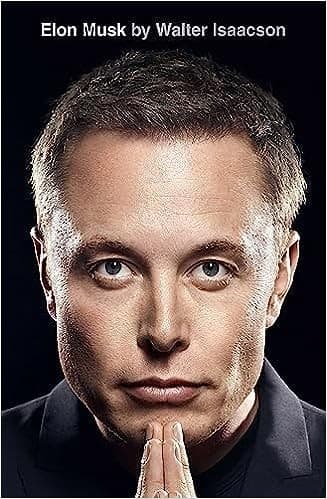
Core Idea
- Isaacson presents Musk as a mission-driven, crisis-addicted engineer-founder whose childhood trauma, low fear response, and obsession with control helped produce extraordinary breakthroughs and repeated damage.
- The book’s central tension is that the same traits that make Musk effective—urgency, first-principles thinking, risk amplification, vertical integration, and intolerance for weakness—also drive chaos in companies, relationships, and public life.
- Musk repeatedly sees himself as building toward civilization-scale goals: the internet, sustainable energy, space travel, AI safety, brain-computer interfaces, and a multiplanetary future.
How Musk Works
- Musk’s childhood in South Africa, marked by bullying and an abusive, volatile father, left him with lasting scars but also a high pain threshold, a reduced natural fear response, and a taste for confrontation.
- He is portrayed as solitary, intensely bookish, and early-obsessed with science fiction, strategy games, and systems thinking; Asimov, Hitchhiker’s Guide, Civilization, Warcraft, and Dungeons & Dragons all shaped his imagination.
- He learned to treat life like a game of logistics and empire-building, and later carried that mentality into startups, rockets, factories, and public disputes.
- A recurring pattern is “crisis mode”: Musk thrives on deadlines, drama, and threat, and often becomes more focused when things are on the edge of failure.
- He is unusually good at seeing what is unnecessary and deleting it; Isaacson treats first-principles reasoning and his “delete, simplify, accelerate” instinct as the core of his engineering style.
- Another recurring Musk concept is the “idiot index,” the ratio of total component cost to raw-material cost, which he uses to expose waste and overcomplexity.
- But the same style often becomes domination: he bullies, rewrites, and overrules, can inspire or terrify teams, and usually struggles with collegiality and shared power.
The Companies and the Method
- At Zip2 and X.com/PayPal, Musk showed the same pattern: brutal work ethic, night code rewrites, obsession with deadlines, physical and managerial conflict, and eventual success paired with conflict and a coup.
- He left those ventures with money and a reinforced conviction that he should reinvest everything into harder, bigger games rather than settle into wealth.
- SpaceX was built from first principles: rockets were absurdly overpriced, so Musk insisted on in-house manufacturing, rapid iteration, cheap testing, and accepting explosions as information.
- SpaceX’s culture became “prototype, test, explode, revise, repeat,” with examples like McGregor test stands, sea-air corrosion failures, and Musk personally getting involved in fixes.
- His insistence on fixed-price, outcomes-based contracts mattered as much as the engineering: after suing NASA over the Kistler award, SpaceX helped shift the aerospace procurement model away from cost-plus, which he saw as rewarding waste.
- Tesla followed a similar logic but in a more chaotic way: Musk pushed vertical integration, product beauty, and software-like iteration, even when the Roadster and Model S were late, expensive, and supply-chain nightmares.
- The book repeatedly shows Musk’s tension with founders and executives—Eberhard, Tarpenning, Marks, Drori, and others—because he wants both authority and credit.
- His most successful operational pattern is to force a surge: compress timelines, concentrate attention, eliminate steps, and mobilize the whole organization around a single measurable target.
- At Tesla that produced both breakthroughs and near collapses, from the Model 3 “production hell” tent line to radical de-automation and the eventual 5,000-per-week milestone.
AI, Starlink, Twitter, and the Wider Fight
- Musk’s AI view begins with fear of decoupled intelligence: after meetings with Demis Hassabis and Larry Page, he treated AI as a major existential threat and invested in DeepMind and OpenAI partly to monitor and counter it.
- He later split from OpenAI’s direction and launched xAI, aiming for a “maximum truth-seeking AI” and arguing that AI should be broadly available rather than concentrated.
- His practical AI strategy depends on data: Tesla driving data, Twitter language and behavior data, and future robot data are all treated as strategic fuel.
- Autopilot/FSD in the book is a story of ambition outrunning reliability: Musk pushed camera-first vision, often dismissed conservative timelines, and accepted dangerous overconfidence in public messaging.
- Neuralink is presented as both medical and civilizational insurance: a brain-computer interface to restore function, speed communication, and keep human intent relevant in an AI-rich world.
- Optimus fits the same logic: a humanoid robot meant to bring AI into the physical world, with Musk insisting on friendly form factor, few parts, and practical manufacturing.
- Starlink and Starship are tied together by Mars logic: Starlink funds the Mars project, while Starship is the stainless-steel, reusable transport system meant to make humanity a space-faring species.
- In SpaceX, Musk’s “best part is no part” and reusability obsession culminate in Mechazilla, rapid stacking, booster-catching, and the drive to make launch economics radically better.
- The book also treats Starlink in Ukraine as a defining moral conflict: Musk rapidly helped civilian and military communications, but then limited offensive use when he feared escalation and nuclear risk.
- Twitter/X is Musk’s social and political culmination: a “digital public square” and “playground” he wanted to own, partly for free speech and partly as a future payments/identity layer.
- His Twitter ownership exposes the limits of his ideals: he attacked moderation, “visibility filtering,” and institutional collaboration, but still suspended journalists and overrode speech when personally threatened.
What To Take Away
- Musk is not portrayed as a normal entrepreneur but as a war-mode systems builder whose identity is fused to mission, conflict, and scale.
- Isaacson’s key judgment is that Musk’s greatness and damage are inseparable: the same engine produces rockets, cars, satellites, and also wreckage.
- The book’s recurring lesson is not that Musk is consistent, but that he is relentlessly pattern-driven: he seeks control, urgency, and simplification across every domain he touches.
- By the end, Musk has become less a CEO than a force moving across industries—space, energy, AI, communications, and media—always chasing the next battlefield.
Generated with GPT-5.4 Mini · prompt 2026-05-11-v6