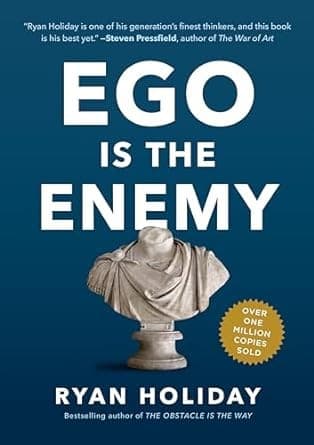
Core Idea
- Holiday’s central claim is that ego—an inflated, self-protective sense of one’s own importance—is the main obstacle to good work, sound judgment, and durable character.
- He organizes the book around three recurring life stages: aspiration, success, and failure; the right posture is to be humble when starting, sober when winning, and resilient when losing.
- Ego offers short-term comfort by masking fear and insecurity, but it distorts reality, blocks learning, and turns ambition into self-display.
Aspiration: Quiet Ambition, Discipline, and Learning
- In early ambition, Holiday warns against mistaking talk, branding, or imagined status for real progress; he repeatedly contrasts “being somebody” with “doing something.”
- Silence matters because publicizing goals can drain energy and create the false feeling that work has already been done.
- He uses figures like Sherman, John Boyd, and Bo Jackson to show that serious aspiration stays focused on duty and execution rather than self-promotion.
- The book prizes humility as a practical advantage: stay a student, accept harsh feedback, and recognize how much remains unknown.
- Holiday’s learning model includes “plus, minus, and equal”—someone better to learn from, someone to teach, and someone equal to test yourself against.
- He treats passion skeptically when it becomes zeal without discipline; better than being “passionate” is being governed by purpose, which is more realistic, bounded, and less self-centered.
- The canvas strategy means making other people’s work easier, doing the unglamorous supporting labor, and earning leverage through usefulness rather than demanding credit.
- Restraint is part of aspiration too: Jackie Robinson’s example shows that sometimes the higher aim requires absorbing insult rather than reacting to every slight.
- Holiday warns against living in an inner theater of self-critique or self-admiration; ego thrives on an imaginary audience that makes people feel watched and important.
Success: Sobriety, Standards, and the Danger of Self-Importance
- Success is portrayed as more dangerous than struggle because praise, money, and status can make ego feel justified.
- Holiday’s antidote is sobriety: plainness, restraint, and contempt for “sizzle,” so that results matter more than image.
- He uses Angela Merkel, Eisenhower, Marcus Aurelius, and Bill Belichick as models of calm, controlled leadership that avoids preening and overreaction.
- Success should not become identity; Holiday warns against telling yourself a heroic story after the fact, because that narrative erases luck, process, and correction.
- Howard Hughes is the emblem of success eaten by ego: brilliance and wealth collapse into paranoia, waste, and isolation.
- Holiday stresses always stay a student; even great people must keep learning, because achievement easily becomes a wall against correction.
- He values process over mythology, as in Bill Walsh’s Standard of Performance, which measures work by internal standards rather than public labels like genius or destiny.
- Post-success ego often appears as entitlement, control, and paranoia: special rules, the need to dominate outcomes, and suspicion of enemies everywhere.
- Leadership means becoming the “adult supervision” of yourself and others: delegate well, stay organized, and do not turn the organization into an extension of your personality.
- General George Marshall is praised for refusing to center himself, deferring honors, and keeping mission ahead of personal glory.
Perspective, Failure, and the Final Discipline
- Holiday argues that people need contact with something larger than their own ambitions; immensity—nature, history, ancestry, the cosmos—shrinks ego and restores perspective.
- He draws on John Muir, Emerson, and Stoic language of sympatheia to show that humans are small participants in a vast and ancient order.
- Visiting battlefields, wilderness, or other places of scale helps dissolve the illusion that one’s present concerns are unique or central.
- Failure is another test of ego: it can produce narcissistic injury, blame, and self-pity, or it can force reorientation, patience, and renewed purpose.
- Katharine Graham embodies the stronger response, enduring personal tragedy, institutional pressure, and public crisis through steadiness rather than swagger.
- Holiday emphasizes the inner scorecard: judge yourself by your own standards, not by applause, gossip, or visible wins.
- He pairs this with Adam Smith’s indifferent spectator, a cool internal judge that makes excuses and gray-area rationalizations harder to accept.
- The book’s moral climax is love over hate: resentment wastes time, fixes attention on enemies, and often strengthens the very thing you oppose, while love lets you keep moving.
- Examples like Nixon, Hearst, and Dave Mustaine show how grievance can trap powerful people in sterile battles over image and injury.
What To Take Away
- Ego is not confidence; it is the refusal to see yourself accurately, and it is dangerous in every phase of life.
- The same discipline applies everywhere: aspire without ego, succeed without ego, fail without ego.
- The lasting alternative to ego is not self-hatred but humility, sobriety, service, and steady work.
- Holiday’s final message is repetitive on purpose: ego returns daily, so the work of clearing it must also be daily.
Generated with GPT-5.4 Mini · prompt 2026-05-11-v6