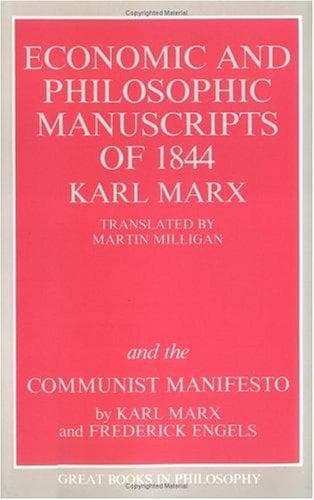
Core Idea
- Marx argues that political economy describes capitalism as if it were natural and objective, but its real effect is to turn most people into commodities, reduce labor to a bare means of survival, and deepen alienation.
- The central contradiction is between labor and capital: labor creates wealth, yet the worker is separated from the product, from life-activity, from other people, and ultimately from species-being.
- The manuscript’s larger movement is from economic critique toward a philosophical claim: private property and alienated labor are mutually producing forms of human estrangement, and communism names their transcendence.
How Capitalism Works in Political Economy
- In the analysis of wages, Marx says the worker and capitalist are locked in an antagonistic struggle that usually favors the capitalist because workers have weaker bargaining power, less endurance, and fewer alternatives.
- Wages tend toward the minimum needed for subsistence of worker and family, which Marx treats as a cattle-like or slave-like standard of existence.
- Labor power is treated like a commodity whose price rises and falls with supply and demand, but workers are the first to suffer from overproduction, wage cuts, and shifts in capital.
- In the “three states of society” — declining, advancing, and fully developed wealth — workers suffer most not only in poverty but also in prosperity, through overwork, machine-like dependence, competition, and premature death.
- Even rising wages do not mean freedom; they can simply intensify dependence on the market, machines, and alien products.
- Marx insists that political economy’s theoretical claims hide the worker’s reality: in theory labor creates wealth, but in practice the worker gets only what is needed to reproduce the laboring class.
- A recurring target is the reduction of humanity to abstract labor, with the rest of the worker’s existence left to law, medicine, religion, charity, and statistics.
- Marx uses cited social observers such as Schulz, Pecqueur, and Buret to show that averages conceal mass immiseration, mechanization can be socially disastrous, and labor as a commodity is a form of disguised bondage.
Capital, Competition, and Land
- Profit of capital is not the reward of the capitalist’s personal labor but the return on stored-up labor that commands labor through purchasing power.
- Profit rates vary with prices, rivals, accidents, monopoly, and market conditions; the capitalist’s aim is private gain, not production as such.
- Competition lowers profits, ruins small capitalists first, and pushes wealth toward concentration, while big capital can endure losses, buy and sell more cheaply, and squeeze out rivals.
- As industry develops, the falling rate of interest marks the decline of rentier wealth and the rise of industrial capital as the dominant form of property.
- The logic of competition is not harmonious but destructive: Marx links it to adulteration, fake production, universal poisoning, glut, crisis, and waste.
- In the discussion of fixed capital and machinery, Marx treats productivity gains as real but socially perverse under capitalism: output rises while labor is displaced, intensified, or cheapened through the use of women and children.
- Land rent is presented as a monopoly price for nature’s powers, not as a moral reward for ownership or improvement.
- Rent depends on fertility, situation, population growth, transport, demand, and the productivity of agriculture and industry; improvements in manufacturing can raise rent indirectly by increasing landlords’ purchasing power.
- Marx rejects the claim that landlord and society share the same interest: under private property, the landlord’s interest is opposed to workers, tenants, and even capitalists.
- Large landed property and large capital both move toward concentration, and Marx says the historical tendency is toward the disappearance of the distinction between capitalist and landowner.
- The romantic defense of landownership is rejected: land becoming a commodity is not a moral aberration but the rational outcome of private property.
- Marx’s longer-term picture is a simplification into two classes, capitalists and workers, with landed property either absorbed into capital or broken by its own contradictions.
Estranged Labor, Money, and Hegel
- In Estranged Labor, Marx says the worker’s product becomes an alien power that stands over against its producer; the more the worker produces, the poorer the worker becomes.
- Labor is external to the worker: it is forced, not self-realizing, and therefore the worker feels at home outside work and alien within it.
- Estranged labor reduces human life to mere bodily functions and denies species-being, which Marx defines as conscious, universal, free activity.
- Alienation is social as well as individual: the worker’s relation to the product mediates relations to nature, self, and other people, and private property is both the result and the vehicle of this estrangement.
- Marx repeatedly identifies wages as the necessary consequence of alienated labor, so improving payment alone cannot overcome slavery-like dependence.
- In the account of money, Marx treats it as the universal power that can convert qualities into their opposites, making the impossible appear real and binding social life into a “world upside-down.”
- Money is the supreme form of alienated species-power: it mediates access to life, power, beauty, influence, and even human relations.
- Marx’s critique of division of labor and exchange is that they are not neutral efficiencies but estranged forms of human social powers under private property.
- He attacks Hegelian dialectic for treating alienation as a movement of thought rather than of real human life.
- Marx credits Hegel with grasping self-creation through objectification, but faults him for making absolute Spirit the true subject and for treating nature and objectivity as something to be annulled.
- Feuerbach is praised for grounding criticism in “man to man” and for breaking the theological form of philosophy, though Marx goes beyond him by tying human essence to practical social production.
What To Take Away
- The manuscript’s most important claim is that capitalism is not just unequal but estranging: it separates people from their labor, their products, and their own human powers.
- Marx thinks political economy naturalizes what is historically produced, especially the wage relation, competition, rent, and the commodity form.
- The book’s philosophical core is that human essence is practical, social, and productive, so any system that turns life into labor for another distorts what humans are.
- Communism appears here not as a detailed program but as the name for overcoming private property, alienated labor, and the split between worker and human being.
Generated with GPT-5.4 Mini · prompt 2026-05-11-v6