Core Idea
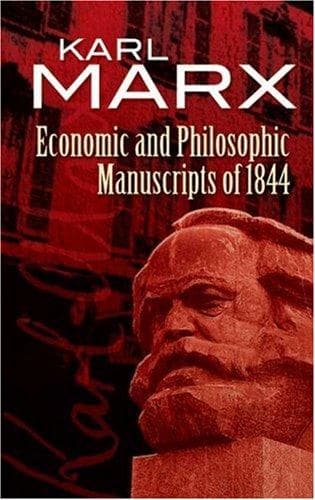
- Marx’s unfinished 1844 manuscripts are an early, searching critique of bourgeois political economy that turns economic categories into a theory of human estrangement under capitalism.
- His central claim is that capitalist society makes the worker into a commodity, separates labour from its product and from human self-realization, and turns private property, money, and capital into alien powers over human life.
- The political stakes are revolutionary: the emancipation of workers is also the condition for universal human emancipation, and communism appears as the practical overcoming of alienation.
Alienated Labour and Political Economy
- Marx argues that wages are fixed by an antagonistic struggle between worker and capitalist, but victory “necessarily” goes to the capitalist because workers are isolated while capitalists combine more effectively.
- The worker’s wage is driven toward subsistence for self and family; even Smith’s “ordinary wage” is treated as a bare minimum compatible with “common humanity.”
- In unemployment or overpopulation, labourers sink into beggary or starvation; in prosperity they face overwork, machine-like dependence, competition, and overproduction.
- Political economy says labour is the source of all wealth, yet in practice the worker receives only the least necessary share and must “sell himself and his human identity.”
- Marx stresses that labour’s price is the most contingent and fluctuating of all prices, even while economists treat labour as the constant measure of value.
- Division of labour increases output but degrades the worker into a machine and intensifies competition, overproduction, and the reduction of the worker to a mere working animal.
- Capital is stored-up labour that becomes active only when it yields profit; the capitalist’s power is the power of purchasing, that is, command over labour and its product.
- Profit is governed by capital, not by need or human use: it can be enlarged by monopolies, trade secrets, rare local production, and new territories, while the capitalist thinks only of private gain.
- As accumulation proceeds, capital concentrates in fewer hands, small capitalists are ruined, some fall into the working class, and competition among capitals deepens wage pressure.
- Landed property follows the same logic: rent is a monopoly relation, landlords charge what tenants can pay, and land becomes a commodity subordinated to money and competition.
- Marx argues that large estates, like large capitals, absorb small ones; the historical tendency is toward the fusion of landownership with capital and the practical abolition of the old distinction between capitalist and landlord.
Estrangement, Need, and Money
- The manuscripts’ most famous concept is estranged labour: alienation from the product, alienation within the act of production, alienation from species-being, and alienation from other people.
- Labour is external to the worker, coerced rather than freely chosen, and becomes activity “for another”; the worker feels at home only outside labour.
- Because the product confronts the worker as an alien power, the more he produces the less he possesses, and the world of things grows while the world of men is devalued.
- Marx extends alienation beyond production into needs: private property creates not human satisfaction but speculative new desires, fresh sacrifices, and more avenues for dependence and swindle.
- Under private property, the true need of the system becomes the need for money; money is the universal form of wealth, and its power expands even as real production grows.
- Marx emphasizes that private property simultaneously refines and brutalizes need: it creates luxury, whim, and caprice on one side, and crude deprivation on the other, where even air, light, and cleanliness cease to count as human needs.
- Political economy treats the worker’s life as bare subsistence and celebrates thrift, saving, and denial, making the ascetic worker the model subject of the system.
- Marx ridicules the moral code of economy: the less one eats, reads, loves, or thinks, the more one “saves,” so capital replaces human life with accumulated money.
- Money is the universal mediator that turns incapacity into power, wish into reality, and human relations into purchasable relations; Marx calls it the visible divinity and the common pimp.
- Shakespeare’s Timon of Athens serves as an example of money’s power to make black white, wrong right, and even the thief respectable.
- For Marx, the poor person’s dwelling is an alien, hostile power, while the wealthy experience wealth as caprice and excess; both are estranged, but in different forms.
Hegel, Feuerbach, and Communism
- Marx criticizes political economy for taking private property, exchange, competition, and money as given formulas instead of deriving them from the real relations of estranged labour.
- He also criticizes Hegel’s dialectic for grasping alienation only as alienation of thought; Hegel sees objectification as a defect of self-consciousness rather than the natural mode of sensuous human life.
- Marx accepts Hegel’s insight that self-genesis is historical and processual, but rejects the speculative move in which the real world is absorbed back into abstract thought.
- Feuerbach matters because he breaks with theology and grounds criticism in sensuous, material human relations, though Marx still treats Feuerbach as incomplete.
- Marx presents communism as the positive transcendence of private property and human self-estrangement, not as a mere redistribution of possessions or leveling of wages.
- He rejects crude communism for simply universalizing possession and labour, and he dismisses schemes that reduce communism to state ownership or to a “community of labour” with equal wages.
- Fully developed communism is linked with humanism and naturalism: a reconciliation of man with nature, with other people, and with his own species-being.
- In this view, history is the actual process through which human essence is produced and understood, and industry becomes the “open book” of human powers and social development.
What To Take Away
- Marx’s early critique is not just about bad wages; it is about how capitalism structurally converts labour, property, need, and money into alien powers over the worker.
- Alienation is the key bridge between economics and philosophy: it names the worker’s loss of product, activity, species-life, and human relation.
- Communism is not a simple ideal of equality or scarcity; it is the practical abolition of estranged labour and the full realization of human powers in social life.
- The manuscripts are foundational because they already link economics, history, philosophy, and revolutionary politics into one argument about human emancipation.
Generated with GPT-5.4 Mini · prompt 2026-05-11-v6