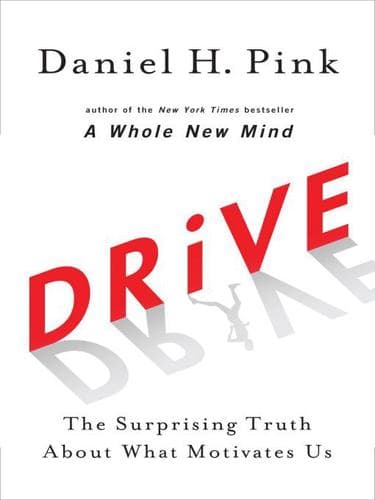
Core Idea
- Pink argues that Motivation 2.0—the reward-and-punishment system that shaped industrial-era management—is now badly mismatched to modern work, learning, and organization.
- The better model, Motivation 3.0, is built on autonomy, mastery, and purpose, which science suggests are the real engines of high performance and durable satisfaction.
- His core warning is that carrots and sticks are not just limited tools; in many settings they actively reduce motivation, creativity, ethics, and long-term results.
Why Carrots and Sticks Fail
- Pink traces the old view to Frederick Winslow Taylor and “scientific management,” which treated workers like machine parts to be controlled with incentives.
- He says this system clashes with three realities: work is now more heuristic than algorithmic, people are not pure self-interest calculators, and many jobs require self-direction rather than supervision.
- The book’s early science examples begin with Harry Harlow and Edward Deci, whose puzzle experiments showed that people and animals can pursue tasks for their own sake, and that contingent rewards can suppress that interest.
- Pink’s seven deadly flaws of extrinsic incentives are that they extinguish intrinsic motivation, damage performance, crush creativity, crowd out good behavior, encourage cheating, become addictive, and promote short-term thinking.
- He uses the Tom Sawyer effect to show how rewards can turn play into work, and cites experiments where expected rewards reduced later drawing interest in children.
- He emphasizes that contingent rewards are especially harmful for creative or nonroutine work, while routine algorithmic tasks may tolerate limited if-then incentives after pay is fair and adequate.
- Studies he cites include the candle problem, artist and art-student research, the daycare-late-pickup fine, blood donation findings, and larger-incentive studies in India that often produced worse performance.
- Pink also argues that external targets can distort morality and judgment, as seen in examples such as Enron, Sears, and Ford Pinto-style goal chasing.
The Three Building Blocks of Motivation 3.0
- Pink grounds the new model in self-determination theory, which says people need competence, autonomy, and relatedness to thrive.
- He distinguishes Type X behavior, driven mainly by extrinsic rewards, from Type I behavior, which is internally driven and sustainable.
- Type I is not anti-money; it treats pay and recognition as baseline conditions or feedback, not as the main point of work.
- The first nutrient is autonomy, which means real self-direction over task, time, technique, and team, not cosmetic empowerment.
- Pink argues people are “players, not pawns,” and shows autonomy’s value through examples such as 20 percent time, FedEx Days, ROWE, and companies like 3M, Google, Atlassian, Zappos, Whole Foods, and W. L. Gore.
- He notes that autonomy improves satisfaction, persistence, productivity, and lower burnout, and that people often prefer autonomy even when it complicates team management.
- The second nutrient is mastery, which depends on engagement rather than compliance and is sustained by flow and deliberate practice.
- Drawing on Csikszentmihalyi, Pink presents flow as the “Goldilocks” zone where challenge slightly exceeds current ability, goals are clear, and feedback is immediate.
- He argues that flow is not a luxury but a basic condition of flourishing, and that work can offer more flow than leisure when designed well.
- Mastery also depends on Dweck’s distinction between entity theory and incremental theory: seeing ability as developable leads to learning goals, persistence, and better long-run performance.
- Pink stresses that mastery is painful and asymptotic: experts need years of deliberate practice, repeated plateaus, and perseverance or grit rather than quick wins.
- The third nutrient is purpose, which gives autonomy and mastery direction by linking effort to something larger than profit or self.
- Pink treats purpose as especially important at a life stage when many boomers, and increasingly millennials, ask what their work is for and what difference they will make.
Purpose, Organizations, and the Type I Toolkit
- Pink argues that modern organizations should pursue purpose maximization alongside profit, and points to TOMS Shoes, B Corporations, L3Cs, co-ops, and other “for-benefit” forms as examples.
- He says purpose becomes stronger when language, norms, and structure reflect it, citing the MBA Oath, the pronoun test (“we” vs. “they”), and warnings that ethics codes can become box-checking substitutes for moral commitment.
- Purpose is also supported by giving people control over meaningful contribution, as in pro-social spending research and the Mayo Clinic example where protected time for meaningful work reduced burnout.
- The book’s practical toolkit translates the theory into exercises and organizational design: the flow test, “What’s your sentence?,” the daily question “Was I better today than yesterday?,” self-reviews, and deliberate use of oblique strategies to break ruts.
- For organizations, Pink recommends autonomy audits, noncontrolling language, involving people in goal-setting, using modest and hard-to-game metrics, and offering rewards as unexpected “now that” recognition rather than controlling “if-then” contingencies.
- In schools and parenting, he applies the same logic against bribes for compliance; instead he favors assignments and routines that pass the autonomy-mastery-purpose test.
- He points to alternative schools such as Big Picture Learning, Sudbury Valley, Montessori, Tinkering School, and unschooling as examples of environments built around self-direction and deep engagement.
What To Take Away
- The book’s central claim is that extrinsic control is overused and often counterproductive, especially where creativity, judgment, and initiative matter.
- Autonomy, mastery, and purpose are not motivational slogans but Pink’s evidence-based replacement for the old industrial model.
- The most durable high performers and healthiest organizations are those that design for self-direction, challenge, and meaning rather than mere compliance.
- Pink’s larger point is that people are not best understood as reward-chasing machines; they are capable of sustained, self-driven effort when the environment lets that drive work.
Generated with GPT-5.4 Mini · prompt 2026-05-11-v6