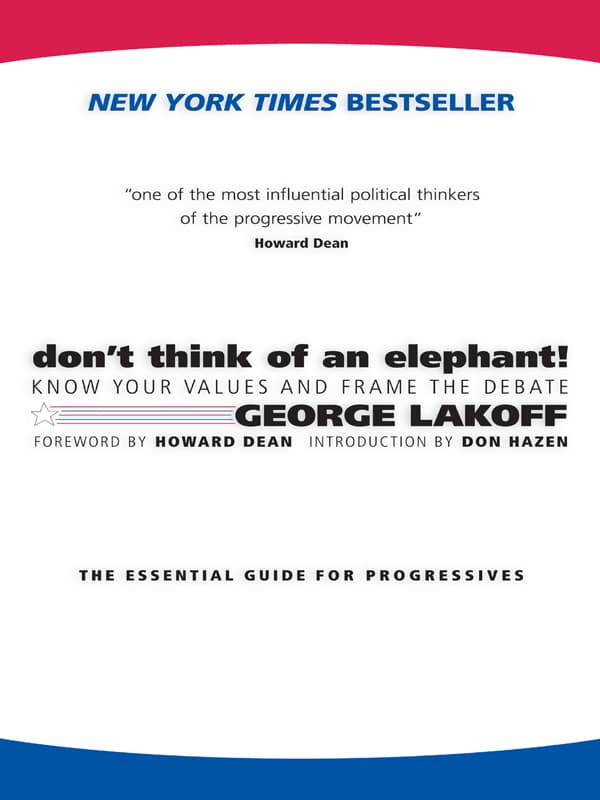
Core Idea
- Lakoff’s central claim is that politics is won through frames: when you negate an opponent’s phrase, you still activate its mental structure, so “facts” rarely persuade unless they fit a prior moral frame.
- He argues that conservatives have been more effective than progressives at building and repeating frames through institutions, media, and language discipline, while progressives often respond in the opponent’s vocabulary.
- His larger project is to show that American politics is organized by two competing moral models of the family and nation: the strict father model and the nurturant parent model.
The Two Moral Models
- In the strict father model, the world is dangerous and competitive, children are born needing discipline, and morality comes from obedience, punishment, and self-control.
- That model links morality to prosperity: disciplined self-interest is said to produce success, while government help, “do-gooders,” and social programs are treated as immoral dependence.
- The strict-father worldview extends naturally to capitalism, limited government, tax cuts, hostility to welfare, and a foreign policy in which the nation plays the authoritative adult.
- In the nurturant parent model, children are born good and should be raised through empathy and responsibility so they become nurturers themselves.
- From that model flow progressive values Lakoff repeatedly names: protection, fairness, freedom, opportunity, prosperity, community, cooperation, honesty, open communication, and trust.
- Lakoff treats these as stereotyped cognitive models, not literal descriptions of every family; real people may combine them or apply them differently across life domains.
- He also says the models are not evenly gendered in the nurturant version, but the strict-father version makes the father the central moral authority and reduces the mother to a supportive “mommy.”
Framing, Strategy, and Why Progressives Lose
- Lakoff argues that conservative success comes from long-term strategy: think tanks, funding, media access, coordinated messaging, and careful linguistic choices.
- The Powell memo is presented as emblematic of the right’s institutional build-out, while progressives are portrayed as fragmented, underfunded, and too focused on short-term response.
- His key cognitive science point is that people do not reason from raw facts; they reason from frames, and information that does not fit a frame is often ignored or rejected.
- He rejects the Enlightenment assumption that truth alone will win, and also the idea that voters simply choose their narrow self-interest.
- Examples such as poor conservatives supporting Bush and union voters backing Schwarzenegger show that voters often act from identity, morality, and symbolic alignment.
- Lakoff warns against treating campaigning like marketing research alone, because polling issue preferences does not create a governing moral vision.
- Conservatives use strategic initiatives that shift many issues at once, such as tax cuts that starve social programs or tort reform that weakens consumer and environmental protections.
- Progressives need their own strategic initiatives, such as the New Apollo Initiative, because one energy investment can connect jobs, health, environment, foreign policy, and development.
- He also describes slippery-slope initiatives, where a seemingly narrow fight like partial-birth abortion, testing, or Medicare changes advances a much broader long-term agenda.
- Lakoff’s recurring warning is that answering within the opponent’s frame only strengthens it; progressives must state their own values and refuse to merely negate conservative language.
Reframing Politics, Religion, and War
- He criticizes conservative euphemisms like Healthy Forests, Clear Skies, and No Child Left Behind as Orwellian because they hide strict-father policies behind nurturant-sounding words.
- Hypocognition is his term for lacking the concepts needed to think and speak about an issue; he argues conservatives have reduced theirs, while progressives still have many conceptual gaps.
- He offers reframings such as taxes as investment in the future or as membership dues in America, so tax avoidance becomes deserting one’s country rather than saving money.
- After 9/11, Lakoff says the Bush administration shifted from a crime frame to a war frame and then to a moralized evil frame that justified retribution, torture, and collateral damage.
- He contrasts that with a progressive emphasis on justice, rescue, restraint, and healing, and says the administration ignored the deeper causes of terrorism: worldview, social conditions, and means.
- On foreign policy, nurturant morality implies empathy, cooperation, global responsibility, and minimizing violence rather than using war as a first resort.
- He argues the Iraq war was not selfless liberation but a betrayal of trust driven by U.S. interests, oil, bases, and corporate benefit, and that “betrayal of trust” is a better frame than simply calling the president a liar.
- In religion, Lakoff says conservatism maps easily onto a punitive strict-father God, while liberal religion emphasizes grace, nurturance, service, and community.
- He also says conservative Christianity is far better organized politically than progressive faith communities, even though many Christians, Jews, Muslims, and Buddhists hold nurturant values.
- Abortion and same-sex marriage function as larger symbolic battles over which moral system governs the country, not just isolated policy disputes.
What To Take Away
- The book’s main lesson is that language is not decoration in politics; it is the mechanism by which moral worldviews become politically real.
- Progressives, in Lakoff’s view, should stop reacting inside conservative terms and instead build durable frames around care, responsibility, fairness, and effective government.
- His practical advice is to be respectful, speak from values, avoid victim posture, and answer with a stronger frame rather than a defensive rebuttal.
- The book ends by recasting progressive politics as a positive national vision: stronger America, broad prosperity, better future, effective government, mutual responsibility.
Generated with GPT-5.4 Mini · prompt 2026-05-11-v6