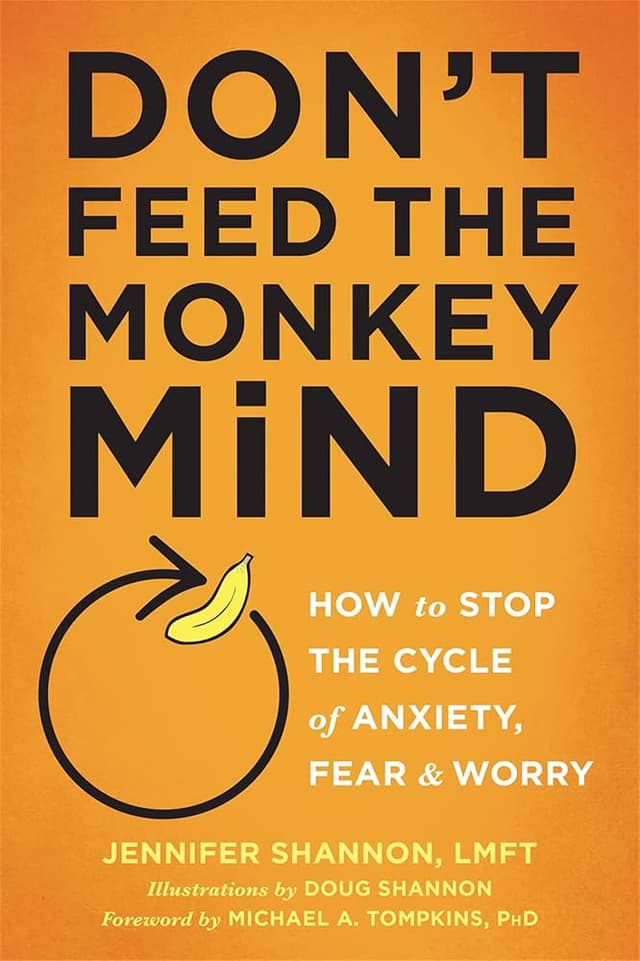
Your monkey mind = the part of your brain that jumps around on worries, "what-ifs," self-criticism, and imagined future problems.
The book teaches how to stop giving attention (energy) to those thoughts so they lose power and you can live more freely.
You can't eliminate thinking — but you can stop feeding unhelpful thoughts.
Key Concepts
1. Monkey Mind
The inner critic/overthinker that is always:
- Worrying about the future
- Rehashing the past
- Imagining worst-case scenarios
It's not rational — it is automatic.
Impact: You don't actually solve problems — you worry about them.
2. Habits of Rumination
Shannon explains that overthinking becomes a habit — just like scrolling your phone. You do it not because it helps, but because it feels familiar or comforting (even if it hurts).
3. Stop Feeding = Don't Engage
"Feeding" means:
- Entertaining anxious thoughts
- Trying to reason with every worry
- Rehearsing worst-case outcomes
- Reinforcing fear with attention
Instead: Acknowledge the thought, then let it go.
4. You Are Not Your Thoughts
Your thoughts:
- Are not facts
- Are not commands
- Don't define you
You can notice them without believing them.
Actionable Techniques
1. Label the Thought
When you notice a monkey mind thought, say (in your head):
"Ah — that's just anxiety talking."
or
"That's a worry thought."
This creates distance between you and the thought.
Why it works: It switches your brain from "I am this worry" to "I see this worry." Awareness breaks the trance.
2. Use the "Objectify" Technique
Ask yourself:
- Is this a real problem right now?
- Is this something I can act on right now?
If not → label it and let it go.
Real problems require real action; worries just simmer.
3. Practice Short Rejections
Tiny responses when anxious thoughts arise:
- "No thanks."
- "That thought isn't helpful."
- "Not right now."
You don't argue — you decline.
4. Notice Sensations Over Stories
Instead of thinking: "What if I fail?"
Shift to: "I'm feeling a tightness in my chest."
Focus on physical experience, not imagined narratives. This anchors you in the present.
5. Scheduled Worry Time
If thoughts keep popping up:
- Set a 15-minute worry window (same time every day)
- If a worry shows up outside that window — mentally file it for later
This reduces constant mental chatter.
6. Daily Mindfulness (Even 5 Minutes)
Techniques include:
- Breath awareness
- Body scanning
- Sensory grounding ("What do I see/hear/feel right now?")
The goal isn't to empty the mind — it's to notice the mind without feeding it.
Daily Habits for a Calmer Mind
| Practice | What You Do | Why It Helps |
|---|---|---|
| Morning mindfulness | 5–10 min breath focus | Reduces baseline reactivity |
| Worry notebook | Write worries at scheduled time | Stops rumination loops |
| Thought labeling | Identify "worry thought" | Separates you from thoughts |
| Physical focus | Notice sensations | Anchors to present |
| Reject & redirect | Say "No thanks" | Cuts attention to unhelpful thoughts |
Common Traps
Trap #1: "I shouldn't think this way."
Better: "I'm thinking this — that's different from doing it." Judgment feeds the monkey more than the thought itself.
Trap #2: "If I think it, it must be true."
Better: Thoughts are like passing clouds — not truth-certificates.
Trap #3: "I need to solve it now."
Better: Solve real actionable problems. Drop imagined ones.
Long-Term Benefits
- Less anxiety over minor futures
- Better focus on what matters now
- More emotional resilience
- Reduced impact of self-criticism
- Clearer decision-making
- Increased presence in life
Core Action Plan
- Notice the thought → label it ("worry thought")
- Ask: Is this a real, actionable problem now?
- If not → Respond with refusal ("Not right now")
- Anchor in the present (body sensations, breath)
- If needed, schedule a worry time instead of indulging it
Quick Daily Routine
- Morning (5 min): Mindfulness + label thoughts
- Throughout day: Notice & reject monkey thoughts
- Evening (10 min): Scheduled worry time