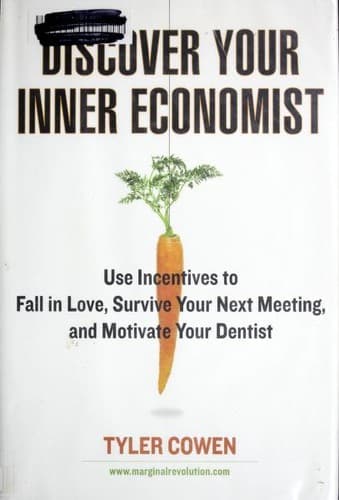
Core Idea
- Economics is about incentives, not money -- understand what people actually want (status, autonomy, control) and you solve problems others can't
- Money often backfires -- external rewards kill intrinsic motivation, trigger resentment, and cause people to "choke" under pressure
- Map the real incentives in any situation to spot the hidden forces driving behavior, then work with them instead of against them
When to Use Money (and When Not To)
- Money works: Commission-based sales, tasks where effort directly increases results, situations where payment boosts status
- Money fails: Creative work, tasks requiring care, family chores, situations where payment signals distrust
- The Dirty Dishes Rule: Paying kids to do chores kills family duty; praise effort or accept imperfection instead
- Context beats the reward itself: Same incentive produces wildly different behavior depending on cultural beliefs and perceived legitimacy
Relationships, Work & Life
What Actually Motivates People
- Status and recognition beat raises -- people want to feel heard and valued more than they want more money
- Autonomy and control are non-negotiable -- people rebel when they feel manipulated, even if the logic is sound
- Self-deception is healthy -- happy couples remember good parts selectively; don't try to eliminate all illusions, just direct them productively
Practical Fixes
- Meetings waste time but serve hidden functions (inclusion, control) -- respect that instead of "fixing" them with efficiency gimmicks
- Know when to give up -- some problems (chronic lateness, unmotivated staff) can't be solved with incentives; redirect your energy
- Don't force culture consumption -- admit you won't read all 100 books; read reviews after, let interest develop naturally
Helping Others & Giving
- Don't give to visible beggars -- they're gaming the system; give to those not asking, where impact is clearer
- Micro-credit beats charity -- loans create accountability and skills; donations get redistributed or wasted
- Matching grants fool donors -- people give the same amount whether match is 1:1 or 3:1; they care about affiliation, not impact
- Stick with one cause -- loyalty matters more than chasing the Cause of the Month; you'll abandon giving if constantly switching
Money & Consumption
- Scarcity is the real constraint -- time and attention matter more than money for happiness
- Avoid warranties on minor items -- expected loss is negative; you're paying to signal care while getting overcharged
- Break shopping momentum -- enter "hot mode" where costs become invisible; split purchases across registers or buy indulgences first
- Order the weird item at fancy restaurants -- strange dishes signal chef confidence and often taste best
Action Plan
- Map real vs. stated incentives -- What do people actually get rewarded for? Solve for that, not what they say matters
- Ask which parable fits (dirty dishes, car salesman, parking tickets) -- before offering money, determine if cash is the right lever
- Identify true scarcity -- Is the problem money, time, attention, or motivation? Solve that specific constraint first
- Lead with status/autonomy -- Try recognition, control, and social proof before reaching for cash
- Accept what you can't control -- Some problems can't be solved with incentives; invest energy only where alignment exists
Generated with Claude Sonnet 4.6 · prompt legacy-pre-v6 · model inferred from repository history